Document Classification in IDP Pipelines
Document classification errors spread silently through pipelines without triggering alerts.
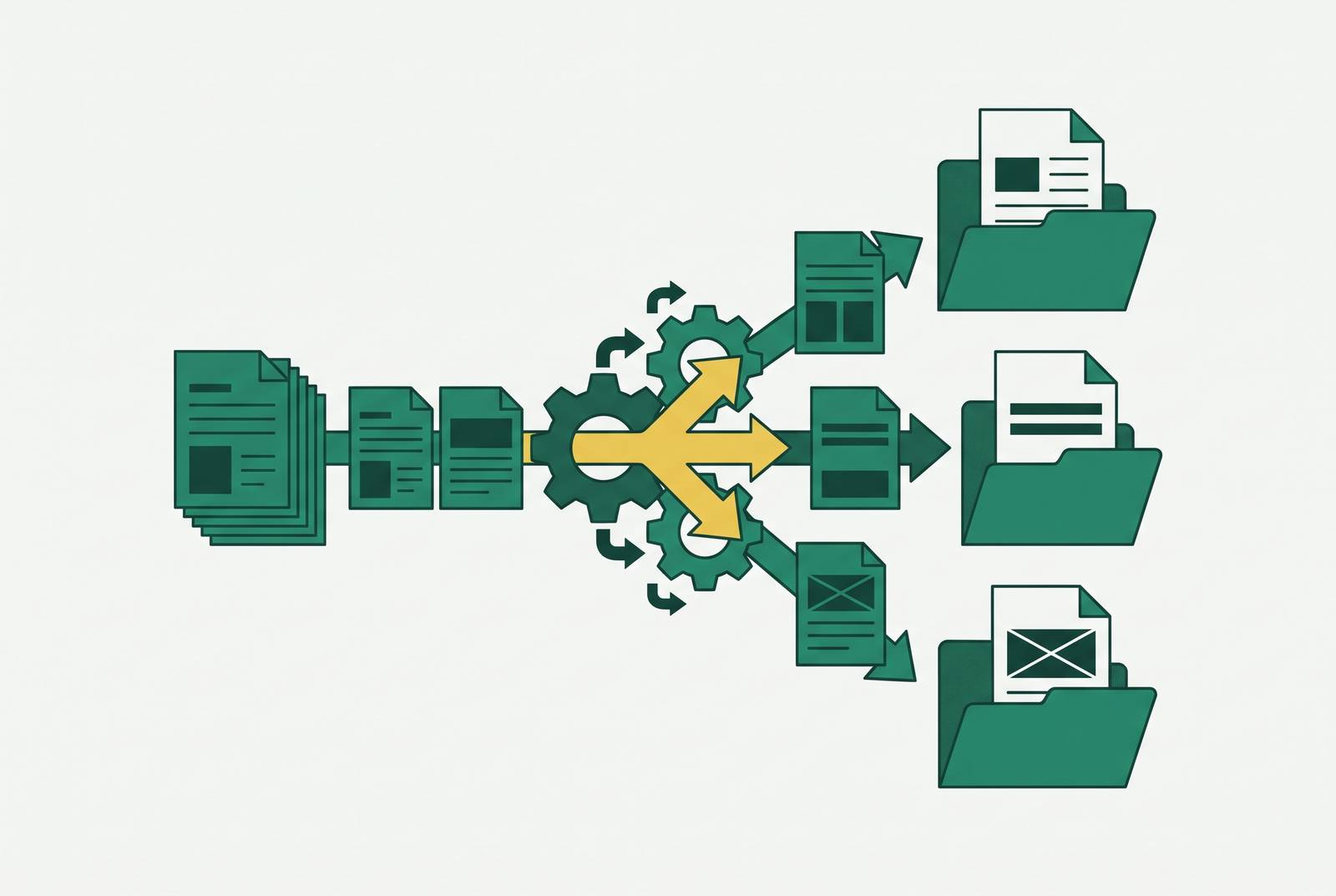
Document classification decides which extraction schema fires, which validation rules apply, and which confidence thresholds govern a document once it lands in an IDP pipeline. Get this step wrong, and the mistake doesn't throw an error. It produces structured output that looks fine and is wrong straight through.
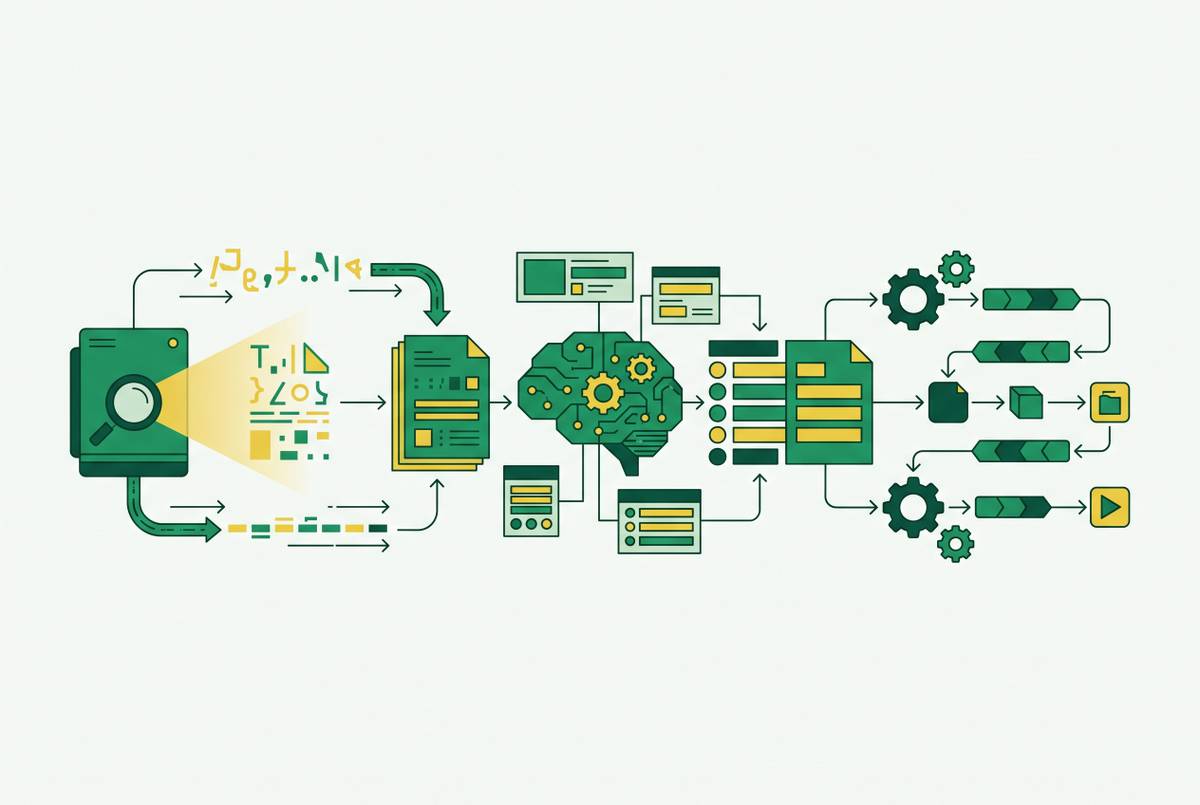
An IDP pipeline, boiled down, does four things: classify what arrived, pull the fields that matter, check those fields against rules, and hand off clean structured data to whatever system needs it next. Somewhere between 80% and 90% of enterprise data is in unstructured form, PDFs, scans, faxes, forwarded screenshots, and IDP pipelines exist to be the intake layer for all of it. Classification is the first judgment that layer makes, and every judgment after it depends on that one being right. An invoice, a payslip, a mortgage closing disclosure, and a bank statement each carry a different schema, different required fields, and a different tolerance for error. Misclassify the document and the pipeline applies the wrong rules to the wrong data, and nothing downstream will flag it. A wrong field value is a data quality problem. A wrong document type is a systemic one.
What document classification means in an IDP context, precisely
Classification is the routing decision that happens before OCR or extraction, and it actually contains two separate problems that get treated as one. It's the routing decision that happens before either one, and it actually contains two separate problems that get treated as one.
The first is document-type classification: is this an invoice, a purchase order, a remittance advice, a utility bill? The second, easy to overlook, is page-level separation and sequencing: in a 40-page scanned batch, where does one document end and the next begin? Getting the type right on a page that's been grouped with the wrong document still breaks extraction, because the schema fires against content it was never designed to read.
To make either call, the classifier draws on visual layout, the text itself, structural cues like header placement and table geometry, and sometimes metadata such as filename or sender domain. What it outputs is a label and a confidence score, and that score is not decoration. It's the signal that should trigger a human review when the system isn't sure. Pipelines that ignore the confidence score just absorb the risk quietly, one misfired document at a time. Practitioners building these systems tend to put it bluntly: get classification and separation wrong, and everything downstream is wrong too.
The three approaches classifiers use, and what each trades away
Rule-based matching is the oldest approach, and it works by comparing a document against known templates: specific keywords, layout zones, structural fingerprints. It's precise when the format is known and useless the moment it isn't. A new vendor invoice layout, a scanned fax, a page that came in rotated ten degrees: any of these can break a rule-based system without so much as a warning.
Traditional machine learning classifiers, things like SVMs, gradient boosting, or CNNs run against document images, learn from labeled examples instead of hard-coded templates. They generalize better across format variation, but they need real volumes of labeled training data per document type, and they drift as document styles change without retraining. Even at their best, they're a static snapshot: a model trained on last year's formats, not a system that keeps learning in production.
Vision-language models and LLM-based classifiers are the newest layer, reading text, layout, and visual context together in a single pass, which lets them handle formats they've never explicitly been trained on. Industry analysts have projected that a growing share of IDP solutions will fold in generative AI capabilities over the coming years. That's a real shift, but it comes with a real cost: confidence calibration. Neural networks, as a class, tend toward overconfidence, reporting certainty they haven't earned, and the pipeline routes the document accordingly. No widely adopted systematic benchmark currently exists for evaluating confidence calibration in key information extraction for IDP systems, which means most teams are flying without an instrument for exactly the failure mode that matters most.
In practice, most production pipelines don't pick one approach, they layer them. Rules handle the high-volume, well-understood majority of documents. ML and vision-language models handle the long tail of formats the rules can't cover. The hard engineering problem isn't either layer on its own, it's the routing logic that decides which one gets to make the call.
How classification errors propagate silently through a pipeline
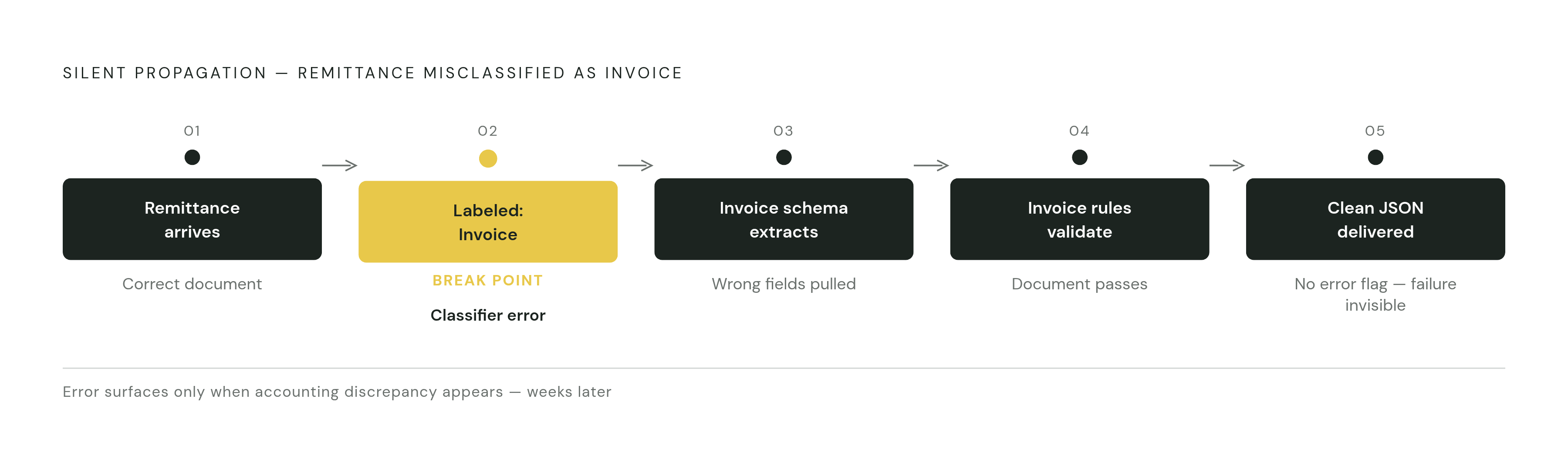
A misclassification doesn't crash anything. That makes it dangerous.
Say a remittance advice gets classified as an invoice. The invoice extraction schema fires, looking for line items, tax amounts, and payment terms in positions where remittance data actually lives. Some fields pull plausible-looking values from the wrong position on the page. Others come back null. The downstream system receives a structured JSON payload with no error flag anywhere on it, and the failure stays invisible until someone in accounting notices a posting discrepancy weeks later.
Validation compounds the same problem instead of catching it. Validation rules are document-type specific: an invoice check might confirm total equals the sum of line items, while a payslip check confirms gross pay equals net plus deductions. If the document was misclassified, the wrong ruleset runs, checking the extraction against constraints that have nothing to do with the actual content. A field value that would have failed the correct check sails through the wrong one, untouched.
The system tends to look solid in testing, then degrades slowly as new vendor layouts, scanned batches, and format variants appear in production, each one adding a small misclassification rate that compounds without announcing itself. Platform dashboards, built by the same vendor whose model is doing the classifying, generally can't catch this. Grading your own homework doesn't surface the errors you didn't know to look for; independent, continuous visibility into document workflows is what catches the failures the dashboard misses. Table extraction offers a smaller, related example of how these problems hide in plain sight: research on table extraction models found that a common table-transformer approach misses the last row when table content runs to the edge of the image crop with minimal padding, undercounting rows in roughly 40% of samples in the PubTabNet benchmark (arxiv.org/pdf/2604.23644). But if the extraction schema fired on the wrong document type to begin with, that missing row is the least of the pipeline's problems.
The document types that break classifiers most often in production
Demos run on clean, single-type, well-formatted documents. Production runs on the opposite.
Mixed packets are the most common failure trigger: a mortgage file scanned as a single PDF that actually contains a closing disclosure, a payslip, a bank statement, and a tax form stapled together. Scanned faxes bring their own damage, coffee stains, page skew, faded contrast, and accuracy on these documents can drop substantially in practice. Screenshots forwarded through email strip out metadata and often get compressed on the way, losing detail the classifier depends on. Handwritten amendments scrawled onto an otherwise typed legal contract confuse a classifier that's never seen handwriting mixed into a typed layout, because it has no training signal for that combination.
Near-identical sibling types cause a quieter kind of damage. An invoice, a credit note, and a proforma invoice look almost the same to the eye and to a model trained on visual layout, but each needs an entirely different extraction schema and validation logic. Multi-page boundary detection is where mixed batches really fall apart: a large scanned batch might hold many separate documents across multiple types in no predictable order, and a boundary error either splits one document into two (each one now misfires extraction on its own) or merges two documents into one (a schema that fits neither).
Locale variation adds another layer most classifiers weren't built for. A German invoice and a US invoice are the same document type, technically, but they differ in date format, decimal separator, VAT labeling, and layout convention. A classifier trained mostly on one locale either misclassifies the other outright or classifies it correctly and still hands extraction the wrong locale context. Ask any vendor how their system handles the 500th invoice format it encounters, not the first. Classification is only as strong as the range of formats it was trained against, and the training distribution always has an edge somewhere.
How to measure classification accuracy in a way that catches these failures
Overall document-level accuracy is the wrong headline number, because it hides exactly the failure distribution that matters. A classifier that's highly accurate in aggregate can still systematically misfile one document type as another and never show it in that top-line figure.
What actually catches the problem is per-class precision and recall, broken out for every document type in scope, alongside a full confusion matrix. The off-diagonal cells in that matrix, the documents mistaken for something else, are where downstream corruption actually lives. Boundary detection accuracy needs to be measured separately from type accuracy too, since a system can get every document type right and still split or merge documents incorrectly in a mixed batch. The document-level failure rate is the share of documents where confidence drops below threshold and a human has to step in.
Confidence calibration deserves its own line item. A well-calibrated classifier's reported confidence should correspond to its actual accuracy on that class, and as covered above, modern neural networks are widely observed to skew overconfident, which means the number on the label often overstates the certainty behind it.
Ground truth itself isn't a fixed, trustworthy baseline either. An imperfect reference set can throw off the accuracy numbers calculated against it, sometimes making a system look better than it is and sometimes worse. Classification ground truth needs the same annotation rigor extraction ground truth gets, not less. Good evaluation practice means scoring against a tuning set and a separate, untouched holdout set, with pass/fail thresholds set by the actual business risk of the workflow rather than a single universal accuracy target. The right question for any vendor isn't "what's your benchmark accuracy." It's "what's your per-class accuracy on my document types, and what happens when confidence is low."
Where classification sits in the broader IDP platform landscape
The market for this has settled into three rough tiers, and each one handles classification differently.
At one end sit cloud OCR building-block APIs. These return text and layout structure and stop there, leaving classification, schema routing, validation, and error handling entirely up to the customer's engineering team. OCR turns out to be the easy part; building and maintaining the classifier is the ongoing job. At the other end sit full enterprise platforms that package classification as a pre-trained capability bundled with extraction and validation out of the box. In between are API-first document intelligence services that expose classification and extraction together, with field-level confidence scores and validation built in, aimed at teams building production pipelines at real scale.
The specific product landscape here has been shifting. Microsoft's document intelligence service, originally launched as Azure Form Recognizer and renamed in 2023, now shows up in 2026 folded into Azure Content Understanding within its Foundry Tools suite. It remains, fundamentally, a building-block service: classification logic has to be constructed by whoever's using it. UiPath ships its own extraction and processing capability inside its broader agentic automation platform, where classification feeds directly into its broader agentic automation workflows rather than standing alone. Legacy capture vendors and newer ML-native services round out the rest of the field, each suited to a different kind of enterprise estate, from long-running legacy capture systems to newer cloud-native pipelines.
Whichever tier a team buys into, the same structural gap holds: a platform's own dashboard can't independently verify that a document was classified correctly and stayed correct all the way through extraction. Vendor-supplied metrics won't reveal a classification error that propagated downstream, because the same system generated both the error and the metric. Independent observability, something outside the platform grading the platform's actual output, is the only real fix for that blind spot.
The build-vs-buy calculus when classification is the hard part
Choosing raw API building blocks means choosing to own classification, validation rules, error handling, downstream integration, and monitoring, in full, indefinitely. OCR was never the hard part. Everything after it is.
Building a classifier that can survive contact with production requires labeled training data across every document type and format variant in scope, including the long tail of edge cases that only show up months in. It requires continuous retraining, because a new vendor layout is either added as a training example or it becomes a misclassification waiting to happen. It requires boundary detection logic built separately from type classification, since the two failure modes don't overlap. It requires confidence calibration infrastructure that actually routes low-confidence calls to a human instead of letting them pass silently. And it requires monitoring built specifically to catch classification drift before it compounds, the same slow-decay pattern that appears everywhere else in these pipelines once volume and format variety start climbing.
None of that is a one-time build. It's a standing commitment, and the calculus on whether to take it on internally or buy it from a platform that's already solved it comes down to how much engineering time an organization is willing to spend keeping a classifier honest, month after month, as the documents keep changing shape underneath it.