IDP vs OCR vs RPA in Document Workflows
Each technology solves a different document problem, not interchangeable ones.
OCR, RPA, and IDP get treated as interchangeable acronyms in most vendor pitches, and that habit is costing companies real money. Each one solves a different, specific problem inside a document workflow, and none of them substitutes for the other two. The failure pattern is consistent: a team picks a tool based on marketing language rather than the actual mechanics of the problem, deploys it, and discovers the mismatch only after go-live, when exceptions start piling up faster than anyone budgeted for.
A finance director sitting through five vendor demos recently heard four different labels for what looked, functionally, like the same product: OCR, IDP, "Document AI," and "agentic" automation. The vocabulary has been stretched so far past its original meaning that it no longer tells a buyer anything useful. That's not an accident. Vendors selling plain OCR have a commercial incentive to call it intelligent, and RPA vendors have an incentive to present their tool as a complete solution rather than one piece of a longer chain. The buyer absorbs that mismatch after the contract is signed.
The cost of the confusion appears in a well-documented pattern of failed digital transformation. BCG has found that roughly 70% of digital transformation initiatives fail to meet their goals, and a recurring cause is a basic mismatch between the technology chosen and the business need it was meant to address. In document workflows specifically, that mismatch takes a predictable shape: a team discovers the tool's real limitations only after implementation, then spends months managing exceptions the technology was never built to handle. What follows is a breakdown of what OCR, RPA, and IDP each actually do, where each one breaks, and how they fit together when a document pipeline is built to hold up in production rather than in a demo.
Precisely what OCR does and where that stops
OCR answers one question: what characters are on this page? It does not answer what those characters mean, how they relate to each other, or whether the resulting value makes sense in context. The pipeline behind that answer runs through a fairly fixed sequence: image preprocessing (deskewing, denoising, normalizing contrast), segmentation of the text into characters or blocks, recognition of each character against a trained model, and post-processing to clean up the raw output into a text string.
That's a narrow job, and OCR does it well under the right conditions. Printed documents with stable, predictable layouts are the sweet spot: regulatory filings in standard formats, printed manuals, archive digitization projects where the goal is searchability rather than structured extraction. Clean, high-resolution scans with no handwriting, no stamps, and no physical degradation push OCR toward the upper end of its accuracy range, typically 85 to 95% at the character level on clean printed text.
The problem is what happens once conditions drift from that ideal, and in real document operations, they almost always do. Noisy scans, handwritten fields, and variable layouts pull accuracy down considerably, and even a small accuracy gap compounds fast. Take a 100-field document processed at 95% character accuracy: that's roughly 5 field errors per document. Multiply that across a few thousand documents a month, and the manual correction queue needed to catch those errors can exceed the labor the automation was supposed to save in the first place.
The deeper issue is structural. OCR cannot understand what characters mean or how they relate to one another; it cannot handle a field that shows up in a different position on every supplier's invoice; it struggles with multi-column layouts, tables with merged cells, or text sitting on top of a colored background or a graph. It has no way to validate whether an extracted value is plausible, and it retains none of the document's original structure for anything downstream to use. When a vendor markets "intelligent OCR," what's usually sitting under the hood is OCR plus a layer of if-then heuristics. That layer catches some known patterns. It still doesn't understand context, and it still doesn't understand intent. OCR remains a legitimate, cost-effective building block for a narrow class of problems. The failure mode isn't the technology, it's treating a character recognizer as though it were a document understanding system.
What RPA does and why document workflows expose its limits
RPA automates the sequence of clicks, logins, copy-paste actions, and system-to-system handoffs that a human would otherwise perform at a keyboard. It follows rules exactly as written. It does not make judgment calls, and it was never built to. RPA is a workflow automation tool, not a document understanding tool, and when a process requires understanding what's actually written on a page before that data can move anywhere, RPA needs something upstream to do that work first.
Where RPA earns its reputation is in stable, rule-based processes: moving structured data between systems that were never built to talk to each other, handling high-volume repetitive tasks where the sequence doesn't change and exceptions are rare, and operating in environments where no API exists and screen-level interaction is genuinely the only option available.
The brittleness of that setup is where the trouble starts. Bots get built around a specific screen layout, specific field positions, a specific sequence of steps. Move a field during a software update, add one step to a process, or introduce a document format the upstream OCR can't parse, and the bot breaks. Automation teams routinely underestimate how much of their time gets consumed fixing bots that already exist, rather than building anything new.
Document-heavy workflows expose this weakness particularly hard, because RPA handles the routine cases cleanly and then stalls the moment it hits anything irregular. Across document workflows generally, somewhere around 70 to 85% of items process automatically, leaving 15 to 30% that require a human to step in. That manual queue has no memory of what came before it: the person handling the exception starts from a blank page every time, reassembling context the system already had and simply didn't pass along. In more than a few organizations, managing that exception queue ends up eating more staff time than the manual process it replaced.
RPA doesn't learn. If a supplier changes an invoice template, the bot has to be reprogrammed by a person; it has no capacity to generalize from the change on its own. RPA is effective once structured data already exists and needs to move somewhere. It's not a substitute for the step that turns a document into structured data in the first place.
What IDP is, and what it adds that the other two cannot
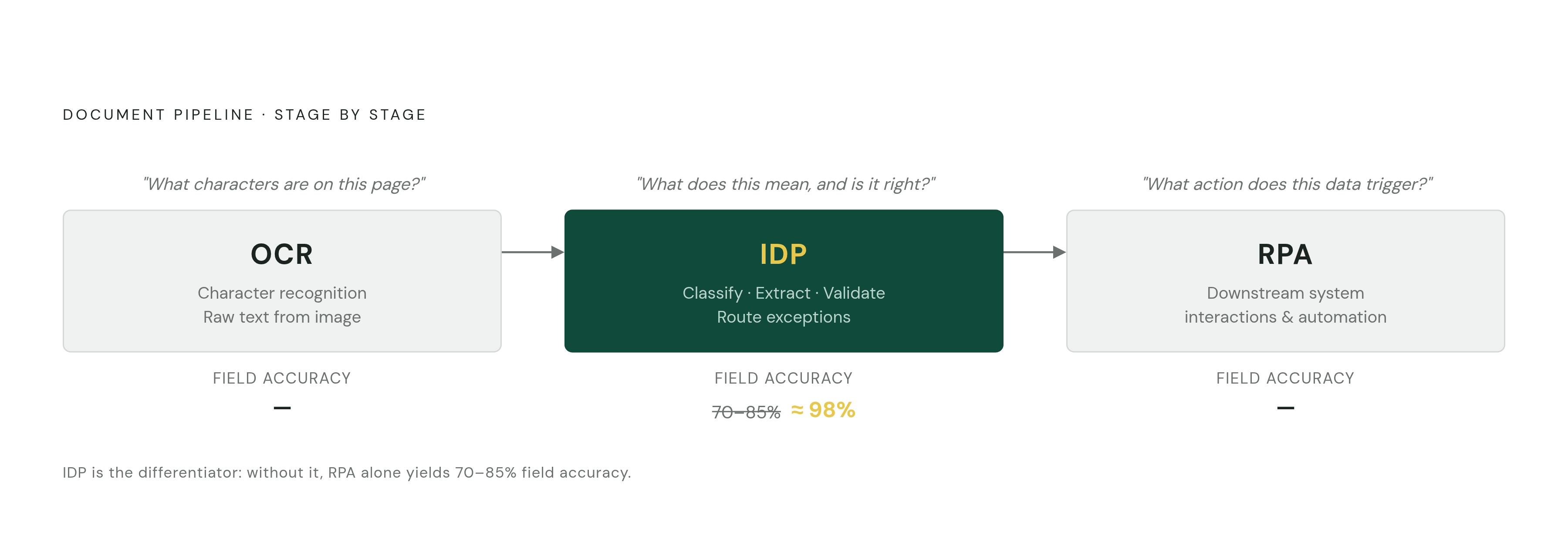
IDP is the layer that sits between raw documents and structured, trustworthy data. It combines classification, extraction, validation, and exception routing integrated into a single workflow, and it's built to answer a different question than OCR: not "what characters are on this page," but "what data is in this document, and where does it need to go?"
Four stages separate IDP from the two technologies discussed above. Classification identifies what kind of document is sitting in front of the system, an invoice, a contract, a payslip, a bank statement, without being told in advance which one to expect. Extraction pulls named fields with an awareness of context and relationship, rather than just spitting out raw character strings, and it handles structured, semi-structured, and unstructured documents in roughly the same pass. Validation checks the extracted values against defined business rules and against each other, catching implausible or inconsistent values that OCR would pass through without comment. Exception routing sends the items that genuinely need a human to a reviewer with the relevant context already assembled, so the reviewer is looking at a complete picture rather than starting from a raw scan.
Document separation and classification have to happen before extraction, and this is a step teams get wrong more often than the marketing suggests. Which pages belong to a single document, and what type is it? Get that step wrong, and everything extracted downstream inherits the error. Teams that treat extraction as the entire pipeline, skipping past classification as a formality, tend to discover the mistake only once the error rate on real production data comes in.
The accuracy gap between pipelines relying on automation alone and ones layered with an understanding system is not subtle. RPA operating alone in a document workflow accurately handles roughly 70 to 85% of cases, largely because it has no real understanding layer feeding it. IDP, properly trained on a client's document types, can push field-level accuracy close to 98%. IDP by itself doesn't execute a process end to end, though; it produces validated, structured data, and something else, usually RPA, acts on that data to move it into the target system. The production architecture that actually works is IDP plus RPA, not IDP as a replacement for RPA.
What IDP handles that OCR structurally cannot: handwritten annotations, supplier layouts that vary from one invoice to the next, multi-column tables, semi-structured forms, and fields that shift position across document versions. The validation layer is arguably the most important piece of the whole system, because it's what prevents silent failure. Without it, a misread field sails downstream into another system before anyone notices anything wrong. IDP's job, in a sense, is to make failure loud instead of quiet.
How these three technologies compose into a production document workflow
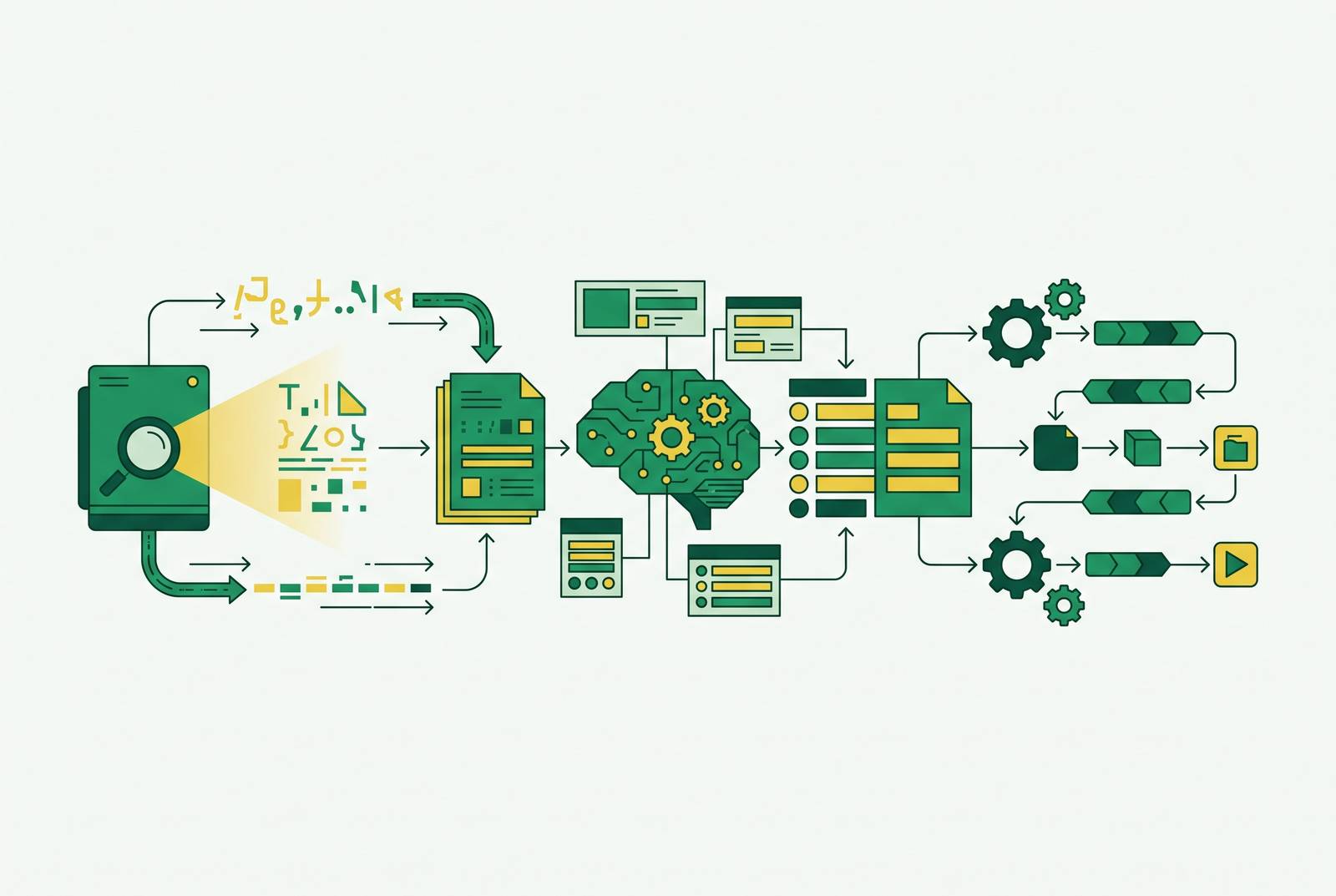
A production-grade pipeline layers these three technologies rather than picking one. OCR, or increasingly a vision-language model that folds recognition and understanding into a single step, handles character recognition first. IDP then handles classification, extraction, validation, and exception routing. RPA takes the validated output and handles downstream system interaction and process execution. Each layer has its own distinct failure mode, and the whole pipeline is only as reliable as the weakest handoff between them.
If OCR produces garbled text off a complex layout, IDP is extracting from garbage no matter how well-trained its models are; validation downstream might catch the resulting error, but the earlier a failure happens in the chain, the harder it is to trace back to its source. If IDP's classification step mislabels a document type, extraction runs against the wrong field schema from the very first step, and nothing after that point can fully correct for it. If IDP hands unvalidated data to RPA, the bot does exactly what it's built to do: it faithfully moves the wrong value into the target system, with no mechanism anywhere in that chain to flag that anything went wrong.
These aren't hypothetical edge cases. These failure modes are well-documented across real deployments: field labels merging into values during OCR on a scanned purchase order, entire sections lost from an insurance claim form due to embedded fonts a parser couldn't read, and a financial statement with clean-looking text but line breaks mid-sentence that broke every downstream regex pattern built to parse it. These aren't stress-test edge cases; they represent the kinds of problems that surface immediately once real documents arrive in production.
Document separation and classification need to happen before extraction in any pipeline meant to survive contact with real documents, because an error at that stage corrupts everything built on top of it. A well-designed production system defines its output schema first, so that any document unable to produce a valid result against that schema fails explicitly rather than quietly passing bad data through. Deterministic extraction, built on rules, regex, and layout logic, handles the predictable fields as a baseline, with extraction from a model used as a fallback for what the deterministic layer can't handle, not as the default method for everything. Between a raw model call and a usable production response, there are additional layers of work: optimized prompting, post-processing, and enforcement of output structure. None of that is visible in a demo, and all of it determines whether the system holds up once real documents start arriving at volume.
The broader shift in this space has moved past processing unstructured documents as a category and toward extracting meaningful insight from documents regardless of structure, while building out end-to-end automation workflows around that insight. That's a composition problem, not a single-tool problem, and it's the actual engineering mandate facing anyone building document automation today.
Where the accuracy numbers come from, and why they're often the wrong numbers
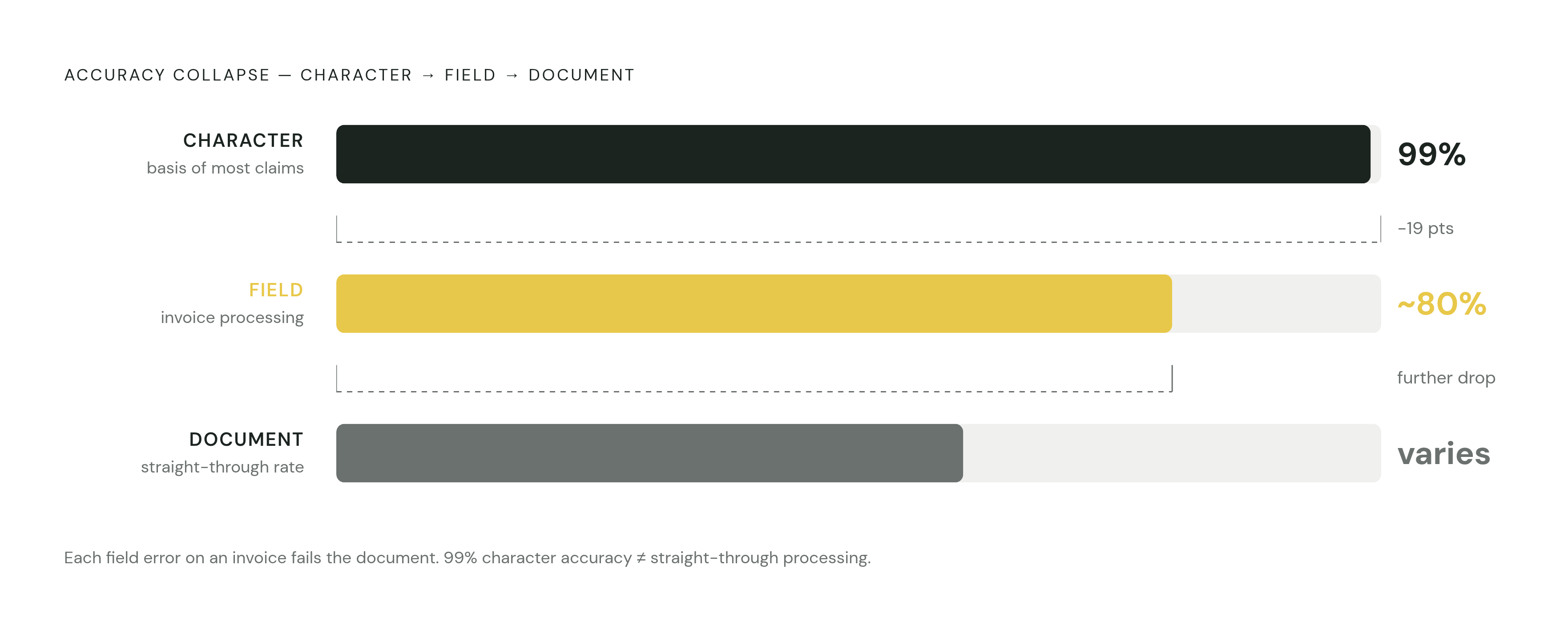
Vendors advertise accuracy figures in the 95 to 99% range routinely. The question almost nobody asks in the sales call is: accuracy at what level? Character accuracy, field accuracy, and document accuracy measure three genuinely different things, and conflating them is where most of the disappointment after go-live originates.
Character accuracy asks whether each individual character in the output matched the original. This is the number behind most "99% accuracy" claims, and it's also the least useful number for judging whether a business process will run cleanly. Field accuracy asks whether the correct value was extracted for each named field, which is the number that actually determines whether an invoice gets processed correctly. Document accuracy asks whether an entire document came through with zero extraction errors anywhere in it, and that's the number governing the straight-through processing rate, the metric operations teams actually care about.
The gap between these numbers is not small. A tool advertising 99% character accuracy can be 80% field accuracy once it's tested against real-world invoices, and that gap can be substantial. For clean, digital-native PDFs in standard formats, invoices from major vendors, regulatory filings, bank statements, modern platforms can reach high field-level accuracy. For scanned documents, handwritten forms, or unusual layouts, that same platform can drop to somewhere in the 70 to 85% range. A single headline accuracy figure hides which of those two worlds a given deployment is actually operating in.
There's a second layer to this problem: confidence scores themselves aren't always trustworthy. An uncalibrated model can report high confidence on an extraction while being correct far less often than that figure implies. That miscalibration breaks threshold-based automation entirely, because a workflow that routes documents to auto-approval versus human review based on a confidence score is only as good as the honesty of that score.
Ground-truth evaluation is the only real defense against this. That means pulling 50 to 100 documents from the actual production corpus, not a vendor's curated demo set, and making sure that sample includes the known troublemakers: low-resolution scans, multi-column layouts, tables that span page breaks, embedded fonts, any document type already known to cause extraction errors. Testing only against clean, well-formatted documents guarantees a system that looks great in evaluation and falls apart in production. One useful framework for this kind of testing is composite accuracy metrics that weight per-field similarity scores across entity types in a document, using normalized Levenshtein similarity for string fields and a tolerance-based comparator for numeric ones. That produces a continuous score per field rather than a blunt pass-or-fail judgment, which maps far more closely to how these errors actually affect a business process.
The metrics that matter most to an operations team aren't the ones vendors lead with. Straight-through processing rate, manual review rate, and false auto-approval rate connect directly to cost and compliance risk in a way character accuracy simply doesn't. If a vendor won't produce field-level accuracy figures against a ground-truth set built from a buyer's own document corpus, that buyer is the one absorbing all the measurement risk in the deal.
How to match the technology to the actual problem in front of you
The decision comes down to a small number of variables, and answering them honestly does most of the work of choosing the right tool. Does document layout stay consistent across issuers, versions, and regions, or does it vary? Is the end goal searchable text, or structured named fields feeding into another system? What percentage of manual intervention is actually tolerable given available staff capacity? Does a misread field carry real downstream consequences, a wrong loan amount, an incorrect payroll figure, a claim routed to the wrong adjuster? And how many document types and format variations does the operation actually deal with over the course of a year?
OCR alone is the right call when documents are consistent, high-volume, and machine-generated, when the goal is text searchability rather than structured extraction, and when there's no validation requirement sitting behind the output. It's the wrong call the moment a downstream process depends on the correctness of a specific named field.
RPA is the right call when structured data already exists somewhere and just needs to move between systems, when the process sequence is stable and exceptions are genuinely rare, and when no API exists for the target system. It is rarely, if ever, the right choice as the layer responsible for understanding a document; that job belongs upstream of it, not to it.
IDP earns its place when documents vary by issuer, version, or format in ways that make a stable layout impossible to assume, when the output needs to be structured and validated rather than just readable, and when the cost of a silent error downstream is high enough to justify a validation layer that catches it before it spreads. Matching the tool to the problem this precisely is a matter of engineering discipline, not preference. It's the difference between a pipeline that holds up at scale and one that generates a manual correction queue large enough to erase whatever the automation was supposed to save.