Field-Level Confidence Scores in Document AI
Uncalibrated confidence scores can mislead teams into false trust or excessive manual review.

A confidence score of 0.95 on an invoice total sounds like a promise: the system is telling you it got the number right almost every time. Most document AI platforms can't keep that promise, because the score they output is a raw probability estimate, not a measured rate of correctness. An uncalibrated model can claim 95% confidence and its actual accuracy is 72%, and that gap has almost nothing to do with the model being bad at its job. Teams that don't know this either trust the score and let errors slide downstream, or distrust it and check every document by hand, undermining the automation of the work. Calibration is what closes that gap, and getting it wrong means treating an uncalibrated score as if it already means something.
How field-level confidence scores are produced
A field-level confidence score attaches to one extracted value, not to the document as a whole. A billing address gets its own number. An amount due gets a different one. Averaging those into a single document-level score buries the exact spot where a reviewer needs to look, undermining the reason field-level scoring exists.
Systems build these numbers a few different ways, and they are not interchangeable. Verbalized confidence has the model state its own certainty next to the answer, which amounts to asking it to grade its own work. Token-level log-probability methods pull the score from the model's internal probability distribution over the tokens it generated, a more mechanical measurement but not necessarily a more honest one. The ConfBench paper (arXiv) notes both approaches exist for extraction with general-purpose language models, but no one has run a systematic benchmark comparing how well each holds up for structured document fields specifically. That gap has a concrete cost: vendors pick one method or the other, and there's no shared yardstick to say which produces numbers worth trusting.
A third method skips self-reported confidence and checks consistency instead. Box's Extract documentation describes sending the same extraction request to an LLM several times and measuring how often the answers agree. Return the same value five times out of five, and confidence reads high. Return three different numbers across five attempts, and confidence drops. That turns confidence into a frequency measurement rather than a self-report, and the two are not the same kind of evidence, even when they land on the same decimal.
Microsoft's Azure Content Understanding, across its 2025-11-01 GA release and the 2026-06-01-preview API, supports confidence scoring across extraction, classification, and generation tasks through an estimateFieldSourceAndConfidence property. Box layers plain labels (Low, Medium, High) on top of the raw decimal, so 0.875 becomes "87.5% confident" in a review queue, easier for a non-technical operator to act on than a bare float.
Azure's own documentation gives a clean illustration of why field-level granularity matters: a billing address field scoring 0.96 sails through untouched, while an amount due field on the same document scores 0.52 and gets kicked to a human. Average those two into a document-level score and the exact spot needing help disappears into the blend.
Why scores vary across field types
Confidence isn't uniform across a document, and the gap between fields on the same page can run wide even when the model handles the document well overall. An audit intelligence study presented at IEEE SoutheastCon 2026 (Vasudevan and Natarajan) recorded an average field-level confidence of 0.781 on financial statements, but the breakdown mattered more than the average: minimum payment amount scored 0.89, statement balance came in at 0.779, and payment due date trailed at 0.675.
Those numbers aren't random. A due date sits in a different spot on every issuer's statement layout, sometimes buried mid-paragraph rather than boxed off, while a minimum payment figure tends to sit in a consistent, clearly labeled field. Structural predictability drives confidence as much as the content itself does, and that's the part a single blended score can never show you.
Research under the name EXTRACTCONF (arXiv) found a related but distinct pattern: numeric fields tend to be well-calibrated, while free-text fields run overconfident at the high end of the scale. When the model says it's 95% sure about a dollar figure, it usually is right to say so. When it says the same thing about a paraphrased clause or a loosely formatted description, it's running ahead of itself. A high score on a free-text field deserves more suspicion than the identical score on a numeric one, because the two fields earn their confidence through different mechanisms.
A production evaluation using o4-mini against 200 NOAA reports (arXiv) showed the same structural pattern from a different angle. Year extraction hit 100% accuracy. Apparatus landed at 92.96%, Agent at 89.95%, Season at 87.94%. Even inside one well-performing model run, some field types are structurally harder than others, and no single document-wide threshold treats them fairly. Per-field-type thresholds are the only configuration the data actually supports, and any pipeline still running one universal cutoff is leaving accuracy on the table.
Calibration: the mechanism that makes scores trustworthy
Calibration lines up stated confidence with measured accuracy. A well-calibrated system that says 90% confidence should be right about 90% of the time at that threshold, no more and no less. Fall short of that and the number stops functioning as a probability. It becomes noise dressed up as precision, and that's worse than no number at all, because it invites false trust.
Calibration runs as a correction layer applied after the model produces its raw output. Engineers check how often predictions at each stated confidence level turn out correct against validation data, then apply an adjustment so future scores track observed accuracy instead of the model's uncorrected self-assessment. A base model doesn't arrive calibrated. Calibration gets built on top of it, and it can be built well, built poorly, or skipped outright, and a buyer often can't tell which from the outside.
A handful of metrics let teams check whether the correction worked. Expected Calibration Error measures the gap between predicted confidence and actual accuracy across bins of scores; a lower ECE means tighter alignment. Reliability diagrams plot the same relationship visually, predicted confidence on one axis, observed accuracy on the other, with perfect calibration tracing a straight diagonal and any bulge above or below it marking exactly where the model runs over- or underconfident. Precision-recall curves chart the trade-off between getting predictions right and how much of the dataset gets covered at a given threshold, the practical tool for matching a threshold to review capacity. The EXTRACTCONF paper uses AURC, area under the risk-coverage curve, and reports 0.042 as the benchmark for near-perfect calibrated accuracy at a coverage level relevant to production automation.
Skipping calibration turns threshold design into theater. A team sets a cutoff assuming it maps to a low error rate, when it might map to something far worse, or occasionally better, with no way to know either way without measuring it. The broader research landscape notes that calibration quality for key information extraction has only recently begun to receive systematic benchmark attention. Calibration right now is a claim a vendor makes, not something a buyer can independently audit, so the burden falls on the buyer to ask for evidence instead of taking a confidence score at face value.
How threshold design turns calibrated scores into routing decisions
A threshold is the line where an extraction either sails through untouched or stops for a human to look at it. There's no universal number that works across use cases, because the cost of an error isn't the same everywhere. Getting a reference number wrong is an annoyance. Getting a payment amount wrong is a liability, and treating those two errors as equally serious is where a lot of threshold designs go wrong from the start.
A conventional structure splits into three bands. High confidence, roughly 90 to 100%, auto-processes straight to downstream systems, fine for standard invoices and cleanly formatted documents. Medium confidence, somewhere around 70 to 89%, routes to a human review queue, catching the poor scans and unusual layouts the model handled less certainly. Low confidence, below 70%, triggers manual re-entry or escalation.
The band alone isn't enough, though. Field criticality has to modify it. A payment amount field might get flagged for review even at 92% confidence, while a reference number only triggers review below 75%, because the consequence of being wrong should set the bar, not the raw difficulty of extraction. That differentiation is what separates a threshold system that actually protects a business from one that just looks rigorous in a slide deck.
Some platforms build conservatism directly into the default, and that's the right instinct even when it costs automation rate up front. One knowledge base describes a default automation threshold of 0.975 applied uniformly across fields, capping the expected error rate on auto-processed documents at roughly 2.5%. That's a deliberately cautious starting point, trading a lower initial automation rate for tighter accuracy, on the theory that loosening a threshold later is a lot easier than explaining a batch of wrong invoice totals that already hit the accounting system.
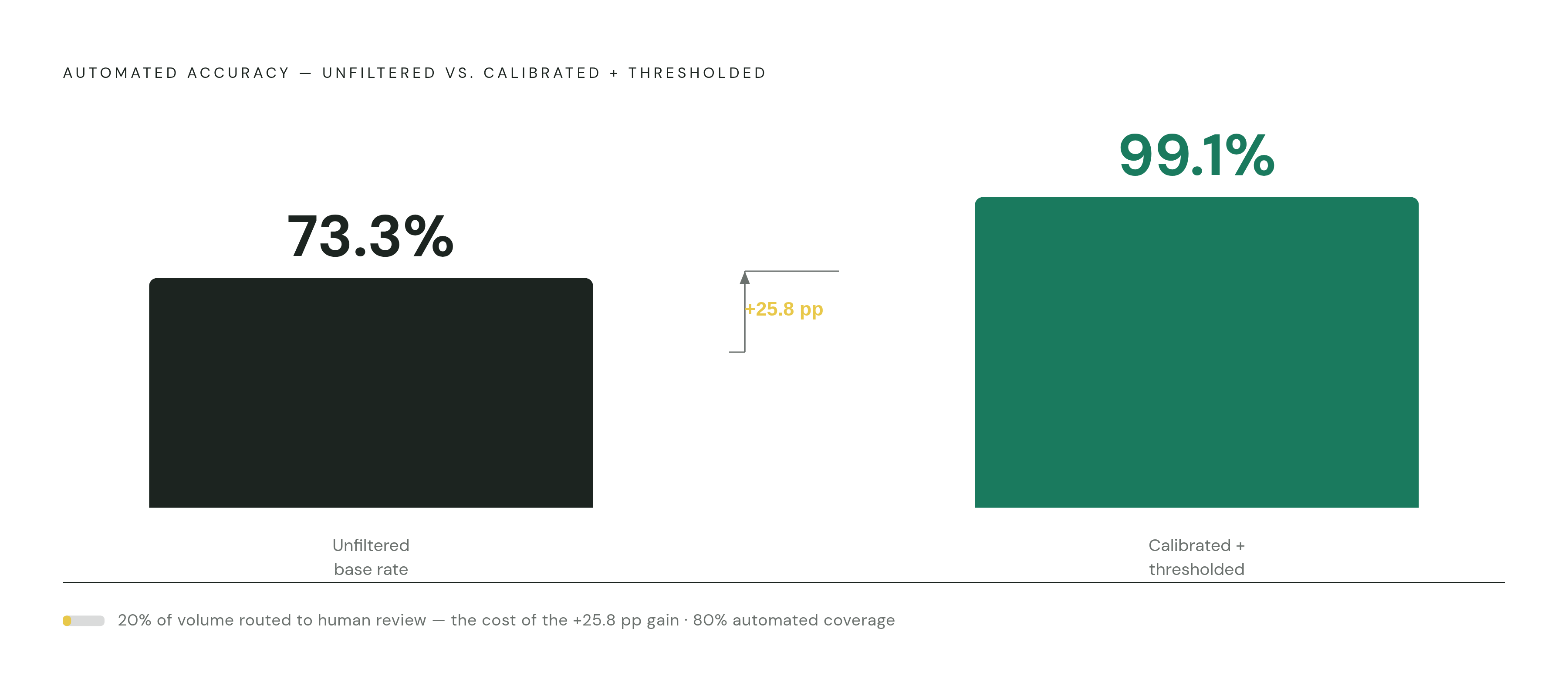
Raise the threshold and errors drop, but manual review volume climbs. Lower it and coverage improves, but more mistakes slip through. No single number solves both problems at once, and any vendor implying otherwise is glossing over the math. The EXTRACTCONF result shows what good threshold design can actually buy: at 80% coverage, the system reached 99.1% automated accuracy, a 25.8 percentage-point jump over the unfiltered base rate of 73.3%. That's the ceiling calibration and thresholding together can reach, and it comes at the explicit cost of routing a real fraction of volume to review rather than zero.
Document quality complicates this independently of the model. A degraded scan doesn't just make extraction harder. It can distort the confidence estimate itself, so routing logic built purely on field scores misses a variable sitting one layer up, at the level of the document rather than the field.
Grounding as the companion to confidence: tracing every extraction to its source
A confidence score tells a reviewer that something needs a second look, but it doesn't tell them where to look. Grounding fixes that by attaching to every extracted field a precise reference back to its location in the source, including precise source location metadata.
Without grounding, a flagged field sends a human back into the full document to hunt for context, turning a two-second check into a five-minute search. With it, review gets targeted. Azure Content Understanding's documentation illustrates this: an extracted field returned alongside its source location lets a legal reviewer jump straight to the relevant passage instead of skimming a multi-page contract.
Financial services, legal work, and compliance functions generally treat traceability as table stakes, not an added feature. A system that can't show its source isn't really usable there, no matter how accurate its scores test out to be.
The audit automation research from IEEE SoutheastCon 2026 frames the combination well: confidence scores get persisted alongside extracted values specifically to support risk-based prioritization and, crucially, to leave room for auditor judgment rather than binary automation. The paper's own term for this, "confidence-aware exception identification," is a more honest description of the goal than "automation" on its own. Confidence and grounding have to be engineered together. A system that flags a low-confidence field but doesn't show where it came from builds a review queue that's slow to clear and tempts reviewers to just re-run the extraction instead of actually checking it.
Where confidence scores fail in production despite correct calibration
Calibration solves one problem and leaves another standing. Extraction errors frequently trace back to the document itself, not to any weakness in the model. A frontier LLM reading a scan degraded by artifacts, or a PDF with a broken embedded font, can generate high-probability tokens describing that noise with total conviction. This is a known failure mode: a model can run accurate in its own reasoning while confidently interpreting degraded input as though it were clean.
A confidence score can be well-calibrated on clean documents and still overstate certainty the moment document quality drops, because document quality is a variable calibration doesn't automatically account for. It has to be measured and handled on its own.
Research into document AI failure modes has cataloged several failure types that slip past confidence scoring entirely, because the model was never uncertain about them to begin with. One such failure is silent omission: a block of information goes missing from the reconstructed output while the surrounding text reads complete enough that nothing flags it. Structural misplacement is another: content survives intact but lands in the wrong location, breaking the document's logical grouping even though every value within it is correct. Perhaps most unsettling are silent value distortions, where a figure or unit gets subtly altered without the model registering any drop in confidence. It was simply certain of the wrong character.
These failures can appear even in otherwise high-performing models, which is what makes them particularly consequential. Strong aggregate accuracy scores don't guarantee correct reproduction of complex documents, and several of these failure classes stay invisible to the metrics typically used to evaluate them.
Separately, engineering case studies covering vision-language and OCR pipelines describe two structurally distinct failure modes: repetition loops, where the model gets stuck cycling the same output, and errors where the model's output reflects its training priors rather than an accurate reading of the document at hand. These call for different fixes: detecting anomalous completion signals and propagating them upstream rather than silently accepting the output, or retrying at a different temperature setting when a recitation flag fires.
Open-source parsing tools carry their own blind spots too: column misordering inside complex tables, footnotes dropped even when they anchor a field the schema depends on, context lost across page breaks. None of this registers as low confidence, because the model is certain even though it's wrong in a way the scoring mechanism was never built to catch. And the documents where the gap between stated confidence and actual correctness runs widest happen to be exactly the ones where an error costs the most: financial statements, contracts, technical specifications, all irregular in layout and high in consequence when something breaks.
Engineering a validation pipeline that treats confidence scores as inputs, not verdicts
The right way to use a confidence score is as one input into a decision, never as the decision itself. A high score should route an extraction to a lighter review path. It should not route it to no review at all, because confidence and correctness diverge in ways no single number can fully expose.
Production-grade pipelines tend to layer three kinds of engineering on top of raw extraction. Prompting gets built with explicit structural guidance, telling the model how to handle headers, irregular tables, and page breaks, and how to weigh coverage against accuracy rather than defaulting to whichever comes easier. Post-processing normalization catches the edge cases a carefully prompted model still produces, standardizing formats and reconciling fields that should match but don't quite. Output structure enforcement defines the valid shape of a response before generation happens, so a schema violation is visible immediately as an error rather than quietly corrupting downstream data.
A hybrid architecture spreads the risk further, and this is the design choice that separates a pipeline built by people who've actually shipped one from a pipeline built on faith in a single model. Deterministic or layout-aware extraction engines handle the core fields, the ones with a fixed, learnable structure, while an LLM comes in selectively: to normalize a description, resolve an ambiguous label, or attach contextual metadata after the primary extraction runs. Containing the probabilistic component that way keeps its errors bounded and checkable, instead of baking them into the first pass where they're hardest to catch.
None of this holds up without a feedback loop. Correction data pulled from actual review queues shows exactly where a model runs over- or underconfident at specific score bands, and that data has to feed back into threshold adjustments as document populations shift over time. A threshold tuned once and left alone degrades quietly, because the documents flowing through a pipeline six months from now rarely match the ones used to set it.
The strongest systems don't lean on a single confidence heuristic. They stack signals: an agentic QA layer checking for rule violations, another pass flagging ambiguous outputs, a third comparing extracted values against known constraints. That's the actual discipline behind field-level confidence done right: treating the number as one voice in a conversation, never the final word on whether an extraction can be trusted.
Sources
- Document analysis with confidence, grounding, and labeled samples - Foundry Tools
- Automated Population-Level Audit Assurance via AI-Based Document Intelligence
- Confidence Scores via API in Box Extract (Jan 2026)
- arxiv.org
- arxiv.org
- learn.microsoft.com
- dev.to
- AI Document Processing in Production: Full Pipeline Guide