Continuous Learning From Corrections in Document AI Systems
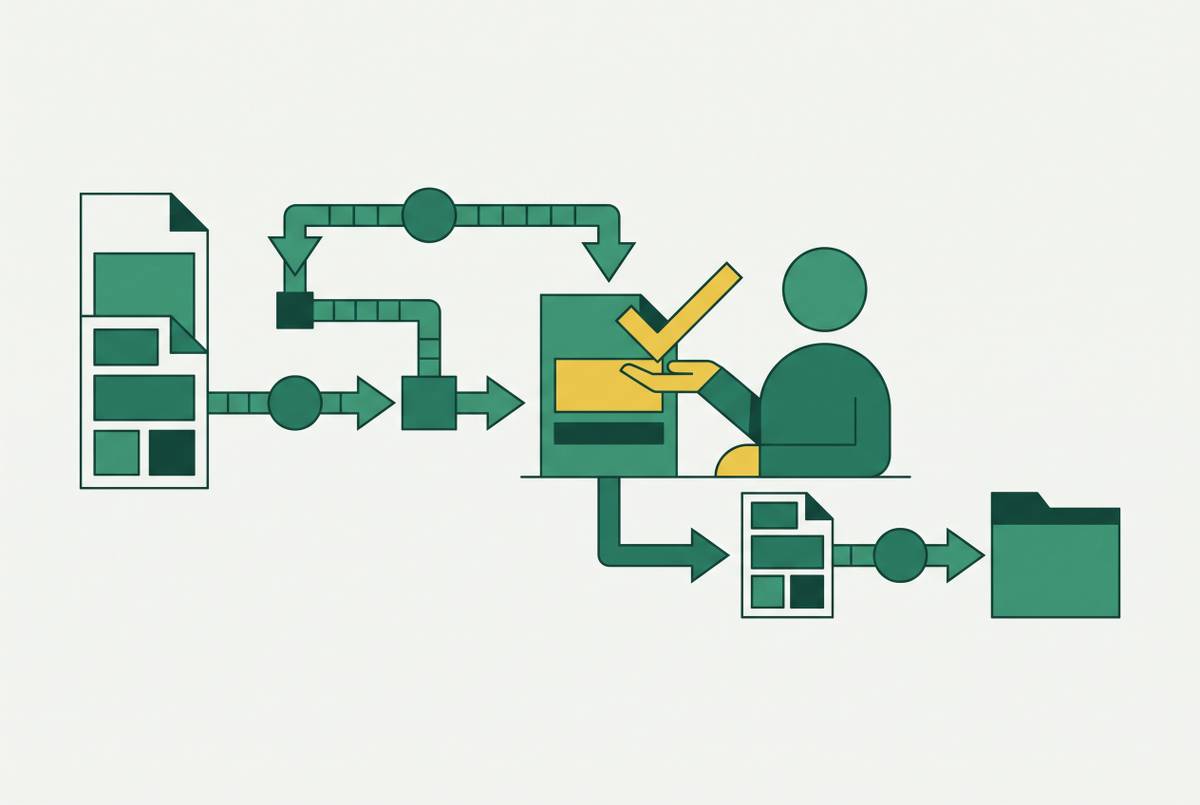
Corrections routed by confidence thresholds become training data that keeps models sharp.
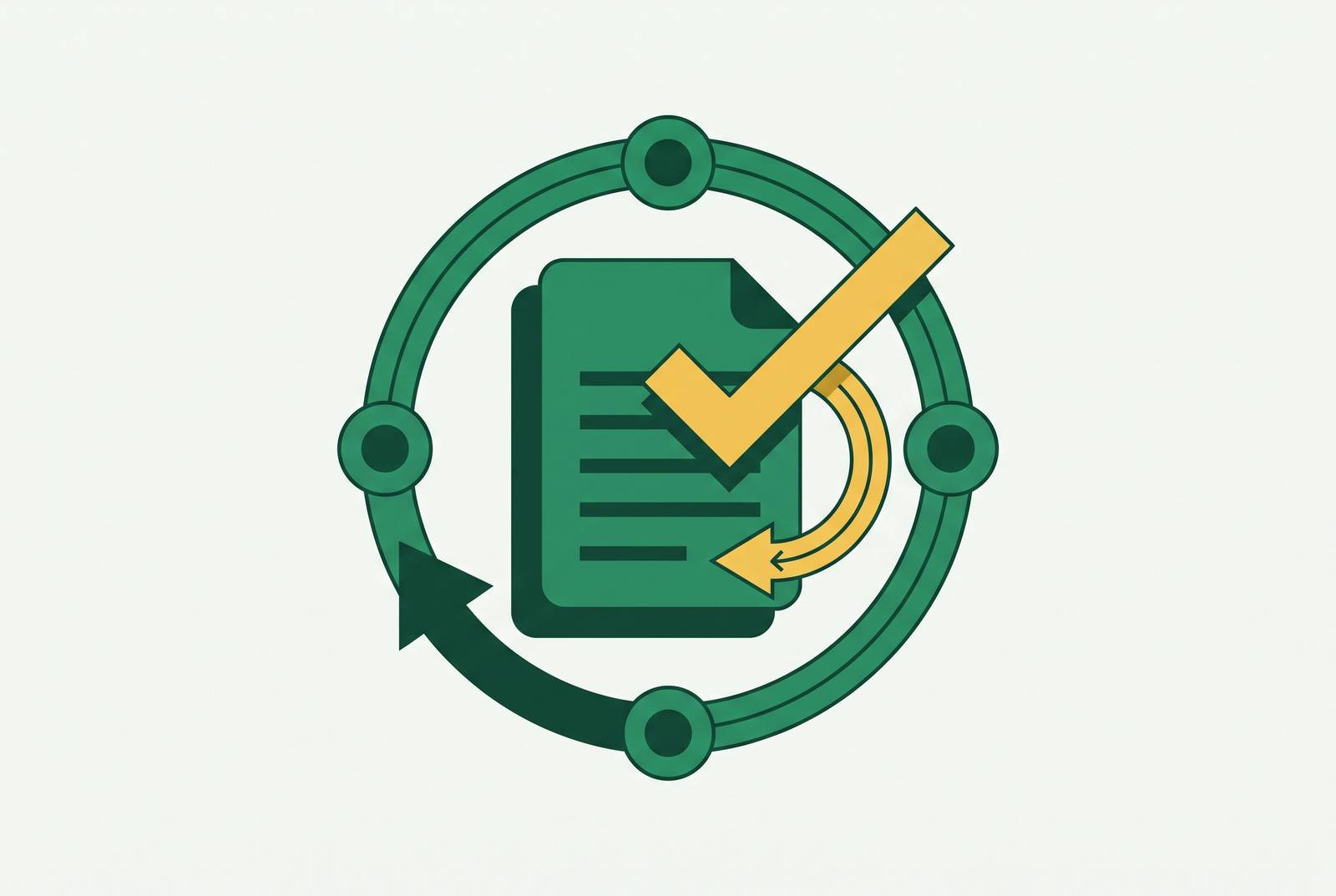
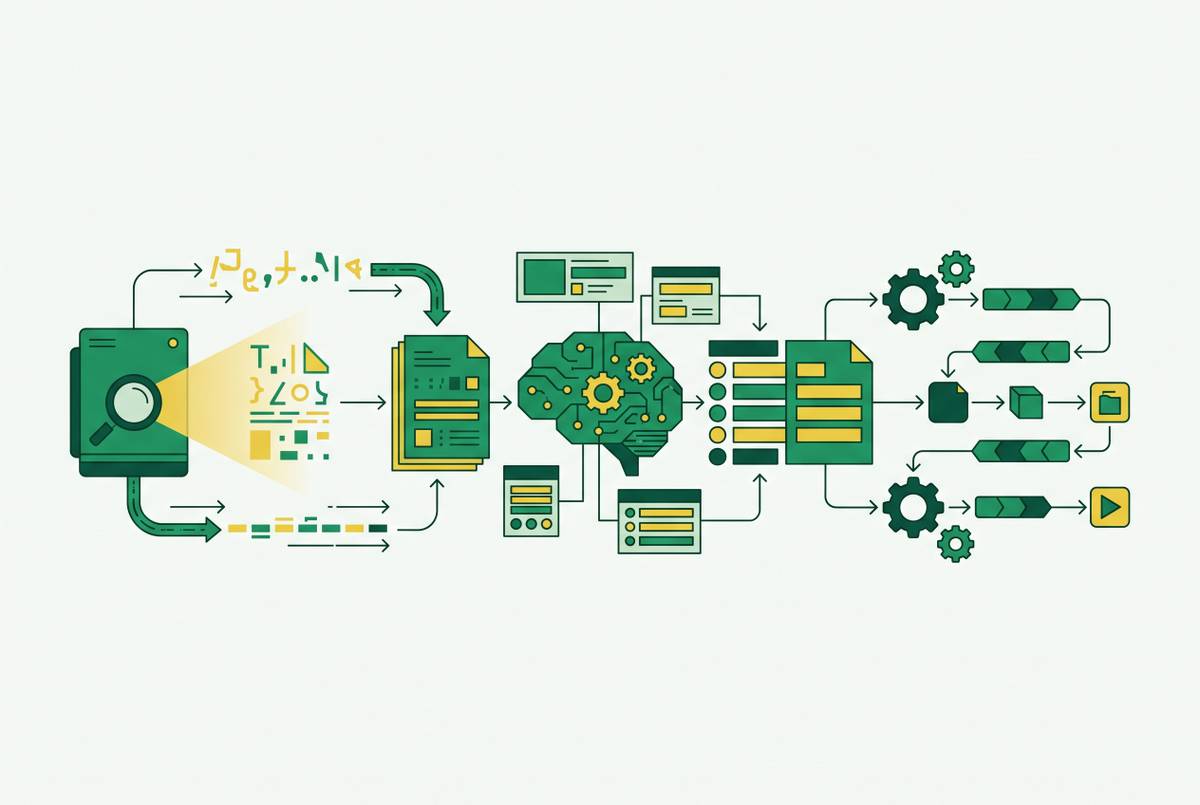
Document parsing systems fail in production constantly, and that failure is not the exception, it's the baseline condition. A model trained on clean, uniform samples meets scanned purchase orders where field labels bleed into values, embedded fonts that quietly drop entire form sections, and PDFs with mid-sentence line breaks that break every downstream regex a team wrote. The mechanism that separates a system that degrades under this pressure from one that gets better is continuous learning from corrections, and most teams never engineer it correctly.
A vendor shifts a column by a few pixels and a coordinate-dependent extraction pipeline drops a field with no error thrown, no alert fired, just an empty value that flows straight into the approval en... A vendor shifts a column by a few pixels and a coordinate-dependent extraction pipeline drops a field with no error thrown, no alert fired, just an empty value that flows straight into the approval engine. That's the dangerous category: not the crash, but the silence. Research on document benchmarks has found that several of these failure modes stay invisible under current scoring metrics, because those metrics don't penalize sidebar semantics or block-level completeness. A model can rank well on a leaderboard and still fail to reproduce a complex document correctly. And this matters because document parsing sits upstream of everything else: before a RAG system or a fine-tuned LLM can produce anything useful, the PDFs, invoices, and contracts feeding it have to become structured data first. The point has been made directly in the field: document parsing is the bottleneck most teams underestimate, garbage in produces garbage out no matter how good the model downstream is.
What turns this from an engineering annoyance into a learning problem is scale. Every new vendor, every new layout, every new form version widens the failure surface. A system that cannot update itself from what it gets wrong doesn't just stay flat, it falls behind, because the space of things it hasn't seen grows faster than any static rule set can cover. So the real question isn't whether a document AI system will encounter errors. It's whether the system has any mechanism to notice those errors and turn them into something useful.
What a correction signal is and why most pipelines discard it
A correction is a specific, structured event. A reviewer looks at an extracted value, decides it's wrong, and replaces it with the right one. That delta, wrong value to correct value, tied to a document type and a confidence level, is about as clean a training signal as exists in this domain. It's labeled data generated for free, as a byproduct of normal operations.
Most pipelines throw it away anyway. The corrected value gets written to whatever downstream system needs it, the original extraction is never compared against the fix, and the model that made the mistake never hears about it. Three things usually explain why. Review interfaces get built to fix records fast, not to capture feedback, so reviewers patch the data and move on. The correction event and the original extraction often live in two different systems with no wire connecting them. And plenty of teams still treat human review as overhead to minimize, not as the most valuable data source the pipeline produces.
There's a compliance wrinkle here too. It's worth noting that a reviewer's correction may be treated as customer data, the same as the original document. A no-training-on-your-data policy that only covers raw documents and stays silent on corrections is leaving a gap, and plenty of vendors leave it open on purpose or by oversight. Ask about it directly.
The line this draws is simple: a static OCR tool processes a document and stops there, forgetting everything the moment the file closes. A system that captures corrections has the raw material to improve. But raw material sitting unused doesn't help anyone. The loop has to be built on purpose.
Engineering the feedback loop: field-level signals, confidence thresholds, and validated ground truth
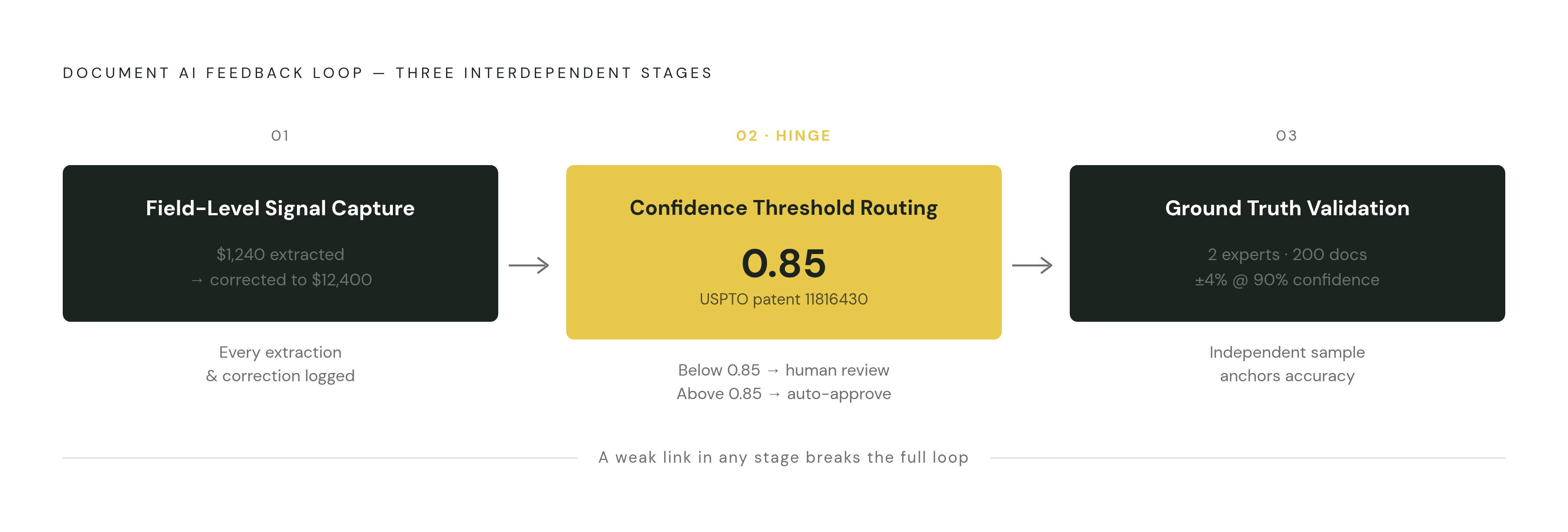
Three pieces have to work together here, and a weak link in any one of them breaks the whole thing.
Signal capture has to happen at the field level. Recording that "invoice_total was extracted as $1,240, reviewer corrected to $12,400" is trainable. Recording that "this document had an error somewhere" is not, it's too coarse to teach a model anything specific. Field-level granularity is what makes the correction usable.
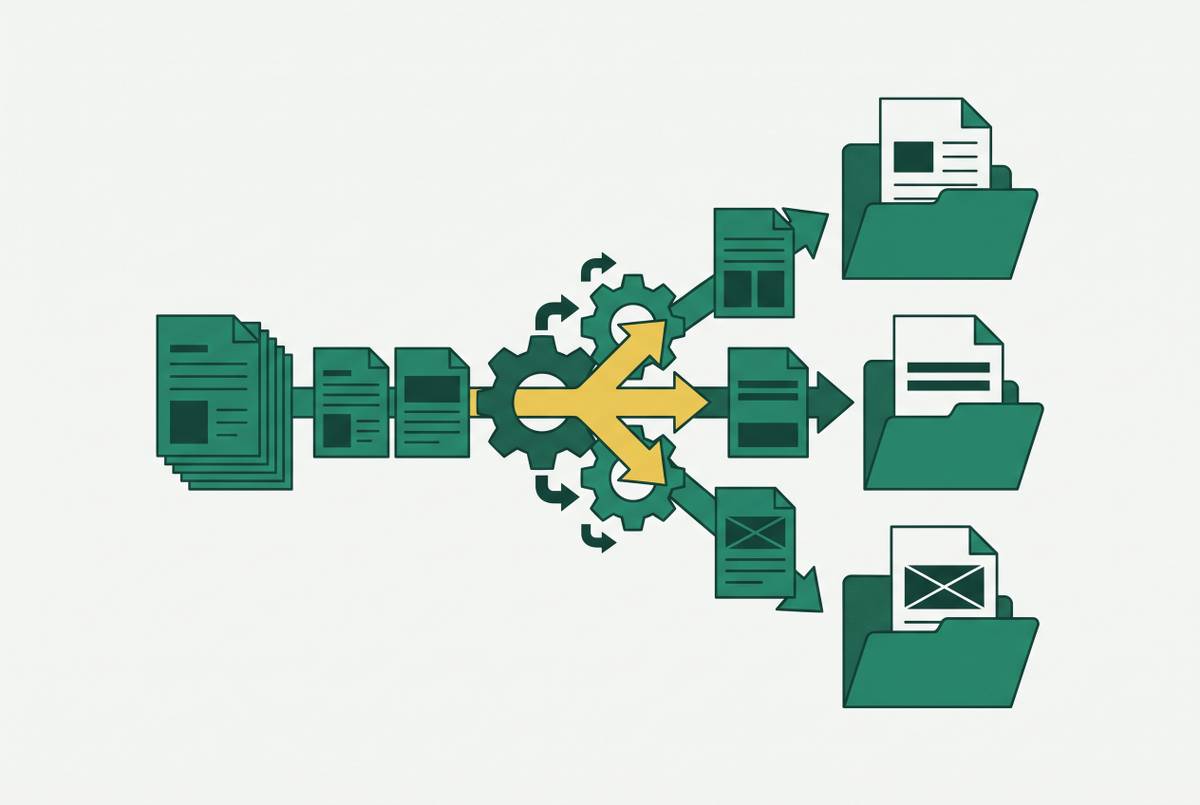
Confidence thresholds do the routing work. A patent from USPTO (11816430) describes the mechanism: when a predicted confidence score drops below a set threshold, say 0.85, the extraction routes to a human reviewer instead of auto-approving, and that human's decision becomes the validated output for that field. The threshold is a dial, not a fixed setting. Pushing the threshold higher makes auto-approved extractions more accurate, but it also sends more volume to human reviewers. That trade-off has to be tuned deliberately, not left at a default.
Ground truth is the third leg, and it's where a lot of pipelines quietly fall apart, because a correction is only as good as the process that validated it. One rigorous approach documented in research (arXiv 2505.01555) uses two independent human experts reviewing a random sample of 200 documents, with a margin of error of plus or minus 4% at 90% confidence, checked field by field against a golden dataset. That's the level of rigor that makes a "correction" trustworthy enough to retrain on, rather than just another guess layered on top of the model's guess.
Layered on top of all three: precision-recall trade-offs tracked per field, alongside continuous benchmarking on a fixed canary set, according to research on invoice extraction (ResearchGate), which is what lets a team tune auto-approve gates and catch drift before it becomes a production incident. A canary set is a held-out group of documents with known correct answers run against every new model version, and it lets a team distinguish "accuracy improved" as a measured fact from "accuracy improved" as a vendor's claim nobody can check.
Calibration remains largely unsolved: there's no reliable way yet to evaluate confidence for extraction accuracy. Research on confidence calibration points out there's no systematic way yet to evaluate confidence calibration for key information extraction in document AI, and real documents (scanning artifacts, physical degradation, the usual mess) throw off both extraction accuracy and the confidence score attached to it. A model's stated confidence might not mean much on a specific team's actual document mix. Some newer research is chipping at this directly: some approaches fuse model-internal signals with consistency checks to build per-field confidence, and Cleanlab's TLM (2025) offers model-agnostic trust scores per field. Neither one has fully closed the gap yet, but they're the right direction.
Structuring human review so it produces high-quality training signal, not noise
Human-in-the-loop review isn't a fallback for when the model fails. It's the mechanism that generates the data the model learns from, full stop. Figures from VentureBeat put this in plain numbers: 96% of AI and ML practitioners consider human labeling important, and 86% call it essential. That's not a minority opinion inside the field.
The workflow itself, per Parseur's description, runs in three stages. The model extracts fields from a document. High-confidence fields pass through automatically. Low-confidence fields route to a human, and that human's correction feeds back into the system rather than disappearing into a downstream record.
A few design decisions make that feedback actually useful rather than just noise with a timestamp. Reviewers need to see the model's confidence score next to the value they're checking, because knowing the model was unsure changes how carefully a person looks. The correction interface needs to capture the fix in the same structured field format the model outputs, not as a free-text note that someone has to parse again later. Reviewers need domain knowledge, not just attention to a screen. A generalist reviewer who doesn't know that a "Unit Price" field on a purchase order can't reasonably read $0.003 will wave the error through. And review time should go toward the model's uncertain outputs, not its confident ones. Checking work the model already gets right burns reviewer hours and produces labels with almost nothing to teach.
Human-in-the-loop systems also carry a governance angle. Human-in-the-loop systems generate logs of decisions, interventions, and outputs as a natural byproduct, and those logs double as audit trails for compliance teams. Strata's 2026 research draws a sharper distinction that's easy to miss: putting a person "in the loop" without training them on what to approve, when to escalate, or how automation complacency creeps in isn't oversight, it's a liability wearing oversight's clothes. A reviewer needs a structured protocol, not just a queue and a login. Done right, though, figures cited from Tely.ai in Parseur's 2025 research put blended accuracy from a combined workflow approach as high as 99.9% in document extraction, which is a meaningfully different number than either piece achieves alone.
Measuring whether the feedback loop is working
Every claim of improvement needs to survive contact with a fixed evaluation set. Reduced review volume doesn't prove the model got better, it might just mean fewer documents are being checked. Reviewer satisfaction doesn't prove it either. Ground truth comparison is the only thing that does.
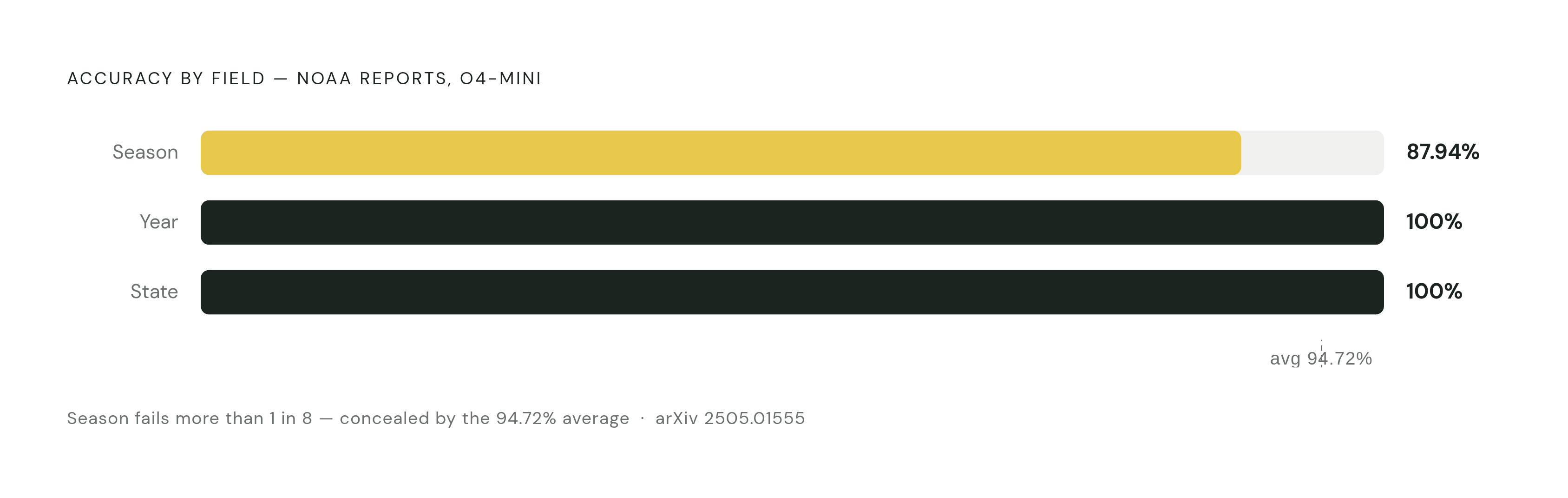
What that looks like in practice, from an evaluation on NOAA reports using o4-mini (arXiv 2505.01555): per-field accuracy ranged from 87.94% on the Season field up to 100% on Year and State, with an overall average of 94.72%. That spread between fields is the point. A single blended accuracy number of 94.72% hides the fact that one field is failing more than one time in eight. Document-level averages flatten exactly the information a team needs to fix the pipeline.
Drift is a separate problem from accuracy, and it needs its own measurement. A model tuned well on Q1's invoice layouts can degrade quietly the moment a major supplier rolls out a new template in Q3, and nothing in a static accuracy report will catch that on its own. Canary sets run continuously are what surface drift before it turns into a pile of downstream errors nobody traced back to the source.
Thresholds aren't universal across fields either. A field like "total amount due" justifies a stricter confidence bar before auto-approval than "supplier address," because the cost of getting the total wrong is higher than the cost of a minor address typo. Measurement has to reflect that asymmetry, not average across it.
The gap between good reporting and typical vendor reporting is wide. Good reporting shows per-field accuracy against ground truth, confidence calibration curves, drift alerts tied to canary sets, and correction rates broken out by document type. What most vendors offer, per research from Extend AI, is an overall accuracy figure measured on clean samples, a number that says almost nothing about how the system handles handwriting, poor scans, or a layout it hasn't seen before. And there's a structural reason this is hard to fix from the outside: research on confidence calibration notes that most published document benchmarks focus on clean, high-quality samples, leaving the low- and mid-accuracy range too thin to evaluate properly. A published benchmark score can't predict how a model's confidence behaves on a team's actual, messy document mix. That evaluation set has to get built in-house, from real documents, or it doesn't exist.
Why building a continuous-learning pipeline in-house compounds faster than most teams expect
Building the first version isn't the hard part. The hard part is keeping alive a system that ingests corrections, checks they're valid, retrains on them, evaluates the new model, and watches for drift, continuously, across document types that keep shifting under it.
The cost picture is not small. Research from Extend AI puts infrastructure costs for self-hosted parsing at roughly $15,000 to $40,000 a year at modest scale, and separately estimates that maintaining parser dependencies, resolving library conflicts, and patching custom edge-case logic eats 20 to 30 percent of an engineer's time every quarter. A total-cost-of-ownership analysis from Hyperscience put the present value of technical labor for a build-it-yourself approach at $1,866,891, covering infrastructure, model work, security, and project management staffing, with technical infrastructure adding another $408,552 in present value on top. And that figure doesn't even include the evaluation and feedback infrastructure sitting on top of the extraction pipeline itself.
The way problems compound in continuous learning appears in a few places. OCR libraries, layout detection models, and format handlers all release on their own schedules, and upgrades break compatibility often enough that an update can quietly undermine the assumptions a team built its pipeline around. A poorly instrumented feedback loop is worse than no loop at all in one specific way: a static tool fails at a fixed, knowable rate, but a loop built on unchecked reviewer output has no mechanism to distinguish good corrections from bad ones, and can degrade rather than improve the model over time. And open-source extraction tools generally ship with no production monitoring or confidence scoring built in, so a team has to build both from scratch before the feedback loop has anything to route on.
A pipeline that fails loudly costs less to run than one that fails quietly, a principle that runs through the space. But building the alerting, the confidence scoring, and the canary monitoring that make failures loud instead of silent is itself a real engineering project, not a checkbox. Research from digitalapplied.com puts the volume pivot point for justifying in-house extraction infrastructure at around 50,000 pages a month. Below that line, the economics of building it yourself get hard to defend, and the feedback loop adds a whole additional layer of infrastructure that doesn't get cheaper just because volume is lower.
What to evaluate in a vendor-provided continuous learning system
The question that matters most: does the vendor's system learn from a specific customer's corrections, or does it pool corrections across every customer into one shared model that may not reflect that customer's document mix? That answer changes everything else on this list.
A few things separate a production-grade system from something that only looks good in a demo. Per-field confidence scores need to be exposed, not just a document-level pass or fail, because routing logic and review prioritization both depend on field-level granularity. Accuracy reporting needs to be honest and specific: per-field numbers against ground truth, not an overall figure measured on clean samples, and it's worth asking directly for accuracy on documents that resemble the actual workload in question. If a vendor won't put an accuracy number into a service-level agreement, the customer is the one absorbing the risk if performance slips, and a willingness to commit contractually is a decent proxy for whether the vendor's own measurement is solid enough to bet on.
Data ownership matters just as much. A no-training-on-your-data policy needs to say explicitly whether it covers corrections and human feedback, not only the original documents, because for payroll, healthcare, or financial paperwork, "where do the corrections go" is a compliance question, not a technical footnote. Ask whether the vendor runs canary sets continuously and can show drift alerts, since that's what turns "the model got better" into something a customer can actually verify instead of just trusting. And check whether human review genuinely closes the loop back into the model, or whether it's a disconnected patch step that fixes today's document without teaching the system anything for tomorrow's.
Security certifications need to cover more ground than usual here too. SOC 2, ISO 27001, and GDPR compliance typically get scoped to the extraction pipeline, but the correction and retraining pipeline carries the same sensitive financial and personal information, often more of it, since it's flowing through a human review step on top of the initial extraction. Regulatory context is shifting the stakes further: enforcement under the EU AI Act began in August 2026, per digitalapplied.com, and for document systems touching employment, credit, or healthcare decisions, how the human oversight is designed and how auditable it is are no longer optional design choices. They're becoming the baseline a system has to clear.