Human-in-the-Loop Validation Architecture for IDP
Routing extractions by field-level confidence prevents silent failures in document processing.
What HITL validation means in an IDP pipeline, and what it is not
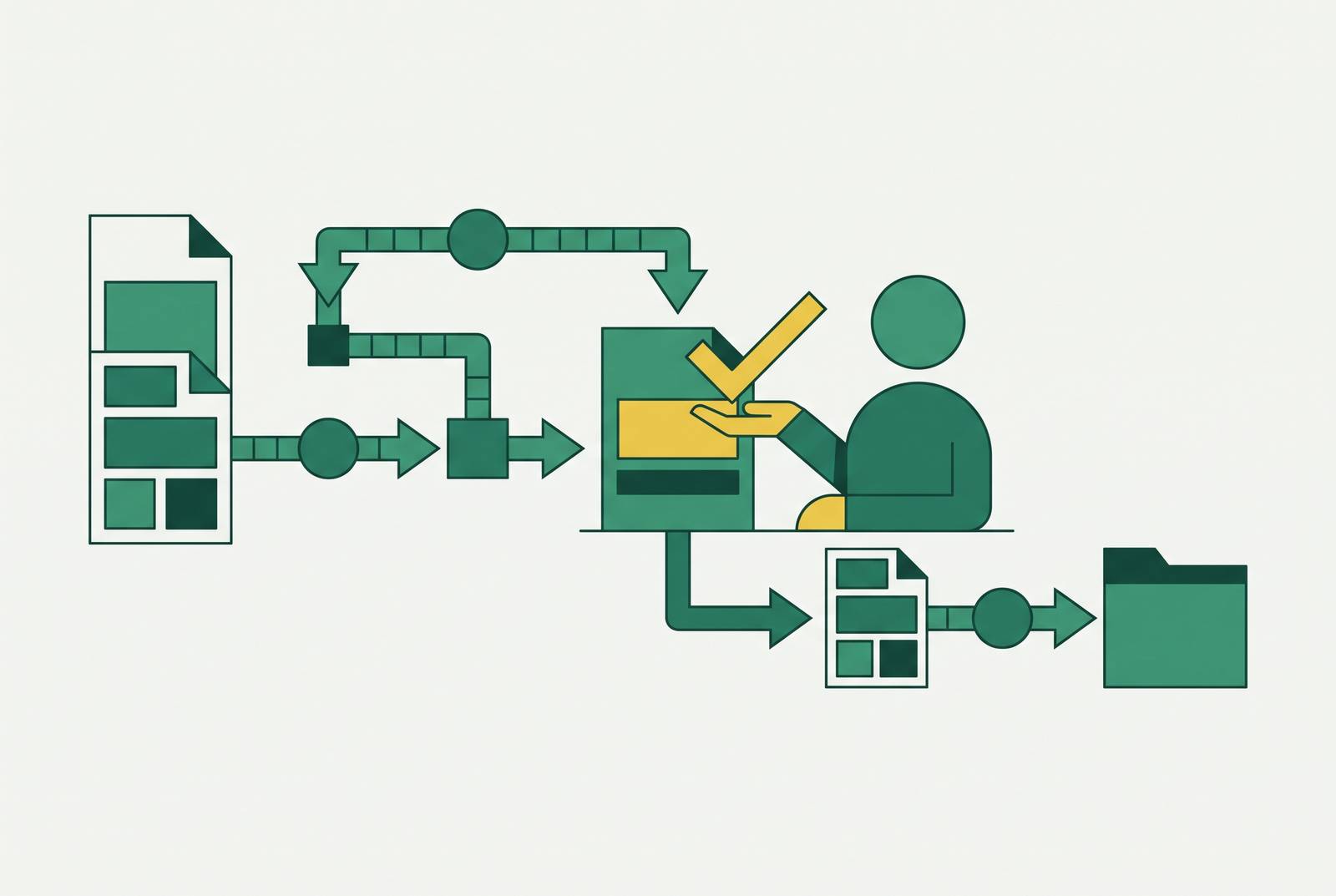
Human-in-the-loop validation is a routing layer. It decides, field by field, which extractions a system trusts enough to auto-approve and which ones need a person to look at them before anything moves downstream. That's a different job than catching mistakes after the fact, and the distinction is the whole point: confidence scoring, exception routing, retraining, none of it makes sense until you stop picturing humans as backup and start picturing them as a target the pipeline routes to on purpose.
Start with why this layer has to exist. Document parsers that look sharp on clean demo samples tend to fall apart on the messy variety production actually throws at them. Research evaluating document parsing at scale (the PureDocBench work, arXiv 2605.07492) found recurring failure patterns: models misreading subscript and superscript characters, misinterpreting sidebar annotation symbols, dropping entire sections of a document without surfacing any error. That last one is the dangerous part. A field that silently fails to extract throws no flag. Unless someone is checking, nobody notices missing data until it causes a downstream problem, such as a rejected claim, a mismatched invoice, or a compliance gap that appears during an audit instead of during processing.
The same research turned up domain-specific failures too, including misinterpretation of structured document elements and failures on specialized content types such as formulas and certification marks. None of it correlates with leaderboard rank. Documented failure cases have involved models that were leading their respective leaderboards at the time. A benchmark score tells you about performance on the benchmark's documents, not about the invoice from a vendor who switched templates last month.
OCR quality compounds the damage before a model ever makes a decision. A clean, digitally native PDF pushes character-level accuracy near-perfect. Hand the same extraction model a photographed, creased receipt from a gas station and accuracy drops into the mid-80s, on the same metric, with the same model. The input did the damage before the AI even started reasoning. Garbage in, garbage out is a measurable upstream variable here. It's a measurable upstream variable that has nothing to do with how capable the model is.
Put it together and the conclusion holds up: failure in document extraction is unpredictable, often invisible, and doesn't get fixed by picking a better model. A static extraction tool with no validation layer has no mechanism for catching any of it. That's the gap HITL architecture closes.
Treating human review as a safety net gets the design backwards. A properly built HITL layer decides, using confidence scores, what it can approve on its own and what it can't, and only the "can't" pile lands in front of a person. Reviewers work exceptions the system has already flagged, not a random sample, not every document.
That's a different job than the data entry people used to do on paper forms. Reviewers in a well-built HITL system make judgment calls on flagged fields instead of retyping whole documents, and the speed difference shows it: this exception-handling model runs substantially faster per item than legacy manual review, because a reviewer is adjudicating one ambiguous field rather than transcribing a page.
The corrections a reviewer makes aren't just fixes to a single record. They're training signal. Every time a human corrects a misread field, that correction can feed the model's next iteration, and that feedback loop is what separates a system that gets better over time from one that just extracts at whatever accuracy it shipped with.
A proper HITL layer needs four things in place: confidence scoring at the individual field level, a way to tell critical exceptions from non-critical ones, reviewer access to the original document plus enough business context to make a real call, and a complete audit trail of every action taken. Skip any of these and the layer stops functioning as architecture and turns into an ad hoc patch.
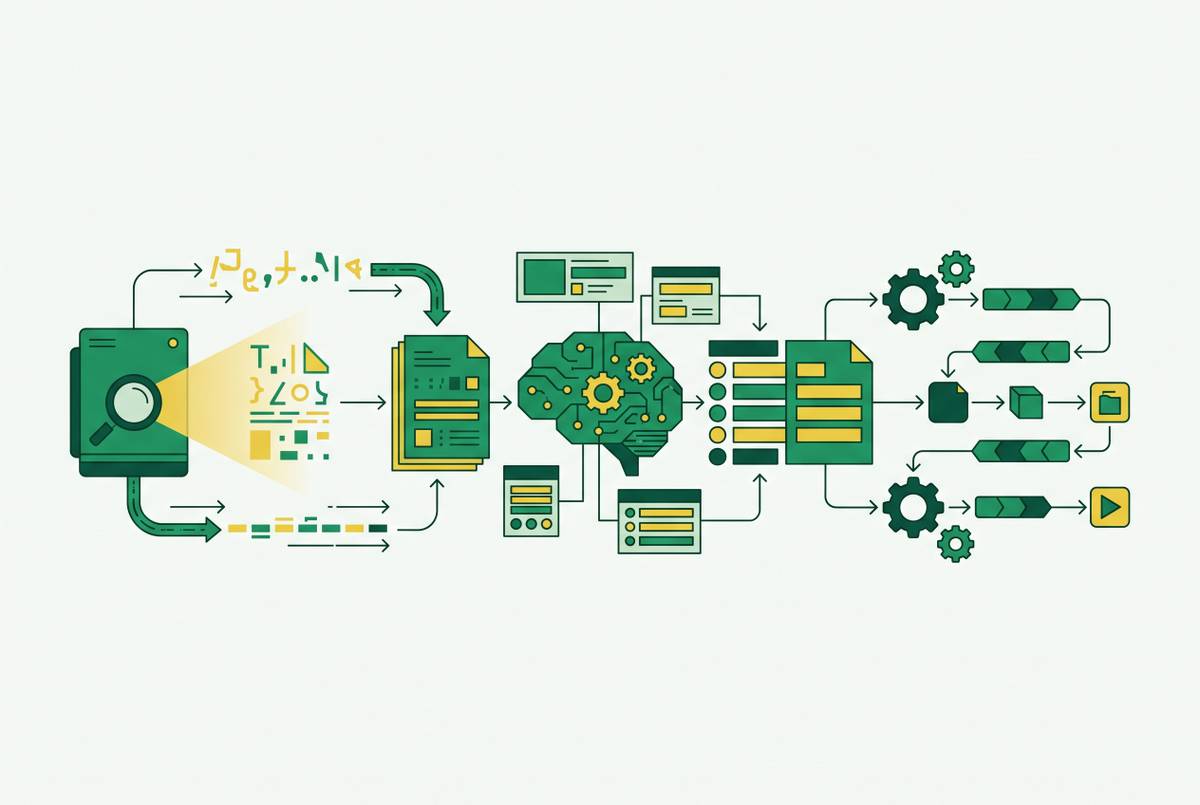
Inside the broader IDP workflow, this gate sits in one specific place: documents come in, get preprocessed, get classified, get extracted (OCR included), then hit the validation/HITL gate before anything reaches output or downstream integration. It is a filter, not manual review of every document or human labor stacked redundantly on top of automation. It's a filter, and the filter's precision is the entire point.
For industries where a wrong field carries regulatory weight, insurance claims, loan underwriting, healthcare records, this layer has to be explicit and auditable, not something a vendor gestures at during a sales call. "Someone reviews it eventually" isn't a compliance answer.
Confidence scoring at the field level: the engineering foundation of exception routing
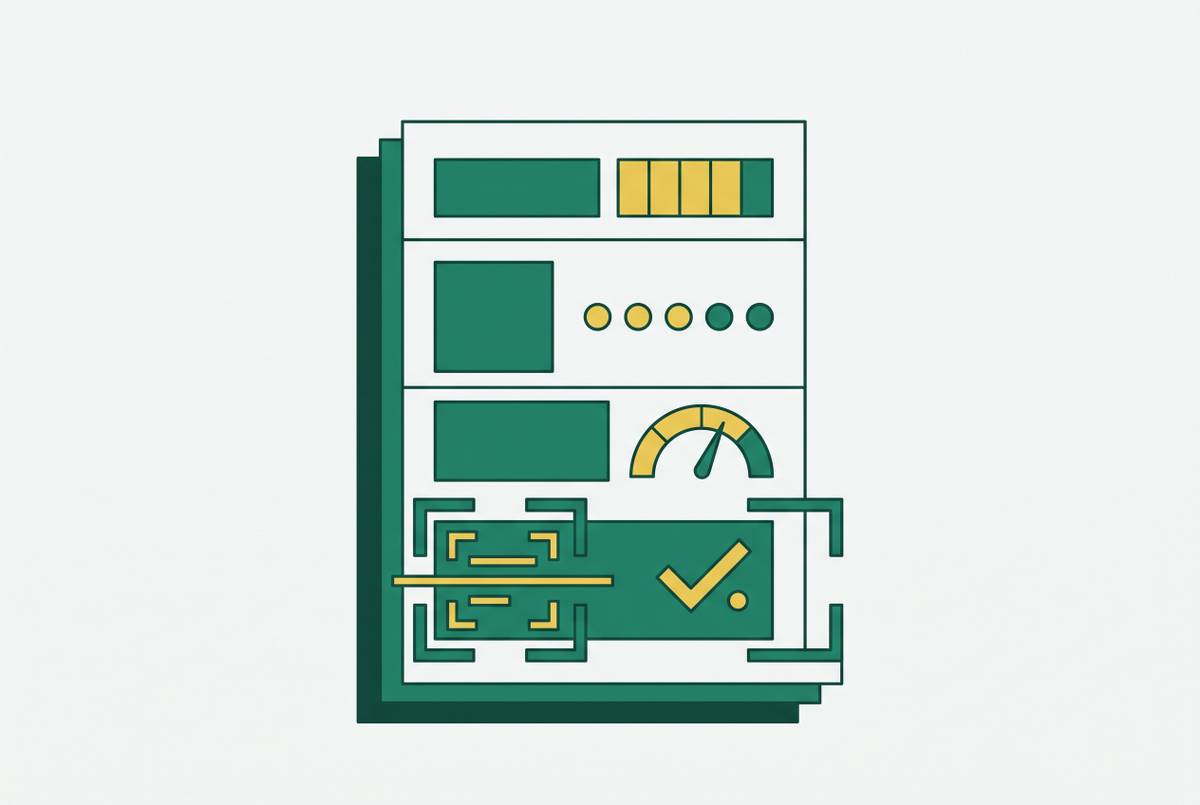
Document-level confidence scores hide the exact problem they're supposed to solve. A document can score high overall while the one field that actually matters is wrong. Averaging confidence across a whole document buries the error you most need to catch.
Field-level scoring fixes this by treating each extracted value as its own unit of measurement. The routing call, auto-approve or send to a human, gets made per field, not per document, so a single bad field in an otherwise clean form still gets caught.
Threshold configuration governs this in practice. If a field's predicted confidence falls below a set number, say 0.85, it routes to manual review instead of passing through automatically. That threshold is tunable, and tuning it is a genuine tradeoff: push it higher and accuracy on auto-approved fields climbs, but so does the volume flowing into the review queue. There's no free win here, only a dial that trades automation for accuracy and back again.
Calibration adds another wrinkle. Numeric fields, amounts, dates, ID numbers, tend to be reasonably well-calibrated, with stated confidence more closely tracking actual accuracy. Free-text fields don't behave the same way. Research on this (the EXTRACTCONF work, arXiv 2606.24420) found free-text fields show overconfidence at high predicted probabilities: the model claims certainty it hasn't earned. A frontier language model reading a badly scanned, noisy document can still generate high-confidence tokens about what it thinks it's reading, because its confidence reflects internal consistency rather than the legibility of what it was actually given. Confidence scoring that ignores document quality is scoring the wrong thing.
No systematic benchmark yet exists for evaluating confidence calibration specifically in key information extraction for IDP. This tells you it is still an open engineering problem industry-wide, not something any vendor has quietly solved.
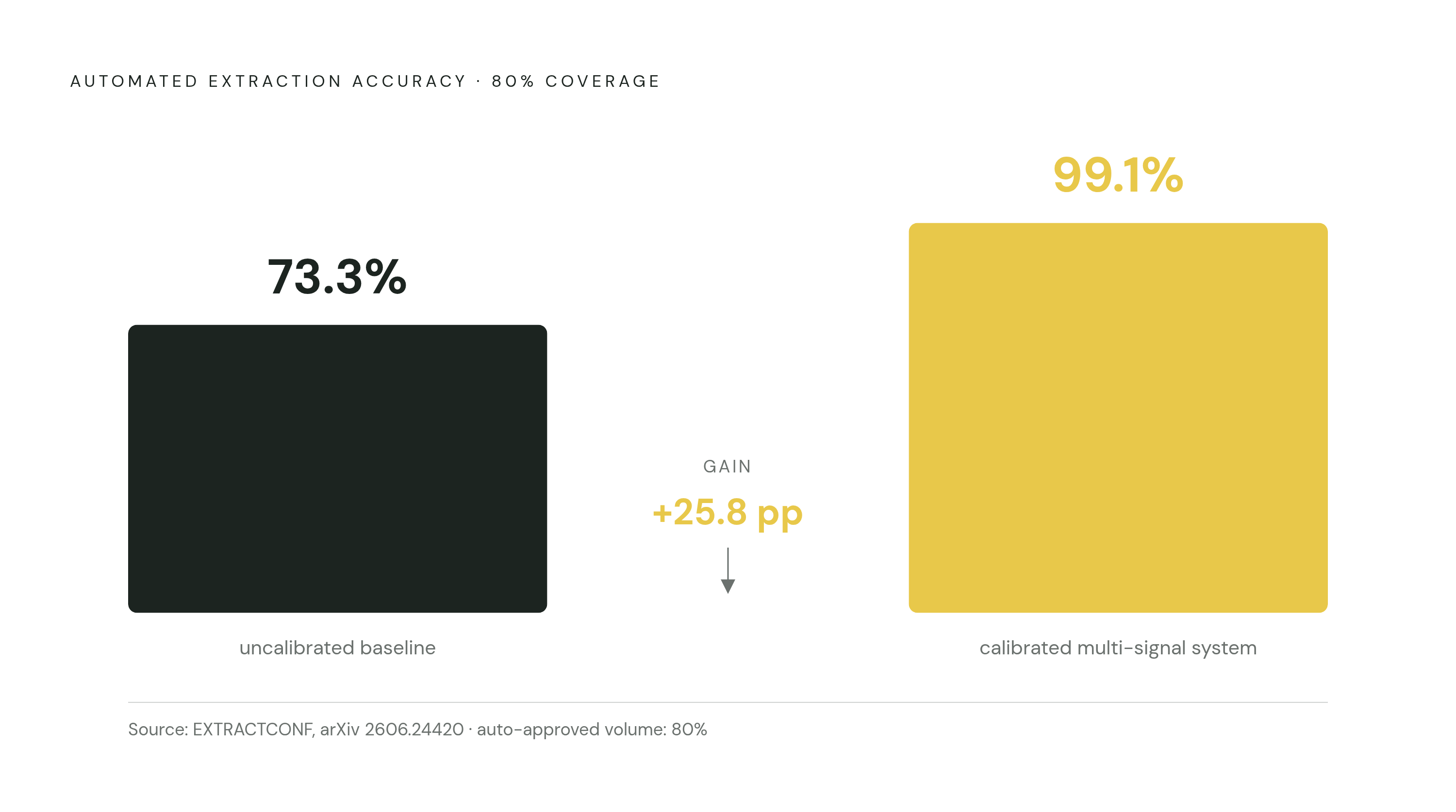
The payoff for getting it right is concrete. The EXTRACTCONF research found a well-calibrated, multi-signal confidence system reaches 99.1% automated accuracy at 80% coverage, a 25.8 percentage-point jump over a 73.3% base rate. That's the number that justifies the whole architecture: calibration done well doesn't just cut risk, it multiplies how much volume a system can safely process without a human touching it.
None of this is a setting you configure once and walk away from. Document mix shifts, model behavior drifts, and a threshold tuned correctly at one point can become miscalibrated as document mix and model behavior shift over time. It needs monitoring like any other production metric, since it's the single dial governing the tradeoff between automation and accuracy.
Exception routing in practice: how flagged fields reach reviewers
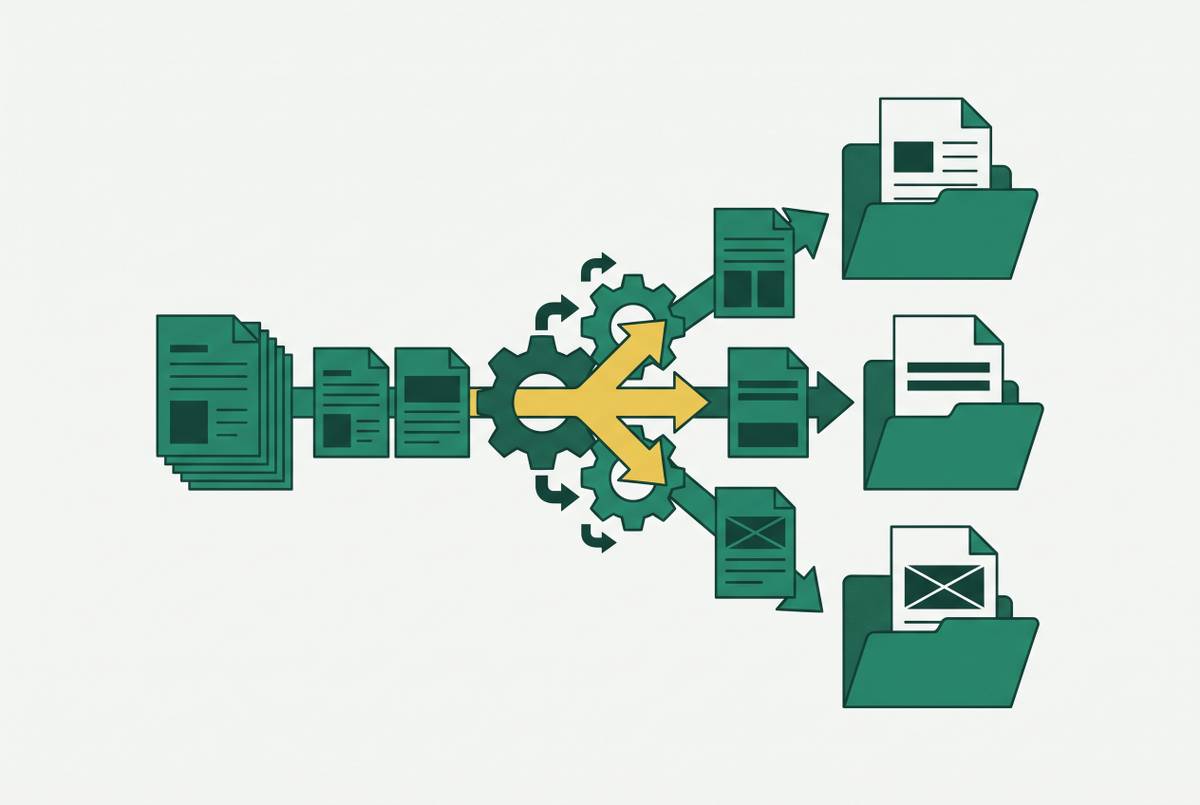
Routing isn't a binary switch between auto-approve and human review. A well-built system treats critical fields, payment amounts, entity names, dates that trigger legal deadlines, differently from non-critical ones, applying tighter thresholds where an error costs more.
What a reviewer actually needs to do this job well is specific, and skipping any piece of it undermines the whole exercise. Reviewers need the original document rendered next to the extracted value, rather than the value sitting there in isolation. They need the confidence score that triggered the flag. They need business context, prior extractions from the same vendor, say, that might explain an anomaly. And they need visibility into conflicting values when cross-document validation caught a discrepancy elsewhere in the file.
The audit trail isn't optional. Every reviewer action, approve, correct, reject, needs a timestamp, a reviewer identity, and a record of the original extracted value before correction. That log serves two purposes at once: it's a compliance record, and it's the raw material feeding the retraining loop.
Skimp on the review interface and the damage compounds quietly. Reviewers who can't easily see the source document default to approving whatever's flagged, because verifying takes effort the interface didn't make easy. That default poisons the training signal (a rubber-stamped correction isn't a correction at all) and erodes the accuracy floor the whole system exists to build.
Not every exception is the same kind of problem. A scan artifact or low-resolution image is a document-quality exception. A novel layout or an ambiguous field label is a model-uncertainty exception. An amount outside an expected range is a business-rule violation. Each calls for a different reviewer response and, ideally, a different downstream fix. Treat a scanning problem and a model-uncertainty problem the same way, and the retraining loop learns the wrong lesson from both.
Straight-through processing (STP) rates above 90% are achievable within 90 days on standard document types. That's a real target to hold a vendor, or an internal build, to.
A reviewer's correction is only as useful as the format it lands in. A structured correction, field type, corrected value, document context, feeds a retraining pipeline. A free-text note scribbled in a comment box does not. Loose correction notes are close to worthless as training data, no matter how thoughtful the reviewer was when writing them.
The retraining loop: how human corrections become a continuously improving accuracy floor
This is the line that separates a living system from a static one. A static OCR tool extracts at whatever accuracy it shipped with and stays there. A system with a real retraining loop extracts at an accuracy that moves, and it moves in the right direction because corrections get fed back in.
The mechanism runs in a cycle: reviewer corrections become structured training signal, the model updates on that signal, confidence thresholds recalibrate against the updated model, and fewer exceptions get routed for that document type next time around. Run the cycle enough times and the review queue for a given field type should shrink on its own.
A few things have to hold at once for this to work. Corrections need to be structured, not loose notes. Volume needs to be high enough that retraining doesn't just overfit to whatever documents happened to come through last week. And the update cycle needs to run often enough to track real drift, because document formats don't sit still.
That drift is a real production headache, not a theoretical one. Vendor invoice templates change. Form versions get revised. New document types enter the pipeline as a business adds suppliers or new geographies. A system with no retraining loop degrades quietly as its training data falls further behind the documents actually arriving, and nobody notices until accuracy on some field type has slipped for weeks without anyone catching it.
This feedback loop is widely described as the central value proposition of HITL, not a side benefit tacked onto it. It's described as the central value proposition. The DocumentIQ/Algoscale framing, separately, lists continuous learning as one of four definitional capabilities of IDP, standing alongside classification, extraction, and validation, not as an optional fifth wheel.
The compounding effect is the whole thesis in miniature. Early corrections on a low-confidence field type cut how often that field type gets routed to a human going forward. Over time, the review queue shrinks and the STP rate climbs, and that rising line on a dashboard is the measurable proof the accuracy floor is actually rising, not staying flat.
A static tool can't distinguish a field it consistently gets wrong from a field that's genuinely hard for any model to parse. Without a retraining loop, both sit in the exception queue forever, no closer to resolution a year in than they were on day one.
McKinsey Global Institute research found organizations that fully deploy intelligent document automation report a 40 to 70% reduction in document-processing FTE. That range compounds after the retraining loop has had real time to work; it does not appear the day a system gets switched on.
Evaluation methodology: measuring whether the HITL architecture is working
A single accuracy number for a whole document or a whole batch hides more than it reveals. If "payment due date" is wrong 60% of the time but every other field is close to perfect, an aggregate accuracy figure can still look respectable while the one field that actually triggers late fees stays broken.
The fix is to measure precision and recall per field type against ground truth, not per document. Give "invoice number" its own score. Give "payment due date" its own score. Only then do you see where the system is actually failing.
A useful reference point for how much this variance matters, even with strong models: a structured extraction evaluation using o4-mini against 200 NOAA weather records, checked by two independent human annotators, found per-field accuracy ranging from 87.94% on the "Season" field up to a perfect 100% on "Year" and "State," with an overall average of 94.72% (per arXiv 2505.01555). That spread, a double-digit percentage-point gap between the weakest and strongest fields, happened with a capable model on a real dataset. Field-level variance is the norm. It's the norm.
Canary sets catch drift before it compounds. Run a fixed, known set of documents continuously through the pipeline and watch accuracy on specific fields, and degradation becomes visible early, before a slipping field type quietly racks up weeks of bad extractions in production.
Precision and recall pull against each other, and the threshold that maximizes one isn't the threshold that maximizes the other. Optimize for recall, catching every possible error, and you accept more false positives clogging the review queue. Optimize for precision instead and reviewer hours go down, but so does the odds a real error gets caught before it slips through. Production systems need to tune this separately for each field based on what an error there actually costs.
STP rate is the leading operational signal to watch day to day: the share of documents clearing the confidence threshold without a human touching them. A field type's STP rate climbing over time is direct evidence the retraining loop is doing its job.
Ask whether a vendor will put a per-field accuracy number into a contract as a service-level agreement, rather than quoting a benchmark in a sales deck. A vendor willing to commit contractually has to have an evaluation process solid enough to stand behind it. One that won't is asking the customer to absorb all the measurement risk alone, and that's not a vendor worth trusting with regulated data.
The audit trail described earlier does double duty here too. The log of reviewer corrections isn't just a compliance record, it's also the ground-truth dataset for next quarter's evaluation cycle. Same architecture, two functions.
Build vs. buy: what the HITL architecture requirement means for teams considering an in-house pipeline
Teams scoping an in-house document pipeline tend to plan for OCR, an extraction model, and a validation step, then treat the HITL routing layer, the audit trail, the reviewer interface, and the retraining loop as something to build later. That "later" is where the real cost hides, and most teams underestimate it badly.
Run the numbers and the picture sharpens. Infrastructure alone can represent a significant ongoing cost at modest scale, which sounds manageable on its own. The harder cost is engineering time: a meaningful share of engineering time goes into dependency management, version conflicts, and custom preprocessors, work that never appears on an infrastructure invoice but drives costs up everywhere else.
The digitalapplied.com and Mavik Labs/Spheron framework cited in S1 puts the break-even point for self-hosting higher than most teams expect: somewhere around 50,000 to 100,000 pages a month, and only with a dedicated ML engineer on staff to maintain it. Below that volume, ongoing maintenance, which typically far exceeds the cost of the initial build, quietly erases whatever per-page savings looked attractive on a spreadsheet. Most teams evaluating this never clear that volume. Building in-house is the wrong call for most of them, full stop.
PaddleOCR-VL-1.6 runs under Apache 2.0, at under a billion parameters, and covers 109 languages. PaddleOCR-VL-1.6 runs under Apache 2.0, at under a billion parameters, and covers 109 languages. DeepSeek-OCR carries several times the parameter count of PaddleOCR-VL-1.6, under an MIT license. GOT-OCR 2.0 handles equations well and runs under 3GB of VRAM. Granite-Docling, a small fraction of the parameter count of the others and also Apache 2.0, performs strongly on financial tables. Each is a real tool solving a real slice of the problem, and each follows its own independent release cycle, so upgrading one can break compatibility with the rest of a hand-assembled stack. The extend.ai source notes that none of them ships with production monitoring or confidence scoring built in, so accuracy regressions only become visible after downstream failures have already piled up.
None of these tools includes exception routing, a reviewer interface, an audit trail, or a retraining loop. Those are the expensive, unglamorous parts to build well, and they're exactly what a real HITL architecture requires.
Procurement decisions in this space fall across three tiers, per the v7labs framing in S1: end-to-end AI solutions, traditional IDP and RPA platforms, and building-block developer tools for teams that want to assemble their own stack. Picking the wrong tier for a given compliance and accuracy requirement is one of the most common mistakes teams make, usually because the tier gets chosen on price before anyone checks it against the regulatory bar the documents actually need to clear.
None of this means building is always wrong. Teams with genuinely unique document types, sovereign data requirements that rule out third-party hosting, and a dedicated ML engineering staff already in place have real reasons to build components themselves. Teams that need production-grade HITL architecture without that standing investment generally don't have those reasons, and the math above explains why.
Security and compliance requirements that the HITL layer must satisfy
Invoices, payslips, loan applications, insurance claims, patient records: these are the documents IDP systems process in regulated industries, and every one carries sensitive personal or financial data that creates a compliance obligation at each stage of the pipeline, not just at the end.
The HITL layer adds its own compliance surface area on top of that. Reviewer identities, correction logs, records of who accessed which document and when: all of it has to be retained or destroyed according to whatever regime applies, GDPR, HIPAA, SOC 2, depending on the industry and geography.
Zero data retention is the right baseline for high-sensitivity pipelines. Documents shouldn't sit on vendor infrastructure after extraction completes. The audit trail of reviewer actions is a separate record from the document itself, so the sensitive content doesn't need to persist just because the compliance log does.
Verifying a vendor or an in-house build against real certifications matters here. SOC 2 Type II is one worth checking for; GDPR compliance and ISO 27001 are others. Deployment options, EU or US data residency, or on-premise hosting for teams with sovereignty requirements, decide which vendors are even eligible for consideration.
The scale here isn't abstract. The Nectain research cited in S6 found large enterprises, particularly in banking, financial services, and insurance, account for 73.6% of IDP market revenue. That segment's compliance bar effectively sets what "enterprise-grade" means for the rest of the market: a system built to satisfy BFSI requirements clears most other industries' bars along the way.
The audit trail plays a dual role: it's a legal record and a training dataset at the same time. It's a legal record and a training dataset at the same time. Its format and retention policy have to satisfy legal and ML engineering requirements simultaneously, not one after the other.
Governance built in from the start beats governance bolted on afterward, and that's the real dividing line between systems worth trusting with regulated data and systems that only look trustworthy. The Cybic/Drava framing in S5 holds that role-based access control, encrypted data handling, full auditability, and an explicit policy against training on a customer's proprietary data without consent need to be built into the architecture from day one. Add these after a system is already in production and gaps tend to persist, since the data flows and storage decisions were made without them in mind. Designed-in governance and retrofitted governance aren't the same thing wearing different labels. For a document pipeline handling regulated data, that difference is the whole ballgame.