OCR Engine Accuracy Benchmarks for Degraded Document Types
Standard OCR benchmarks hide errors in critical fields that break production pipelines.

A system can score very high on a standard OCR benchmark and still corrupt the exact fields a production pipeline depends on. That's the core problem with how OCR accuracy gets measured and reported: the errors a model makes are not spread evenly across a document. They cluster on invoice totals, tax IDs, checkboxes, and table cells, which is precisely where a RAG pipeline or downstream automation can least afford them.
Why character-level OCR accuracy misleads on production readiness
Standard OCR benchmarks score models on clean, well-formatted documents using character-level accuracy. A high mark on that kind of test reveals little about how the same system will behave on the messy, inconsistent documents that actually show up in a production pipeline.
Two of the most common metrics, Character Error Rate and Word Error Rate, treat every position in a document as equally important. Under both, a wrong letter buried in a paragraph of body text counts exactly the same as a wrong digit in a tax ID or an invoice total. The math treats a typo that nobody will notice the same as a dollar amount that triggers a payment to the wrong account.
This produces a specific and dangerous pattern: a model can transcribe running text almost flawlessly while consistently misreading numeric fields, subscripts, or checkbox states, and its aggregate score will still look strong. The ACL 2026 InduOCRBench study tested this directly. It ran leading OCR models through a controlled RAG pipeline on realistic industrial documents, and it found clear performance degradation, even for models that posted strong scores on conventional benchmarks. The paper's conclusion is direct: high OCR accuracy does not translate reliably into strong downstream RAG performance.
The benchmarks most engineers cite were built to measure how well a model reads clean printed text. That's a reasonable thing to measure, but it tests the condition least likely to break anything downstream. It skips the messy formatting and edge cases that actually break document pipelines in production.
The document conditions that expose what aggregate scores hide
Degraded and structurally complex documents aren't rare exceptions that a pipeline occasionally stumbles on.
InduOCRBench goes further, covering 11 difficult document types, including extreme layouts, high-resolution pages, backgrounds with watermarks or heavy visual noise, historical documents with reading orders that don't follow modern conventions, decorated or stylized text, and pages mixing tables with mathematical formulas.
Camera-captured documents bring a failure mode that flatbed scans simply don't have: geometric distortion. Perspective angle, page curvature, and uneven lighting all warp the image before a model can even start reading it. The TeleOCR paper makes a specific point about this: methods that separate layout analysis from text recognition rely heavily on getting that layout analysis right, and geometric distortion in a camera-captured page can set off a chain of errors that starts in layout detection and spreads through everything that follows.
Checkboxes deserve their own mention. They're among the elements vision-language models handle worst without extra tuning, so this becomes a serious problem fast in healthcare and insurance forms, where a checked or unchecked box can carry as much meaning as a dollar figure.
High-resolution, text-dense pages introduce a different kind of risk: hallucination. A misread is a transcription error. A hallucination is the model inventing text that was never on the page and presenting it as if it had read it there. Both corrupt the data that flows downstream, but a hallucination is often harder to catch, because it looks complete and plausible instead of obviously wrong. A missing value draws attention. A confidently invented one doesn't, and a downstream system has no way to know it was never real.
How layout error cascades from OCR into retrieval failure
At the layout detection stage, a small OCR mistake spreads outward and corrupts everything built on top of it. When a model misreads the structure of a page, that error doesn't stay contained. It travels through chunking, through embeddings, and into whatever gets retrieved later, and no character-level accuracy score captures it.
Tables are one of the clearest examples. When a table gets flattened into a plain run of numbers with no row or column markers preserved, nothing downstream can tell which value belonged to which line item. Multi-column layouts cause a related but different problem: when a model reads straight across two columns instead of down each one separately, it stitches together two unrelated sentences into a single chunk. That chunk has almost no internal coherence, and it will retrieve badly against nearly any query sent to the system. Headers and figure captions cause a quieter version of the same damage: when they get merged into the surrounding body text, they dilute the meaning of the chunk they land in, which weakens the embedding built from it.
The InduOCRBench paper found that this mismatch between OCR accuracy and retrieval performance varies by document category, appears on both the retrieval side and the generation side, and holds steady across different OCR-first pipeline designs. That consistency matters. It means the problem is a structural property of how OCR output gets handed off to a RAG system, regardless of which pipeline receives it.
This failure is most dangerous when it makes no noise. The pipeline runs to completion and returns a result that looks fine, but the missing content disappears without a trace unless someone compares the output against ground truth by hand. Subscript and superscript errors cause a related kind of quiet damage on lab reports and technical documents: a measurement like m³ gets rendered as mˆ3, passing basic format checks while carrying the wrong value. Sidebar annotations using arrow symbols face a similar fate: they get converted into unrelated plain text, and this failure hits any document that relies on visual notation instead of standard characters.
An engineer evaluating an OCR system purely on a character-level benchmark has no way to see any of this coming. None of these failures move the needle on CER or WER in a way that would raise a flag before deployment.
Per-field accuracy against ground truth as the correct production metric
So you need to stop asking how many characters a model got right, and start asking whether it returned the correct value for each field that actually matters. Field-level accuracy, measured against ground truth, is the only metric that answers the question a production system actually needs answered.
A 2026 preprint (arXiv:2608.01792) proposes one formalization of this approach called ECARB, a review-budget metric that turns discriminative accuracy gains into concrete operational savings. ECARB is one example of the right kind of approach, not the only correct answer. The real argument is for the category of metric: score per field, compare against ground truth, and use a comparator suited to the field type.
The tolerance-based comparator for numbers matters more than it might first appear. If a metric can't tell those two cases apart, it flags correct extractions as wrong, and that makes it useless for accounts payable or mortgage workflows where formatting varies constantly.
If you weight fields by business priority, you can build your actual risk tolerance directly into how you measure accuracy. A total-amount field and a vendor-name field don't carry the same consequence if a payment run gets the number wrong. A metric that scores both the same way produces a number that doesn't reflect what's actually at stake.
The benchmark field has started to move in this direction already. InduOCRBench scores structural and semantic correctness alongside raw character accuracy, and olmOCR-Bench's eight category splits test specific degradation conditions instead of collapsing everything into one mixed-corpus average. So this gap between aggregate benchmarks and production reality is why extraction systems like Invofox measure per-field accuracy against ground truth rather than character-level metrics. The entire validation model rests on the idea that a vendor has to quantify what actually breaks a downstream pipeline, not whatever happens to be easiest to score.
The practical step for any team evaluating an extraction system is to build a test set of 100 to 200 hard cases pulled from their own document mix and score it against ground truth at the field level. A published leaderboard, no matter how well constructed, is built from a document distribution that may not resemble the one a given team actually processes.
What benchmark leaderboards show
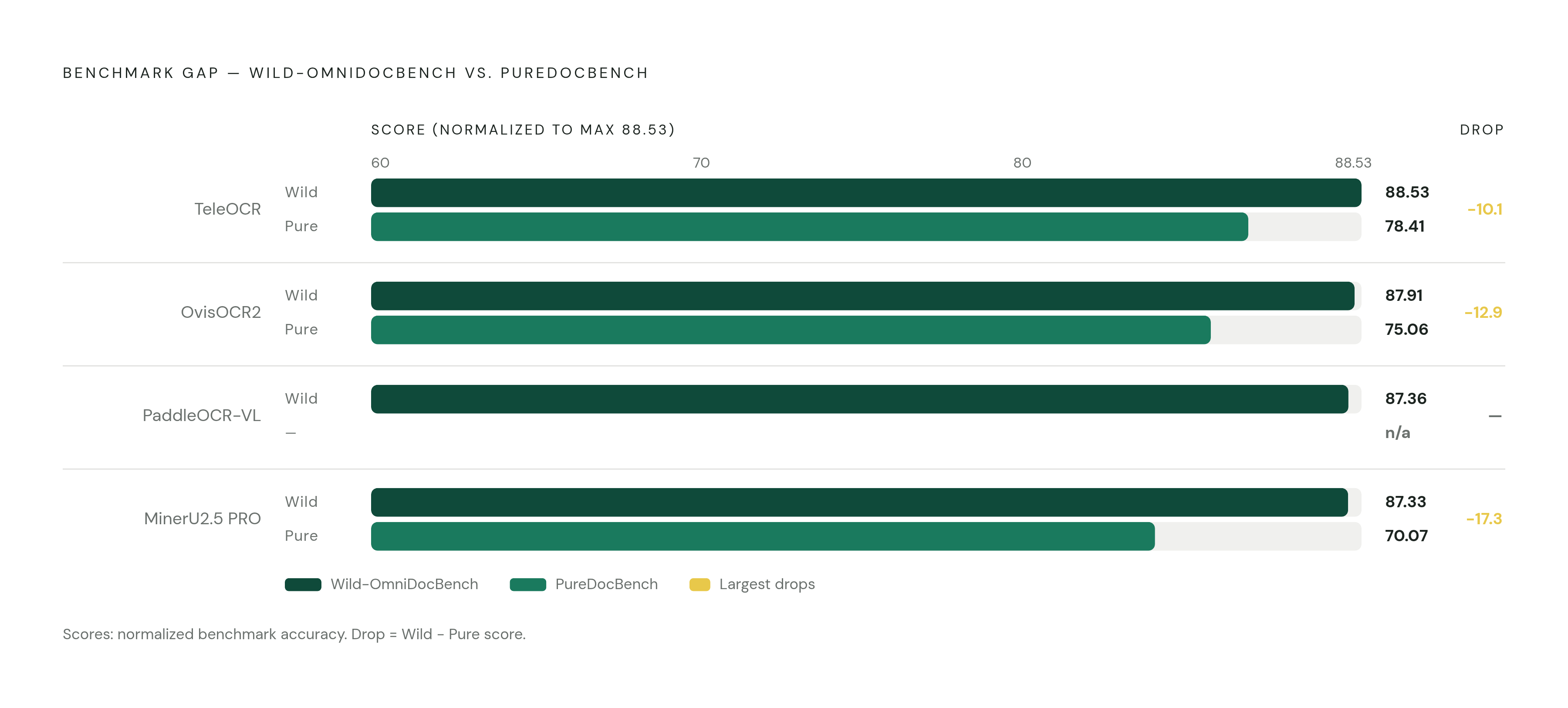
Public benchmarks have gotten a lot better at measuring something closer to real performance, but even the top systems on the hardest benchmarks show specific, repeatable gaps that a headline score won't reveal.
On Wild-OmniDocBench, which tests more realistic and less controlled document conditions than earlier benchmarks, TeleOCR scores 88.53, OvisOCR2 scores 87.91, PaddleOCR-VL 1.6 scores 87.36, and MinerU2.5 PRO scores 87.33.
PureDocBench pushes further, testing document parsing across clean, degraded, and real-world conditions together. There, TeleOCR scores 78.41, OvisOCR2 scores 75.06, Logics-Parsing-v2 scores 72.61, DotsMOCR scores 70.39, and MinerU2.5-Pro scores 70.07. PureDocBench is built specifically to expose failures on structured content that OmniDocBench's design tends to smooth over.
One pattern stands out at the top of these leaderboards: model size and benchmark rank move in opposite directions. A bigger model is not a safer bet for document parsing on structured or degraded content, and parameter count isn't a usable stand-in for how well a system will hold up on real documents.
The Wild-OmniDocBench and PureDocBench numbers tell a team far more about real-world performance than the headline scores usually quoted in vendor announcements, which tend to lead with whatever number looks best. Throughput deserves a place in this conversation too, as a real engineering trade-off rather than an afterthought. A model that scores lower on an accuracy benchmark can still be the right call for a high-volume, lower-stakes preprocessing step. You should make that decision deliberately, using field-level accuracy data, not by defaulting to whichever model tops an aggregate leaderboard.
How confidence scores behave on degraded documents
A confidence score is only useful if it's calibrated. Calibration means that when a model reports a given confidence level, it's actually correct about that proportion of the time, not some other rate that happens to look reassuring. On degraded documents, this kind of calibration breaks down in predictable ways.
In production, confidence thresholds decide what gets automated and what gets sent to a human. If a document scores below a set threshold, say 0.85, it routes to manual extraction. The threshold itself is a choice a team makes.
A 2026 paper on selective risk (arXiv:2608.14639) identifies a calibration failure specific to document extraction that runs counter to how most engineers would expect confidence to behave. Extraction errors tend to come from the document. A frontier LLM reading a genuinely unreadable page will still generate high-probability, high-confidence tokens about whatever noise it's looking at. The model ends up most confident exactly where the source material is least trustworthy, which is the opposite of what a routing system needs from a confidence score.
The same paper found that free-text fields tend toward overconfidence at high predicted probabilities, while numeric fields stay comparatively well-calibrated.
There's a sampling issue hiding in here too. Even if a calibration set looks big enough on paper, it can still badly underrepresent the true error rate on the hardest document types.
What good calibration actually buys a team shows up clearly in the ExtractConf confidence engine (arXiv:2606.24420). At a fixed coverage level, a well-calibrated confidence system delivers meaningfully higher automated accuracy than an uncalibrated one running at the same coverage. The gap between the two is large enough to change the economics of a document pipeline, not just its error rate on paper.
What build-vs-buy decisions miss about degraded-document failure modes
If a team scopes a build around clean-document benchmark scores, it almost always underestimates the real size of the job, because the hard part was never the easy documents. It's everything this piece has already walked through: degraded scans, layout cascades, calibration, and the validation work needed to catch what the model gets wrong.
A production-grade pipeline built in-house needs layout detection and error handling across a wide range of document conditions, field-level confidence calibration with real routing logic behind it, audit infrastructure to meet standards like SOC 2, HIPAA, and GDPR, and a process for retraining as new document types show up. Realistically, that's two to three full engineering quarters of focused work before launch, and ongoing maintenance after that. In real production workflows, accounts payable, healthcare, legal, these degraded documents are the baseline, not edge cases sitting outside normal operations. So when systems combine native text extraction with vision-model fallback, reserved only for scanned or camera-captured pages where layout is already compromised, they tend to outperform single-pipeline approaches across a diverse document mix.
Every failure mode covered earlier, silent section drops, subscript misrecognition, multi-column interleaving, checkbox errors, needs its own specific detection and handling logic. None of them get solved by swapping in a model with a higher score on OmniDocBench v1.6. Because layout corruption spreads through chunking, embedding, and retrieval, a document extraction pipeline has to validate character accuracy, field-level correctness, and structural integrity together. So RAG systems fed by extraction APIs with real accuracy guarantees tend to hand cleaner context to the LLMs sitting downstream than systems relying on unvalidated OCR output.
Building in-house still makes sense in a few specific cases: a highly specialized policy requirement that no existing platform covers, an on-premise or air-gapped environment that demands full internal control, or a situation where document AI security is itself the product being sold. Even then, the calibration and validation infrastructure described throughout this piece still has to get built. There's no shortcut around it, whether a team buys a platform or builds its own.