AI Investment Trends in the IDP and Document Automation Market
Vendors now must prove IDP systems deliver real efficiency gains, not just promise them.

Money in the IDP market is starting to follow outcomes, not roadmaps. Vendors get paid, and get renewed, based on efficiency gains, error reduction, and compliance assurance they can actually show.
The scale backs this up, even if the analyst firms don't agree on exact numbers. MarketsandMarkets has the broader Document AI market growing at a 15.1% compound annual rate through 2031, and Precedence Research, looking at the narrower IDP slice specifically, sees the same upward climb.
Who's writing the checks and why affects how the size of the number should be read. Automation Anywhere raised a substantial round in early 2024 specifically to advance its IDP and automation technology, and UiPath acquired Re:infer, an NLP firm, to strengthen its communications mining and document intelligence capabilities for unstructured documents and communications. Neither of those looks like a bet on a future maybe. They look like infrastructure purchases, the kind companies make when they've decided a capability is load-bearing rather than experimental.
IDP, the merger of AI, machine learning, NLP, and LLMs into one document automation layer, has stopped being a side project in banking, insurance, wealth management, and investment management, a structural shift that FutureVault flagged back in April. It's becoming something closer to plumbing. BFSI carries the largest share of this market and is growing the fastest within it, with finance and accounting the leading use case by deployment and accounts payable still the door most companies walk through first.
Gartner's first Magic Quadrant for IDP, published in 2025, counted over a hundred vendors, some of them arriving from entirely different markets to grab a piece of this one. A field that crowded doesn't happen by accident. It's what heavy capital inflow looks like from the outside, and it sets up the next phase almost automatically: consolidation, the Re:infer deal being an early example of a pattern that's likely to repeat as buyers get pickier about who they trust with production volume.
What changed: from template-based extraction to context-aware, LLM-enhanced pipelines
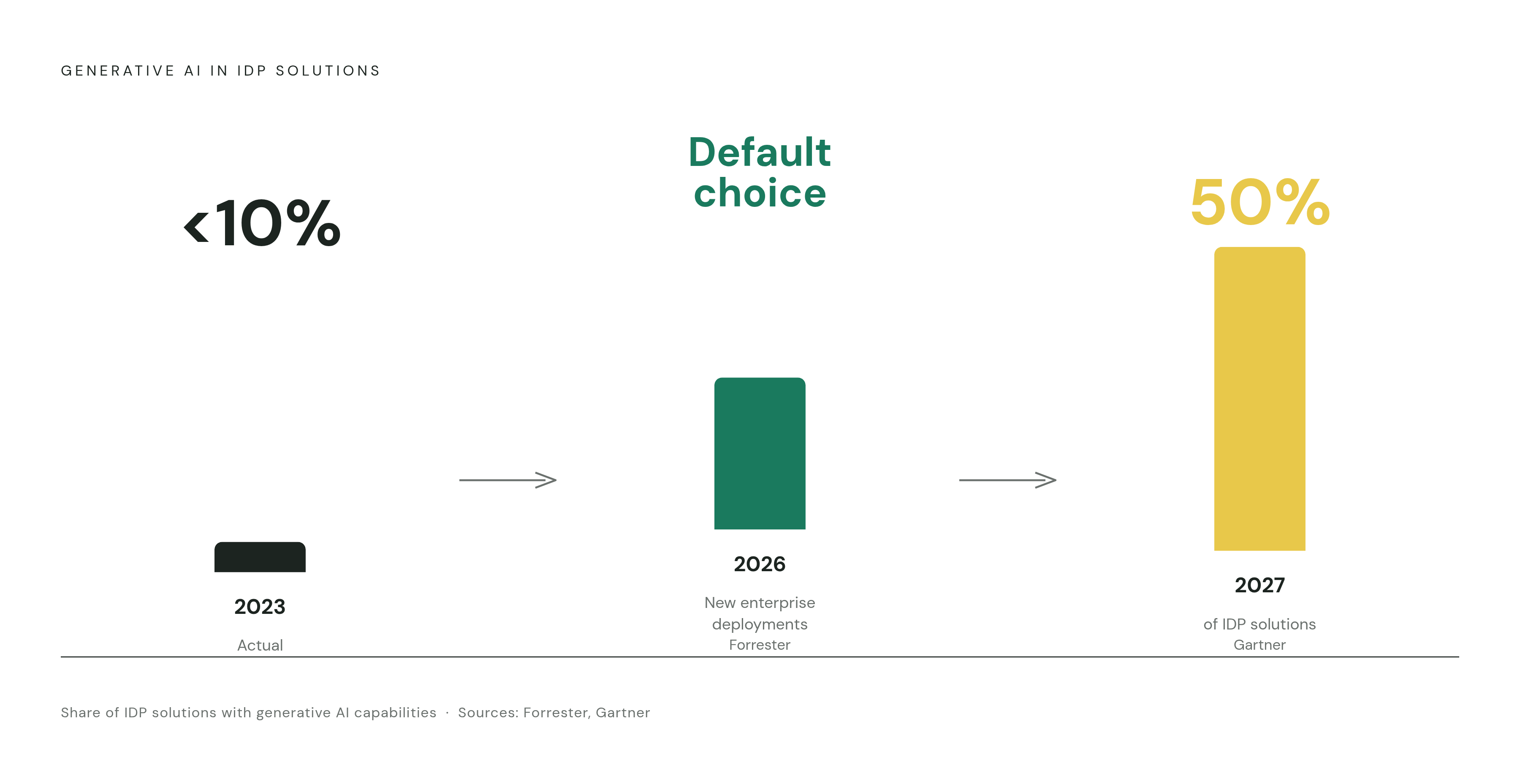
Investment doesn't accelerate just because a market is big. The move from rule-based, template-driven extraction to LLM-enhanced, context-aware pipelines is the underlying technical event that justifies the investment acceleration and changes what buyers must evaluate.
Old-school OCR needed a template for every document layout it touched. Show it an invoice from a vendor it hadn't seen before, or a scanned form with a slight skew and an unfamiliar font, and it broke, or worse, it silently pulled the wrong numbers. It also had no concept of relationships between pieces of information. A table cell could get read correctly and still get filed under the wrong row, because the system never understood it belonged to that row in the first place.
LLM-enhanced IDP works differently, and it onboards faster than the alternative. Gartner's numbers track the same shift: by 2027, half of IDP solutions are expected to carry generative AI capabilities, up from under a tenth in 2023, and GenAI is expected to cut deep into the need for custom-trained document models well before that. Forrester expects GenAI-enhanced IDP to be the default choice for new enterprise deployments by 2026.
None of this happens with one piece of technology. FutureVault lays out the modern stack as a combination of advanced OCR, NLP, machine learning for classification and extraction, computer vision for reading layout, RPA to route what comes out the other end, and LLMs sitting on top of all of it. That last layer is what actually marks the turn. MarketsandMarkets names the specific technologies driving this: OCR paired with named entity recognition, generative AI, LLMs, and vision-language models like LayoutLM and Donut, and it projects that multimodal or mixed-content documents (the ones combining text, tables, and images in one file) will grow faster than any other document type through 2031. Market.us finds about 65% of companies are accelerating IDP projects using Generative AI to improve extraction accuracy, classification, and automation speed.
The architecture is also stretching past extraction itself. Agentic automation is pushing Document AI from just capturing information toward actually running workflows, handling cases, and supporting decisions, and Gartner expects the share of enterprise applications built with task-specific AI agents to jump sharply by 2026 from a small slice in 2025. That trend deserves more room later in this piece, because it changes what "accuracy" even means once a system isn't just reading a document but acting on it.
None of this modernization guarantees reliability on its own. Swapping templates for LLMs solves one set of problems and opens a new one, because LLM-based parsers fail in ways template systems simply couldn't, and that gap is exactly where the next wave of investment scrutiny is aimed. What LLM-enhanced IDP changes. Zero-shot extraction: processing document types the system has never seen, with minimal custom training (per FutureVault's article "The Intelligent Document Processing Revolution," new document type onboarding dropped from weeks to hours and setup costs that previously blocked adoption have collapsed).
Why accuracy accountability became the central investment criterion
The uncomfortable part of the LLM shift is that it made demos look better and made production failures harder to catch. A model can extract flawlessly from a clean sample set in a sales pitch and still fail silently once it hits the messy, high-volume reality of an actual back office, and buyers have caught on. They're no longer satisfied with a benchmark slide; they want proof measured against their own documents.
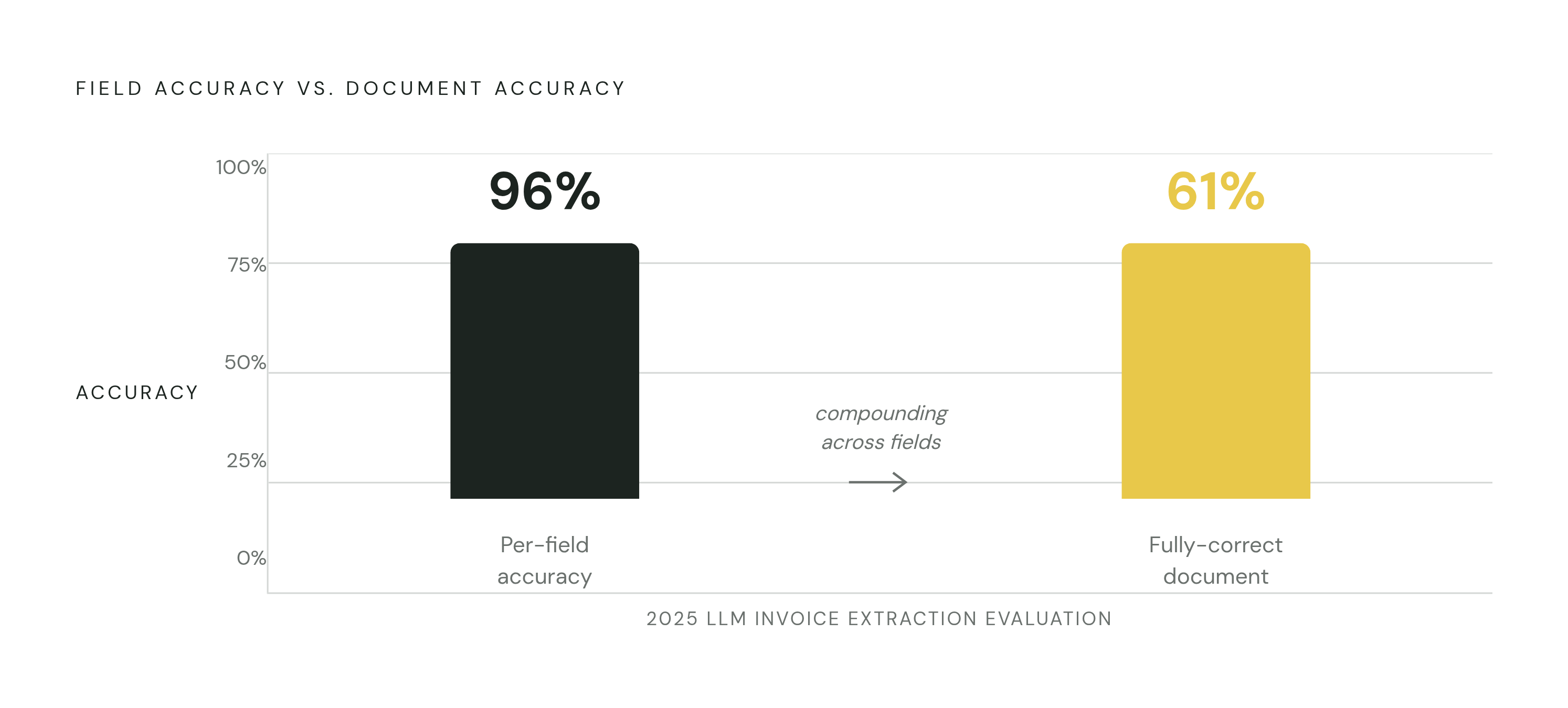
The math behind this leaves no room for error. Vendors love to quote a single accuracy number, and it's almost always a field-level figure, meaning the percentage of individual data points (a date, an amount, a name) extracted correctly. But a document usually has many fields, and a high field-level accuracy rate, once compounded across every field on the page, translates into a much lower rate of documents that are fully, completely correct. A 2025 evaluation of LLM-based invoice extraction found exactly this: strong accuracy field by field, but a meaningfully smaller share of invoices where every single field landed right. That compounding effect is why per-field accuracy against verified ground truth is the only metric worth trusting in production.
LLMs bring their own specific failure patterns on top of that math. Unstructured.io breaks down the gap between a raw model call and something production-ready into three separate layers: prompting tuned to the document's actual structure, post-processing that cleans up the output and catches edge cases, and enforcement that forces the output into a usable structure. Skipping any one of those layers produces a different kind of failure. Research built on the PureDocBench benchmark backs this up with specifics: STEM documents tend to fail on notation, business documents tend to fail on structural integrity, and a chunk of these failures don't show up in average accuracy scores at all. A high leaderboard rank says nothing about whether a system correctly reproduced a complicated document.
The sharper warning comes from a paper accepted at the RobustifAI Workshop at IJCAI-ECAI 2026, which looked at how systems decide whether to trust their own output. Token-level log-probabilities, models describing their own confidence in words, and running the same extraction multiple times to check for consistency all tend to collapse toward saying "yes, this is right" once you push them to a threshold useful in real pipelines, especially in financial reconciliation and compliance checks. That's a serious problem, because a wrong answer that looks confident does more damage than a blank field that obviously needs a human to look at it.
A blunt statistic from Unsiloed.ai reflects the result of all this: less than a tenth of in-house parsing pipelines actually reach production. Edge cases pile up faster than engineering teams can patch them, and the failure modes appear once real volume hits, never visible in the demo.
The fix that's actually working looks less like a smarter model and more like better plumbing around the model. Fields get routed based on confidence: auto-accept, send to a review queue, or route straight to manual entry, and the threshold for auto-accepting shifts depending on the stakes. Financial data earns a stricter bar than something like content aggregation, where a mistake costs almost nothing (implied by threshold-based routing logic, applied per field type). The better systems also adjust those thresholds on their own over time, tightening or loosening based on rolling accuracy windows as more validated data comes in, so calibration improves without someone manually retuning it every quarter. Confidence scores have to trace back to actual pixels on the page, not just a number the model reports about its own certainty, and that standard separates something production-ready from something that's just a good demo.
Investment by Industry Vertical and Document Type
Money is concentrating unevenly across this market, and it should. It's piling up in the places where a document error carries a real regulatory or financial cost, and in the document formats that are hardest to standardize.
BFSI sits at the center of that pile. It holds the largest vertical share of the Document AI market according to both MarketsandMarkets and Market.us, and MarketsandMarkets expects it to keep growing faster than any other vertical through the forecast period. The use cases explain why: KYC and anti-money-laundering checks, loan origination, fraud detection, invoice processing, trade confirmations, SEC filings. These are all places where a missed field or a misread number is not a minor inconvenience; it is a compliance event.
Even inside BFSI, adoption isn't uniform. Accounts payable and corporate finance are furthest along, with most firms at least piloting and plenty running enterprise-wide deployments already. Wealth management and investment management are further behind, and FutureVault points out that's exactly what makes them the highest-value opportunity left on the table: the gap between where the technology could be and where it currently sits is wide, and closing it is worth real money.
Healthcare sits in a structurally similar spot to BFSI, carrying the same weight of compliance obligation and data sensitivity. Accuracy service-level agreements and zero-retention architecture (where a system doesn't keep a copy of sensitive documents after processing them) matter here for the identical reasons they matter in finance.
On the document side, structured formats like invoices and standardized forms led by sheer volume back in 2024. But the growth curve points elsewhere. MarketsandMarkets projects multimodal and mixed-content documents, the ones blending text, tables, charts, and images together, as the fastest-growing category through 2031, which lines up with what companies actually deal with day to day rather than the clean, single-format samples used in early automation pilots. Finance and accounting remains the top use case by overall share per Market.us, while marketing and sales is climbing the fastest by growth rate according to MarketsandMarkets.
Geography follows a fairly predictable pattern too. North America holds the biggest share across every analyst estimate in this space, while Asia Pacific is growing the quickest, with MarketsandMarkets putting that region's rate at 17.1% and Straits Research pegging it even higher. Europe's growth, meanwhile, is being pushed along by a mix of rising demand and compliance rules that are only getting stricter.
Why domain-specific models are outperforming general-purpose extraction
The industry's working consensus heading into 2026 is that pointing one giant general-purpose model at every kind of document doesn't hold up once it hits production. What's winning instead is a system built from specialized components, each one narrow enough to test, monitor, and improve on its own.
There's a clear reason generalist models struggle here. Failure modes differ by domain: research on the PureDocBench benchmark shows STEM documents breaking on notation while business documents break on structural integrity, and a model tuned to handle both reasonably well ends up being truly excellent at neither. MarketsandMarkets points to exactly this pattern driving adoption: domain-adapted models built for BFSI, healthcare, logistics, and other document-heavy industries, rather than one model asked to do everything. The silent failures raised by the IJCAI-ECAI 2026 paper get worse in generalist systems specifically, because their confidence scores are calibrated against a broad, average distribution of documents rather than the particular field patterns found in a financial statement or a medical chart.
Anyformat.ai's 2026 predictions show that purpose-built platforms consistently beat homegrown, do-it-yourself solutions on both accuracy and uptime, and the strongest document processing systems next year are the ones built from components specialized enough to be monitored, tested, and improved separately, rather than as one tangled black box. What separates a real product from a glorified OCR wrapper is whether it learns. Systems that improve from human corrections over time close the gap between how well they perform in a demo and how well they perform once real volume and real edge cases start hitting them.
This also explains something counterintuitive about how these deals get won. The AIIM 2025 survey found that two-thirds of new IDP projects replace an existing system rather than starting from scratch. That means the real test isn't whether a vendor can process a document reasonably well in isolation. It's whether the new system can beat the incumbent on the customer's own documents, with all their quirks and edge cases already known. Domain specialization is what makes that possible.
Human oversight isn't going away either, and MarketsandMarkets treats that explicitly as a market-wide trend rather than a stopgap: human-in-the-loop approaches, pairing automated extraction with expert review, are advancing across the market as a way to strengthen accuracy, oversight, and accountability all at once. Gartner, meanwhile, expects a substantial share of agentic AI projects to get canceled by the end of 2027, done in by rising costs, unclear payoff, or weak risk controls. The projects still standing after that shakeout won't be the ones with the flashiest automation pitch. They'll be the ones that can show measurable accuracy and a validation loop that actually catches mistakes before they become expensive ones.