Document Parsing API Pricing Models Compared
Comparing vendors by headline rate masks hidden costs in modes, credits, and complexity.
Document parsing APIs get sold on one number: price per page. That number hides more than it tells you. Two vendors quoting the same rate can produce wildly different bills once mode selection, credit conversion, and failure rates enter the picture, and a team that prices its pipeline off the sticker figure alone will misjudge the real cost by four times or more before a single document reaches production.
Comparing document APIs by cost per page feels like the obvious move. It's the number vendors print on the pricing page, and it drops neatly into a spreadsheet next to a competitor's. But "per page" almost never means one fixed thing. It shifts by mode, by document complexity, by which features come bundled in, and by whether the vendor bills in pages, credits, or API requests.
Take a credit-based system where the spread between modes runs 45 times over, from the cheapest tier to the most capable one. A team that defaults to the wrong mode, or picks one mode at setup and never revisits it, doesn't overpay by a little. It overpays by an order of magnitude, and nothing on the invoice flags the mistake. The same distortion appears inside a single vendor's own product line, where one lightweight parse mode runs a fraction of a cent per page and a higher-end mode, billed through the identical credit system, costs several times more. Same API, same company, same billing unit. The mode selected is the only variable, and that choice usually gets made once, early, by whoever wired up the integration, and never gets revisited as the document mix shifts underneath it.
The wrong lesson to take from any of this is that a lower headline rate signals a cheaper pipeline. The wrong lesson to take from any of this is that a lower headline rate signals a cheaper pipeline, but it doesn't work that way. The headline rate tells you almost nothing until you know which mode a team will actually run in production, and that's a decision made by an engineer months before anyone looks at a bill.
How the 2026 market is structured
The market splits into four distinct camps, and none of them sell quite the same product. Lining up their per-page rates side by side is a category error, not a shortcut.
Agentic document platforms run a full pipeline: parsing, extraction, classification, and document splitting, priced by document complexity and which mode handles it. RAG-ecosystem parsers optimize for a narrower job, feeding clean, chunked text into retrieval pipelines, and price in credit or page tiers built around that one use case. OCR specialists narrow the scope further still: fast text and character recognition across many languages, usually billed per page or per image, with no extraction or classification layer stacked on top. Then there are open-source parsing engines that offer a managed tier alongside the free, self-hosted version, where the real pricing question has little to do with the rate card and everything to do with an organization choosing to run the infrastructure itself or pay someone else to carry that weight.
Sitting outside all four camps are the cloud platform defaults, the document intelligence products bundled into the major cloud providers' AI services. These get priced per page and per feature, tightly bound to whatever cloud spend a company already has, convenient but not comparable on rate alone.
Cohere Parse, priced at $1.50 per 1,000 pages, is available through the Cohere API, Model Vault, Microsoft Foundry, and AWS SageMaker. It positions itself as the low-cost, managed option, and on the headline number, it is. Whether that number tells the whole story is a separate question that matters through the rest of this piece.
Setting an OCR specialist's per-page rate next to an agentic platform's rate is comparing the cost of scanning a document to the cost of scanning it, classifying it, extracting structured fields from it, and validating those fields against a schema. Those are not the same task. Treating a rate-card comparison as a substitute for scoping the actual job is how procurement decisions go wrong before a document ever gets processed, and it happens more often than any vendor's pricing page would suggest.
The published per-page rates and their inclusions
The published numbers, gathered from vendor documentation, look like this. Cohere Parse: $1.50 per 1,000 pages. Mistral's Document AI OCR runs $4 per 1,000 pages, with the fuller Document AI product at $5 per 1,000; a $1-per-1,000 figure still floats around in some comparisons, but that belongs to a deprecated 2025 model, so confirm the current version before quoting it. Mathpix prices PDFs at roughly half a cent a page, with a lower rate at high volume, but Mathpix converts content rather than extracting it against a schema. A separate extraction step is required to get structured output.
AWS Textract lists $10.00 per 1,000 pages as its base OCR rate, with separate per-page pricing for specialized endpoints like expense, lending, and ID document processing, each bundling OCR in rather than stacking it on top of the base fee. Google's Document AI invoice parser quotes $0.10, but that figure is not the total cost of using the product. Actual spend scales with document layout complexity, how Google rounds processing into billable blocks, and what other GCP services sit around the call, and a human review step may also be added.
On the extraction-and-parsing side: one platform's light parse mode runs about half a cent per page, its performance mode several times that. Another vendor's older credit model priced pay-as-you-go at $0.015 per credit, with standard parsing consuming roughly one to two credits per page and agentic enhancement costing more, though that legacy model has since been retired in favor of revised pricing. A retrieval-focused parsing tool offers a free tier before moving to pay-as-you-go, and its scope is document partitioning, enrichment, and connector integration rather than agentic extraction, so its rate isn't pricing the same job as the extraction-focused platforms. One extraction engine vendor sells credit packs starting at $250 a month in the US. The open-source engine at the center of the managed-tier camp runs free under its MIT license, with a managed enterprise tier priced around $4 per 1,000 pages.
Schema-bound extraction gets sold as a distinct product from general-purpose parsing, even inside a single vendor's own lineup. Pricing the parsing tier and assuming that number covers a full structured-extraction workflow is a common and expensive miscalculation, and it's the single easiest way to blow a budget that looked conservative on paper.
Every number above carries the same caveat: confirm the current mode, plan, region, and minimum commitment before treating any of it as a basis for comparison. Pricing changes, product scope changes, and a rate quoted today can shift within a quarter. The range on offer here, from a fraction of a cent to several dollars per page, looks decisive enough to make a call on, but it isn't decisive.
Billing mechanics that turn a simple rate into a variable bill
Credit systems are where a clean per-page rate stops being clean. The billing unit, the credit, rarely converts to a page at a fixed 1:1 ratio, and that conversion rate is often where the real cost hides.
Mode selection is the single biggest multiplier in the pricing structure. A team that routes every document, simple or complex, through the most capable and most expensive mode by default pays a multiple of what a properly routed pipeline would cost, simply because nobody built the logic to send easy pages to a lighter, cheaper mode. That's the default state of most pipelines the day they ship, and it stays that way until someone notices the bill.
Feature add-ons compound the problem. Citations and bounding boxes, the metadata that tells a downstream system exactly where on the page a piece of text came from, aren't always folded into the base parse rate; some vendors charge for them separately. Chunking and retrieval enrichment, the preprocessing that makes parsed text usable in a retrieval-augmented pipeline, gets billed apart from raw parsing at several providers. Processing lane matters too: one vendor's batch queue, built for workloads that aren't latency-sensitive, offers a 20% discount against a 12-hour processing guarantee, which saves money for teams that don't need results back in seconds.
Google's Document AI pricing gets described in vendor comparisons as genuinely difficult to forecast, and that's a fair read. Rates vary by which processor handles the document and by request volume, so estimating a real bill means modeling the specific configuration a workload will actually use, not reading the rate card once and extrapolating from it.
Failure rates and the costs beyond the per-page charge
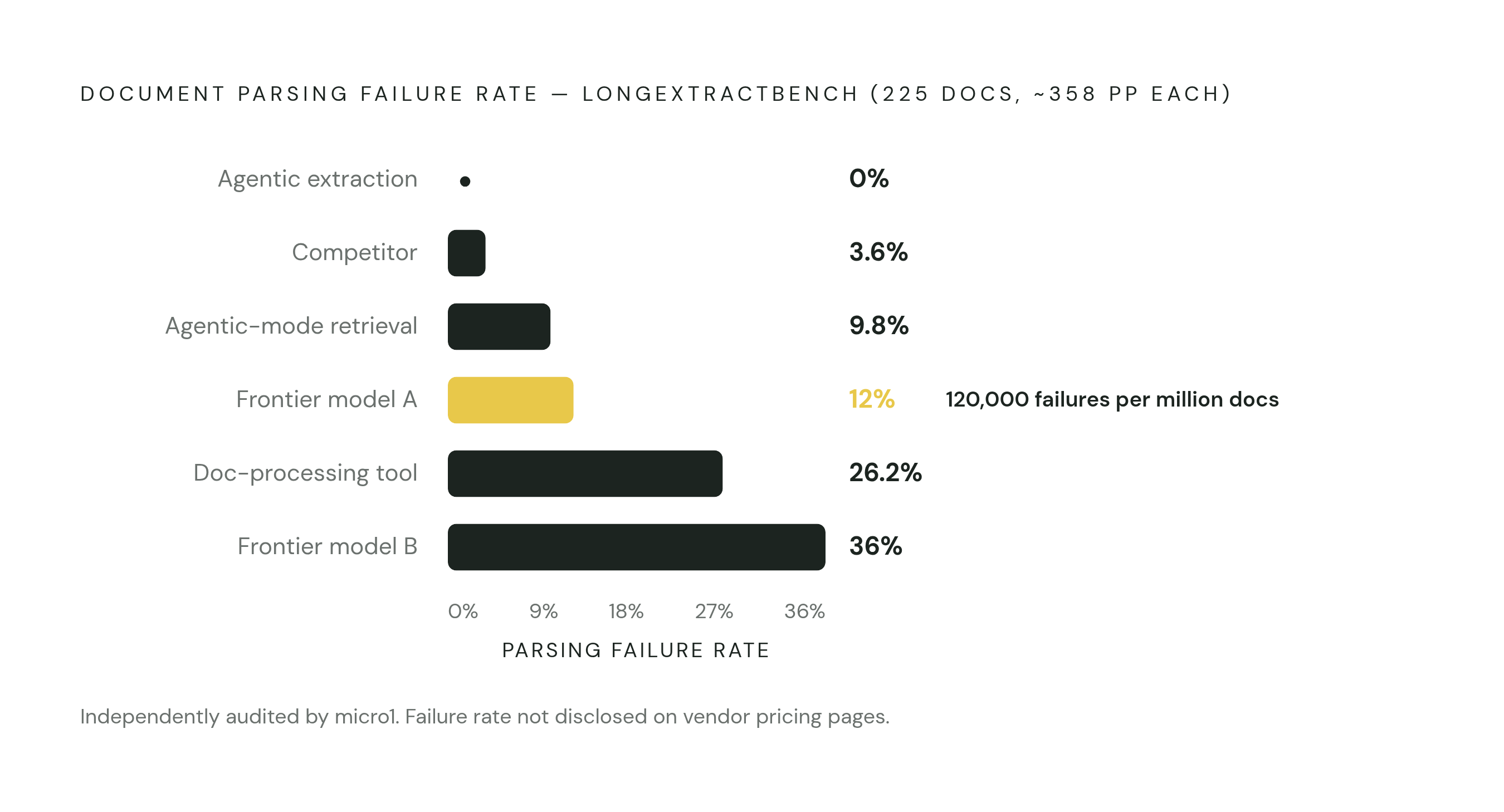
None of the arithmetic above accounts for what happens when a parse simply fails. That's where the LongExtractBench results matter: 225 documents, averaging roughly 358 pages each, commissioned by one vendor but independently audited and published by micro1. The spread in failure rates across the tools tested is the widest number in this piece, and the one most absent from any pricing page.
One agentic extraction tool completed all 225 documents with zero failures, hitting 99.6% recall and precision. Others didn't fare as well: 3.6% failure for one competitor, 9.8% for an agentic-mode retrieval parser, 12.0% for one frontier model tested in the benchmark. Further down the list, failure climbs into the double digits fast: 26.2% for one document-processing tool, 36.0% for another frontier model tested in the benchmark.
Run the arithmetic at scale. A 12.0% failure rate across a million documents means 120,000 documents landing in a retry queue or a human review pile. Retry charges, engineering hours spent triaging what went wrong, human review labor, and, for any workflow bound by a service-level agreement, latency penalties on top of all of it. None of that appears as a line item on any per-page price sheet.
Sending long, raw documents straight to a frontier language model, with no dedicated parsing and extraction layer in front of it, produced the highest failure rates measured. Sending long, raw documents straight to a frontier language model, with no dedicated parsing and extraction layer in front of it, produced the highest failure rates measured, and that is not an edge case to footnote. Skipping the parsing step is the baseline risk, and the numbers above are what that risk looks like once it lands on a real document set.
Accuracy gaps and the operational cost they create beyond the invoice
Two different things get called "accuracy" in this space, and conflating them is a common mistake. Parsing accuracy asks whether the output preserves the document's structure: reading order, table layout, section boundaries. Extraction accuracy asks a narrower question, whether the specific field values returned match what a defined schema expects. A tool can excel at one and lag badly at the other.
On the published benchmarks, one vendor's performance-tier parser hit 95.7% field-level accuracy on document question-answering tasks in the RealDoc-Bench evaluation, with a layout-adjusted F1 score of 0.847, published and independently reproducible since the underlying benchmark is open source. A competing agentic tool scored 91.1% on the same field-level Q&A task, while separately posting 99.6% recall and precision on LongExtractBench, a different benchmark measuring a different kind of task, so the two figures don't line up against each other directly.
Separately, academic research on extraction accuracy against NOAA data, a study covering 200 documents, found that a cheaper model reached 94.72% average field-level accuracy at half a cent per document, while a pricier model hit 96.33% at roughly five cents per document. That's ten times the cost for a gain of about a percentage and a half, and on most workloads, that trade doesn't clear. Pay for the expensive model anyway and you're buying a rounding error at a ten-fold markup.
A gap of a few percentage points, the distance between 95.7% and 91.1% in the field-level benchmarks above, reads as small on a slide. At scale, it isn't. Across a few hundred thousand documents, that gap turns into thousands of fields coming back wrong, each one needing correction, reprocessing, or a downstream fix that costs far more than the per-page rate that produced it. On open-source parsing paths especially, these regressions can become visible downstream only after failures pile up, without a dedicated confidence scoring or monitoring layer to catch the problem earlier.
Confidence scoring and routing thresholds as a cost-control mechanism
Confidence scoring sits between the extraction step and whatever happens next. A field that scores below a set threshold gets routed to a human reviewer instead of flowing straight into a downstream system unchecked, and that single routing decision does more for cost control than almost anything else in the pipeline.
The EXTRACTCONF research benchmark makes the case with numbers. At 80% coverage, where 80% of fields get automated and the rest route to review, a multi-signal confidence engine reached 99.1% accuracy on the automated portion, a 25.8 percentage-point jump over the 73.3% baseline achieved with no routing. The area-under-risk-coverage curve, a standard way of measuring how well confidence scores track actual errors, came in at 0.042, confirming the signal tracked real risk rather than noise.
Where the threshold gets set should depend on what the field controls, not on a single number applied uniformly across a schema. Financial fields, invoice totals, payment amounts, account numbers, deserve a threshold of 0.90 or higher, because a wrong number carries a direct dollar cost. Informational fields, like content metadata or article authorship, can tolerate a looser threshold in the 0.75 to 0.85 range, since getting an author's name wrong doesn't ripple downstream the same way.
Field type also affects how much the confidence score itself can be trusted. Numeric fields tend to be well-calibrated: a high confidence score reliably predicts a correct value. Free-text fields behave differently. They show a pattern of overconfidence at high predicted probabilities, so a model can report high confidence on a free-text field and still be wrong more often than that number implies. A uniform cutoff applied across an entire schema misses this distinction. Routing logic built to vary by field type is where the research attention in this space is currently concentrated.
The true cost of building and operating your own parsing pipeline
The alternative to paying any vendor's rate, per-page or otherwise, is building the pipeline in-house. That path carries its own price tag, and it's rarely the one teams budget for at the start.
Fewer than 10% of in-house parsing pipelines reach production. Fewer than 10% of in-house parsing pipelines reach production, and that failure rate alone is a cost signal to weigh before committing engineering time to the build. For the pipelines that do get built and maintained, infrastructure runs $15,000 to $40,000 a year in compute, storage, and data egress alone, before a single hour of engineering labor gets counted.
Labor is where the estimate usually breaks down. Maintaining parser dependencies, resolving library version conflicts, and writing custom logic for every new edge case a document throws at the pipeline consumes 20% to 30% of an engineer's working hours every quarter, a recurring drain most budgets never plan for. That's not a one-time setup tax. It recurs, quarter after quarter, for as long as the pipeline stays in production, and most budgets only account for it once, at the start, when the real cost is in the renewal that nobody modeled.
Open-source parsing tools, whatever they save on licensing, ship with no production monitoring and no confidence scoring built in. Accuracy regressions don't announce themselves. These failures surface only after downstream problems have piled up and a real workflow has already been touched by them, so the cost of catching the issue late lands on top of everything already spent building and running the system.