IDP Vendor Selection Criteria for Regulated Industries
Field-level accuracy matters far more than vendor benchmarks in regulated document processing.

Selecting an intelligent document processing vendor for a regulated industry is an engineering evaluation. It's an engineering evaluation that demands measurable accuracy commitments, field-level validation, provable data security, and contractual accountability, because the cost of a wrong choice compounds through errors, compliance failures, and replacement projects. Most buyers still miss the core distinction that makes this true: OCR converts pixels to text, while IDP layers classification, structured extraction, field-level validation, and human-review routing on top of that raw conversion. Score a vendor on OCR metrics alone, and the evaluation will systematically underestimate what the system actually needs to do in production.
The stakes scale with the industry. A wrong extraction in accounts payable produces a correction and maybe an annoyed vendor waiting on payment. A wrong extraction in mortgage lending, insurance claims processing, or a healthcare record can turn into a compliance failure, an audit finding, or a re-processing project that costs far more than the original implementation.
Most vendor evaluations run on features that vendors self-report: demo accuracy on clean documents, claimed certifications, announced integrations. None of it predicts production behavior on the messy, inconsistent document corpus a regulated organization actually processes day to day. The evaluation that matters answers three different failure modes (merged labels, missing sections, and broken line breaks) that appeared in the first three documents from a real client folder, not in edge cases discovered weeks later. Can accuracy be verified per field against ground truth, rather than trusted as an aggregate benchmark score? Who absorbs the cost when an extraction error slips downstream, contractually and financially? And does the deployment model actually satisfy the data sovereignty rules the organization has to live under, rather than the vendor's default cloud offering?
What follows works through each of those gates in sequence: where parsing breaks in production, how to measure accuracy before signing anything, how confidence scoring and routing architecture actually behave under load, where security and deployment become non-negotiable, what building your own pipeline really costs, and how the current vendor landscape breaks down across deployment model, benchmark performance, and price.
Production document parsing failure despite misleadingly high demo accuracy
Dense tables and multi-column layouts are where naive extraction breaks first. OCR reads a page cell by cell with no concept of how a row relates to its header, so a number comes out of the pipeline with no context attached to it, just a value floating free of the label that gave it meaning. Scanned pages with embedded fonts or image-layer PDFs cause a different failure: the parser returns text that looks clean on the surface, but field labels have merged into the values themselves, or entire sections of a form have dropped out silently, with no error thrown to flag it. Tables and sentences that span a page break introduce a third failure mode, producing line-break artifacts that shatter whatever regex or NLP logic sits downstream. None of these are rare. One practitioner account describes all three failure modes appearing in the first three documents pulled from a real client folder, as the default behavior of the very first files tested rather than as edge cases discovered weeks into a rollout.
Large language models layered into agentic OCR pipelines introduce their own failure modes on top of the structural ones. Production experience with agentic OCR has traced repetition loops and recitation errors back to root causes that are structurally distinct from classic OCR failures. The fixes for one don't transfer to the other. Research presented at EXTRACTCONF found something more unsettling still: a frontier model reading degraded source material generates high-confidence tokens describing OCR noise as if it were real content, an error caused by the document, not the model. The model is confidently interpreting garbage as signal. It's confidently interpreting garbage as signal.
Benchmark work on PureDocBench adds a further wrinkle: failure modes are domain-specific. Finance and certificate documents show annotation contamination, loss of formula semantics, and failure to recognize seals, and a vendor's overall leaderboard rank says nothing about whether it can correctly reproduce a specific complex document type your organization actually processes. Vendors demo against clean, well-formatted documents because that's what makes a demo look good. Regulated industries process low-resolution scans, multi-column claim forms, and tables that break across page boundaries, which is exactly the category of document that breaks parsers. Knowing where the breakage happens is the prerequisite for knowing how to test for it, which is the next question a buyer has to answer before any contract gets signed.
How to measure extraction accuracy before signing a contract
The cardinal rule of vendor evaluation is simple to state and consistently skipped in practice: build the test corpus from actual production documents, including every edge case already known to exist, low-resolution scans, multi-column layouts, page-spanning tables, embedded fonts, and document types where extraction has already proven error-prone. A minimum viable test corpus pulls 50 to 100 documents from the real production pipeline, and testing only against clean, well-formatted samples guarantees an unpleasant surprise once the system goes live Best IDP Software in 2026: Platforms, Approaches, and Trade-Offs.
Before running that test, define what correctness even means. Is a field correct if the value matches but confidence came back low? Does a table extraction fail only when a whole row goes missing, or does a single wrong cell count against it? Leave this ambiguous and vendor comparisons stop meaning anything, because two vendors can post identical-looking scores against entirely different definitions of a pass Best IDP Software in 2026: Platforms, Approaches, and Trade-Offs.
Aggregate document accuracy hides more than it reveals. A 2025 study evaluated field-level extraction across a manually reviewed sample of 200 records, checked independently by two human experts, with a margin of error of plus or minus 4 percent at 90 percent confidence Best IDP Software in 2026: Platforms, Approaches, and Trade-Offs. Field-level accuracy in that study ranged from 87.94 percent on a field called Season up to a full 100 percent on Year and State, averaging 94.72 percent overall Best IDP Software in 2026: Platforms, Approaches, and Trade-Offs. That spread, inside a single model on a single workload, is the whole argument against trusting an aggregate score: the fields that matter most to a regulated workflow are frequently the ones sitting at the bottom of that range, not the top.
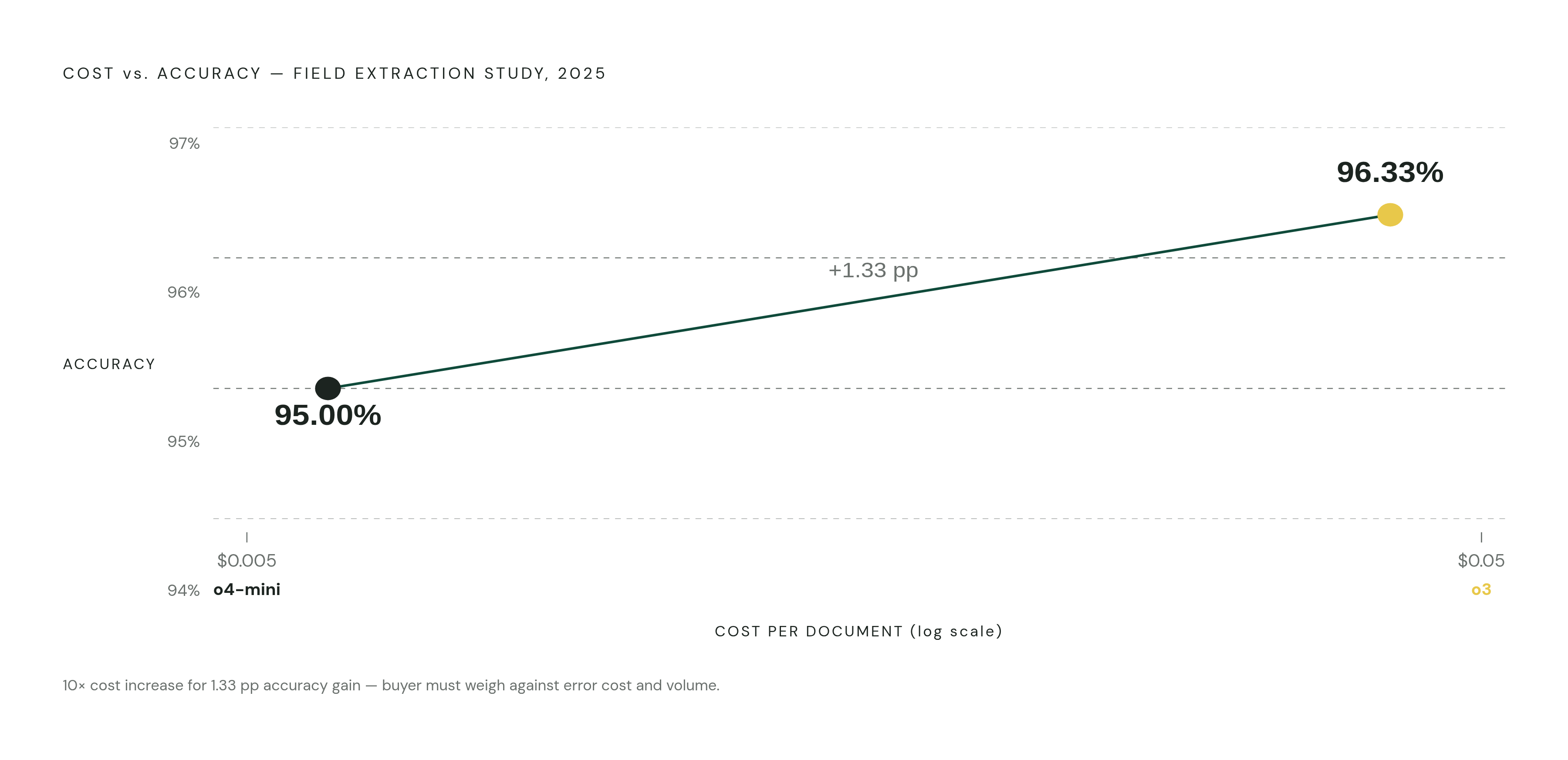
Cost and accuracy trade off against each other in ways that deserve explicit modeling rather than assumption. In the same study, a smaller model, o4-mini, hit 95.00 percent accuracy at roughly $0.005 per document, while a larger model, o3, reached 96.33 percent at roughly $0.05 per document, an order of magnitude more expensive for a modest accuracy gain Best IDP Software in 2026: Platforms, Approaches, and Trade-Offs. Whether that trade is worth making depends entirely on volume and on what an error actually costs downstream, a calculation every regulated buyer needs to run against its own numbers rather than accept on a vendor's recommendation. What to demand from any vendor, at minimum: field-level accuracy reports measured against ground truth, not aggregate benchmark claims, plus a clear account of which document types and field types were in scope for any published benchmark, and whether complex tables and scanned pages were actually included or quietly excluded.
Confidence scoring, routing architecture, and the calibration problem vendors don't advertise
A well-designed extraction pipeline scores every field for confidence and routes accordingly. Fields above a set threshold flow straight into downstream systems; fields below it land in a human review queue before touching any business workflow. That threshold is a dial, not a fixed setting, and moving it in either direction changes outcomes directly: raise it and automated output gets more accurate but more documents land on a human's desk; lower it and automation rate climbs while extraction errors slip through more often. Regulated industries need to set that dial on purpose, with a documented rationale, not accept whatever the vendor ships as a default.
Calibration itself is the harder problem, and it's the part vendors tend not to advertise. Research on ConfBench in 2026 found that existing document benchmarks concentrate heavily on clean, high-quality documents, leaving the low- and mid-accuracy range too sparse to properly assess calibration. A vendor's published confidence numbers may be accurate only for the narrow band of document quality its benchmark happened to cover, which is rarely the full range of documents a regulated buyer actually processes.
Field type compounds the problem. EXTRACTCONF research from 2026 found that at 80 percent coverage, a system achieved 99.1 percent automated accuracy, a 25.8 percentage point jump over the 73.3 percent base rate, though numeric fields were well-calibrated while free-text fields showed overconfidence at high predicted probabilities. That gap matters most where it hurts most. A system reporting high confidence on free-text fields can be systematically wrong precisely on the fields that carry the most weight in a regulated document, clinical notes, claim narratives, contract language. Newer research from 2026 has started building tools to address this directly, proposing validity ladders and per-field selective risk control with explicit selective-risk reporting as an alternative to a single, uncalibrated logprob standing in for confidence. Buyers evaluating a serious vendor should ask, point blank: does confidence scoring run per field or per document? Is calibration assessed separately for numeric versus free-text fields? And what's the false-confidence rate on the actual document types this organization processes, not the vendor's benchmark set?
Data security and deployment model: where compliance requirements become non-negotiable constraints
Cloud IDP means uploading documents to a third party's servers for processing. That step alone hands over direct control of the data, and it can create a data residency conflict under GDPR depending on where those servers sit, while making the buyer dependent on a vendor's security posture rather than its own. None of that shifts liability. The data controller stays responsible for a breach regardless of what certifications the vendor holds.
On-premise deployment is the sovereignty baseline against which everything else gets measured. All processing happens behind the organization's own firewall, and it's the only viable option where the environment is air-gapped; auditors can verify security controls inside a single, company-owned environment rather than tracing a chain of custody through a third party. According to an analysis published by Apryse, this simplifies compliance with HIPAA, GDPR, and financial services mandates directly, rather than requiring the buyer to inherit a vendor's compliance posture wholesale.
Holding a certification is not the same as deleting the data afterward. Zero data retention has to be verified as its own explicit requirement, not inferred from a SOC 2 badge, because a vendor can pass SOC 2 audits and still retain processed documents indefinitely unless zero-retention processing is confirmed in writing. Check what tier actually buys that guarantee. Compliance features get tier-gated across this market often enough that a buyer can assume HIPAA support is included and discover, mid-negotiation, that it sits behind an Enterprise price point.
The right deployment model isn't a matter of preference so much as fit. Options run from cloud SaaS through customer VPC, on-premise, and fully air-gapped, and the correct choice depends on data residency law, internal security policy, and the organization's ability to operate that infrastructure reliably once it's live. A vendor's default offering is a starting point for negotiation. SOC 2 Type II. ISO 27001.
Build vs. buy: the true engineering cost of a self-hosted parsing pipeline
Building an in-house parsing pipeline sounds like control. In practice, fewer than 10 percent of in-house parsing pipelines ever reach production, because edge cases compound faster than a team can patch them. The ones that don't fail still carry costs that open-source licensing tends to obscure.
Self-hosted parsing workloads typically run $15,000 to $40,000 a year even at modest scale. Maintaining dependencies, resolving version conflicts, and writing custom logic for each new edge case consumes 20 to 30 percent of an engineer's working hours every quarter. One practitioner estimate puts the opportunity cost in stark terms: a company spending roughly €400,000 on an internal solution over six months could have shipped two product features in that same window instead. Most teams cross over to where a production API subscription costs less than the engineering overhead of self-hosting before the first year is even out.
Self-hosting is still the right call in a narrower set of circumstances. Where regulation flatly prohibits cloud processing, or the environment is air-gapped and no external API call is permissible at all, building in-house isn't a choice, it's the only path available. Even then, the system only works if enough engineering maturity exists to operate, monitor, and maintain it reliably over time, and without that maturity, the hidden maintenance cost outweighs whatever control benefit justified the build.
The architecture of the field is shifting too. Predictions for 2026 point away from the "throw everything at one AI model" approach and toward systems built from specialized components, each monitored and tested independently, because a single model failing under that older architecture takes the whole pipeline down with it. Purpose-built platforms have consistently outperformed DIY builds on both accuracy and uptime under that same analysis. Build-versus-buy, in the end, comes down to a total cost of ownership calculation. It's a total cost of ownership calculation, and a complete one has to include engineering time, the audit burden compliance adds, and the cost of extraction errors that reach downstream systems undetected.
The vendor landscape in 2026: deployment models, accuracy benchmarks, and pricing across the main platforms
As of one verification pass dated July 16, 2026, the market has split into two distinct shapes. Suite platforms sell capture, classification, workflow, and human-in-the-loop review as one bundled system, aimed at operations teams. Agentic document platforms are API-first and LLM-native, built to feed AI systems and software pipelines directly, aimed at engineering teams.
Two suite platforms illustrate the operations-first end of that split Best IDP Software in 2026: Platforms, Approaches, and Trade-Offs. ABBYY runs Vantage as its flagship offering while still selling FlexiCapture and a Document AI API, deployed either in the cloud or self-hosted. It carries deep OCR pedigree and a marketplace of pre-trained skills as its notable strength, though it publishes no pricing, so budgeting requires a full sales cycle before a number materializes. Hyperscience runs Hypercell across SaaS, private cloud, on-premise, and air-gapped deployments, and carries FedRAMP High certification, making it the strongest government deployment story among the platforms covered here. Human-in-the-loop throughput scales with review staffing, so capacity planning has to account for this.
On the agentic side, one platform's Parse, Extract, Classify, Split, and Edit APIs, paired with a Studio interface, publish pricing openly: $150 in free usage to start, then $10 per 1,000 pages for its r-1 Parse tier, with a 20 percent discount on batch jobs and a 12-hour completion guarantee attached. It runs across cloud, customer VPC, and on-premise deployment, holds SOC 2 Type I and II certification, and offers HIPAA with a signed BAA plus zero data retention on its Growth and Enterprise tiers, with custom MSAs, SLAs, and SSO/SAML added at Enterprise. On benchmark performance, it ranks first on LongExtractBench with 99.6 percent recall and precision and zero failures across 225 long documents, and posts 90.2 percent accuracy on complex tables under its own RD-TableBench testing. It covers more than 100 languages including mixed-language documents, over 30 file types, and handwriting through agentic OCR modes, with more than 4 billion pages processed to date. Every extracted value can carry a bounding-box citation back to its page, coordinates, and table cell, which matters directly for audit trails in a regulated environment where an examiner may ask exactly where a number came from.
Rossum, running its Aurora T-LLM engine, was acquired by Coupa in an announcement made in May 2026. That acquisition folds Rossum's roadmap into Coupa's broader spend-management strategy, and any organization considering it as a standalone accounts-payable tool should weigh that shift before signing a multi-year contract, since the product's future direction now answers to a different set of priorities than it did as an independent company.
No single platform wins across every axis: deployment flexibility, benchmark accuracy, pricing transparency, and compliance depth trade against each other differently across the field. The evaluation gates laid out above, measurable field-level accuracy, calibrated confidence routing, verifiable data security, and an honest build-versus-buy calculation, are what turn that landscape into a defensible shortlist rather than a features comparison chart. Platforms covered (all facts from the Reducto source and the Infrrd vendor guide).
Sources
- IDP Vendor Guide: Exploring the Top Intelligent Document Processing Vendors
- On-Premise IDP vs Cloud IDP: Choosing the Right Approach for Regulated Industries | Apryse
- IDP Software Vendors Directory
- Every Way to Build a Document Parser: Costs, Trade-offs, and What We Chose | by Belaun | Mar, 2026 | Medium