Total Cost of Ownership When Migrating an Extraction Pipeline From Azure Document Intelligence to a Predictable Per-Document Model
Silent failures and infrastructure costs often exceed Azure's per-page extraction fees.
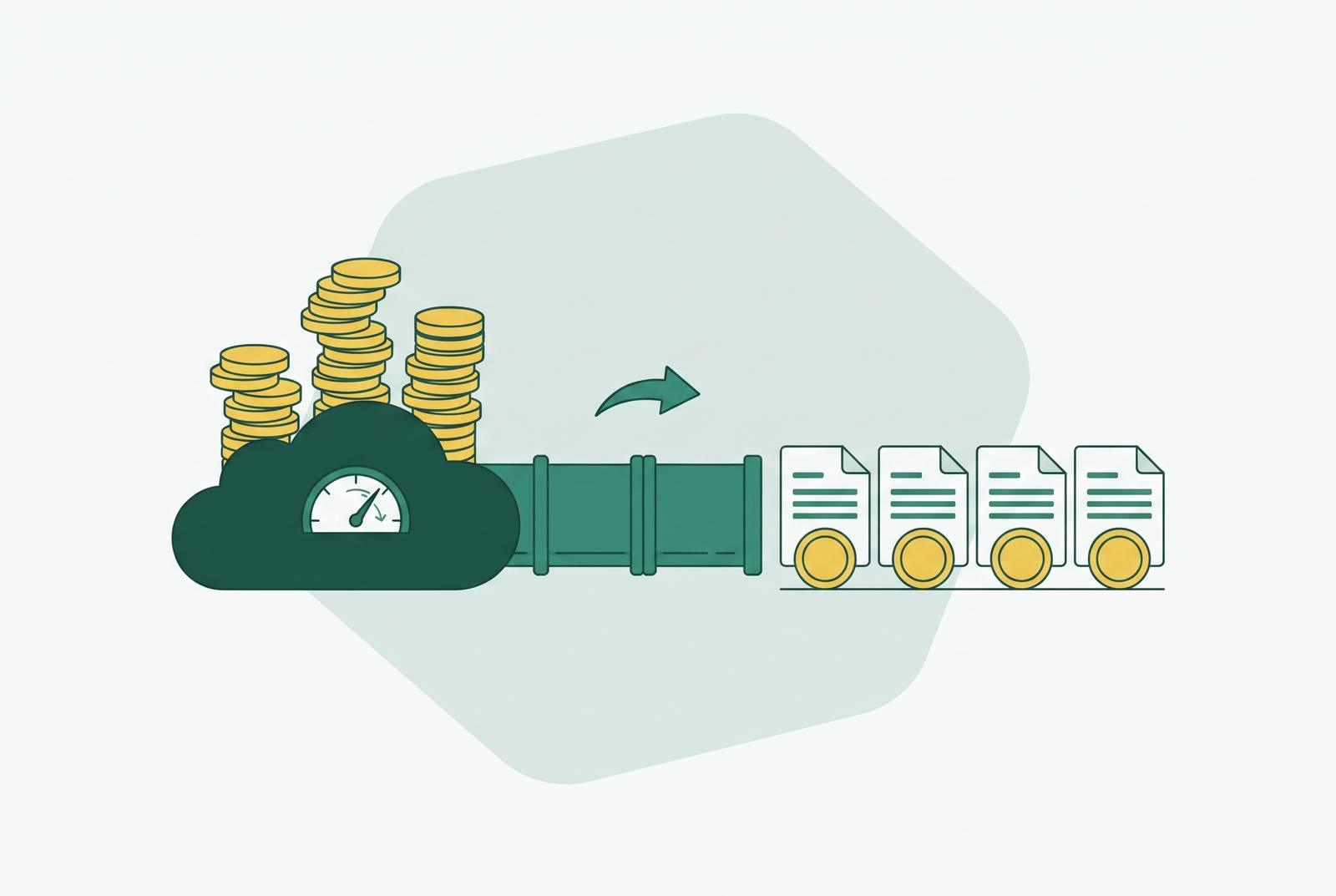
Migrating from Azure Document Intelligence to a predictable per-document model is a total-cost decision. A price tied to correctly processed documents makes spending measurable only when those surrounding costs genuinely move to the vendor.
What Azure Document Intelligence actually charges per page, and why the rate card understates the bill
Azure Document Intelligence charges per page by model tier. The model calls can stack. In the scanned-invoice example in the notes, Prebuilt, Layout, and the high-resolution add-on total $26 per thousand pages for line-item extraction and low-quality scan reading. That is the inference charge before application code, storage, or review. A budget based on one tier therefore does not describe the cost of a workflow that calls several.
Azure analyzes every page submitted unless the caller explicitly passes a page range. An invoice with attached terms and conditions can therefore incur charges for the attachments as well as the invoice itself. The billing unit is the submitted page. Pipelines that do not strip trailing pages or select a range must account for that full count.
The free F0 tier also limits what a trial can establish. It reads only the first two pages of a request and caps files at 4 MB, so it cannot evaluate a realistic multipage workflow beyond those limits. That evaluation requires the paid S0 tier. Pricing also varies by region, currency, and agreement. Within those terms, the three pricing levers are which model is called, how many pages are sent, and whether the service runs in Azure’s cloud or in a container.
Why the legacy Form Recognizer meter and the custom tier’s model generation are two hidden traps for migrating teams
A product migration does not necessarily mean a billing-meter migration. Teams moving from Form Recognizer may still be charged against a legacy custom meter at a substantially higher rate than the current custom extraction rate of $30 per thousand pages. The product name is not enough to establish the charge. The audit action is to inspect the actual meter name on the invoice and establish which custom extraction rate applies.
Microsoft’s transparency note says that custom models now use GPT-3.5, which is an older model generation. Teams with documents outside the roughly 20+ prebuilt types can therefore end up paying for the most expensive extraction tier and doing the labeling work too. Price does not identify model generation. When assessing a migration, teams need to check the model-generation note as well as the meter.
Commitment tiers do not remove either issue. The smallest prebuilt commitment saves only a little per thousand pages, so it takes enough pages over time to cost less than pay-as-you-go. Unused capacity weakens that saving. Overage is billed at the commitment rate, which stays the same as usage grows. A commitment can change the unit price, but it does not change which services the pipeline needs around extraction.
The infrastructure costs that sit outside the API bill entirely
The Document Intelligence API charge pays only for model inference. A production pipeline still needs document staging, request orchestration, queue and retry handling, and a way to route uncertain results for review. Those functions sit outside the extraction meter. In a customer-built Azure architecture, Blob Storage handles staging, while Logic Apps, Azure Functions, or custom services manage the request lifecycle. Their costs appear separately, even though extraction depends on them.
The asynchronous request pattern also creates work beyond submitting a document. Multipage requests need polling for completion, and failed or timed-out requests need to be requeued. Results then need post-extraction validation. Low-confidence fields must be flagged for human review before they pass downstream. The customer pays both for the services that run these steps and for the engineering that connects them.
These are production requirements. Their cost cannot be read from the Document Intelligence pricing page because that page prices a narrower service. At lower volumes, the surrounding build and operating work can outweigh inference spending even when relatively few pages are processed. Once that infrastructure is accounted for, the next question is how much work it takes to keep the pipeline usable.
Ongoing engineering costs — retraining, format drift, and the compounding maintenance burden
Microsoft’s Document Intelligence v4.0 migration guide shows how an API lifecycle can force teams to do maintenance. It sets June 30, 2026 as the end-of-support date for 2024-07-31-preview, 2024-02-29-preview, and 2023-10-31-preview, and directs applications to the 2024-11-30 GA API version. The guide also ties preview-trained custom extraction and classification models to their preview version’s lifecycle and base model. Those models need to be retrained on the GA API. That work is not represented by a per-page inference price.
Changes to documents can call for maintenance between API releases. Vendors change invoice layouts, new document subtypes arrive, and production exposes cases absent from labeled training data. Each can require retraining or another composite model. Microsoft’s pricing page gives the first 10 hours of custom neural training free, then charges $3 per hour. Teams also have to pay for the work to prepare and test the model.
Confidence scores require attention too. To choose which fields pass downstream and which go to human review, teams need to keep checking against ground truth beyond the threshold set at launch. A small mix of documents that stays the same may need little maintenance, while more vendors and formats add work for each custom model. Page volume alone will not forecast it. This maintenance layer is also where production failures become engineering and operational costs.
How Azure’s production failure modes translate directly into unplanned remediation cost
A failed request is visible in a way that incorrect output may not be. The expensive case is a request that returns wrong data with a success status. Consider a multi-document PDF that yields one wrong, merged record where there should be separate records. If an incorrect invoice number and total pass downstream as successful output, they can reach an ERP and trigger a payment. The extraction request has finished, but the correction work has only begun.
Degraded capture quality and varied field labels create further exposure in template-dependent extraction pipelines. Faxes, phone photos, and documents copied over and over can be hard to read, while field extraction can fail when training has too few variations of a label. These are input conditions. Their financial effect depends on where the mistake is caught. It takes less work to catch an error through a human-review step before routing than to find it later through reconciliation, a vendor dispute, or an audit flag.
The relevant TCO measure is therefore not just the proportion of requests that succeed. It includes the labor required to identify and correct wrong results after a technically successful response. This is a general cost of silent failure when assessing Azure as a platform. The pricing alternative changes accountability only if its terms make the vendor responsible for incorrect processing and remediation.
How does per-document pricing change the cost of replacing Azure?
A per-document model that charges only for correctly processed documents ties payment to an outcome. That distinction defines what the customer buys. Under the inclusive model described here, classification, extraction, confidence scoring, and validation sit inside one document price. Internal model choices and add-ons no longer create separate customer charges. The vendor decides how to produce the result within the agreed price.
The same boundary can move operational work out of the customer’s pipeline. Instead of building staging orchestration, queues, retries, and confidence routing, the customer submits a request and receives structured JSON. Retraining and format drift become work for the vendor’s continuous learning system. Incorrect merged records also become the vendor’s remediation responsibility under the outcome terms. Those inclusions, rather than the phrase “per document,” create the economic difference.
They include the definition of correctly processed output, bundled validation, responsibility for retries and errors, maintenance ownership, and any single-cloud dependency. A vendor ranking needs evidence to show that those terms hold. Per-document pricing alone also leaves cloud independence and accuracy unproven. The comparison needs to count the whole pipeline the customer owns against the promised outcome service, including any work the customer still has to do.
Data retention and compliance costs that the API rate never accounts for
Encryption, access logging, and retention policies must be configured, tested, and documented for audits. Data residency also requires deliberate configuration. Azure pricing varies across regions and commercial terms, but a region on a price sheet does not implement a customer’s GDPR or sovereignty requirements. When documents pass through storage the customer controls, incident response and breach-notification procedures add more work.
For financial services, mortgage lending, healthcare, and insurance, that work belongs in the ownership calculation. It consumes legal, security, and engineering time even when inference is inexpensive. The comparison turns on the retention boundary. If a replacement removes customer-managed staging, it can remove that particular retention surface, but a per-document price alone does not establish that no retention surface exists. The business case must show which obligations go away, which move to someone else, and which stay the same.
How to build an honest migration business case — the costs and numbers to gather before committing
The last three months of Azure bills provide the practical starting point. Divide that spending by the number of documents processed. This establishes the billed Azure cost per document. Labor, remediation, and compliance must then be added because they do not all appear on that invoice.
Within the API total, check meter names for legacy Form Recognizer charges and work out the blended rate across every SKU called for each type of document. Use actual submitted pages, including attachments. Then separate storage, compute, queue, and retry spending. Their share of the API charge should come from the bill. This shows how costs differ with the document mix and architecture before a quote for a replacement is added to the comparison.
Record initial build hours, the time spent on the most recent API migration, and the expected work for the next format or model change. Remediation needs its own evidence. Count the reconciliation exceptions, vendor disputes, and AP corrections caused by extraction in the last quarter, then work out the cost of labor for each incident. Add legal and security review hours, audit preparation, and incident-response costs from the measurement period without counting the same work twice.
Migration belongs on a separate, one-time line. It includes schema mapping from Azure output to the target JSON schema, integration testing, and parallel-run validation. Treating that work as a recurring annual expense would overstate the cost of leaving, just as omitting future maintenance would understate the cost of staying. For the replacement, multiply the outcome rate by the number of correctly processed documents and include any obligations the customer still has. The decision then rests on priced responsibilities and measured work, rather than on whichever API rate looks smaller.