Generative AI and IDP Integration Patterns
Four distinct architectural patterns determine where and how GenAI fits into document workflows.

Adding GenAI to a document pipeline is a choice among four distinct architectural patterns, each with its own role, its own failure mode, and its own validation needs. Teams that skip this choice and just drop an LLM somewhere into their existing pipeline haven't upgraded anything. They've relocated their error budget to a place where it's harder to see and harder to predict.
Why GenAI integration into IDP is an architectural choice
The most common mistake in document AI right now is treating GenAI as one interchangeable layer, a thing you swap in wherever OCR used to sit. In practice, there are several distinct places in a document pipeline where a language model can operate, and each placement carries a different job, a different way of failing, and a different set of checks needed to catch that failure.
Intelligent document processing has moved past raw OCR extraction into something closer to governed, agentic document understanding. Accuracy on clean, well-formatted documents is close to solved at this point, so the real competitive gap has moved elsewhere: how a system handles complex tables, how it scores its own confidence, how human reviewers get looped in, and how the whole thing holds up under audit.
The old OCR pipeline worked as a chain: recognition, then text cleanup, then natural language processing, then extraction. Every step in that chain could introduce an error, and each error passed downstream, compounding as it went. Single-pass document AI models collapsed that chain into one step, eliminating the compounding errors but introducing GenAI's own stochastic failure modes, different in kind from the deterministic errors of the old pipeline.
That's why a team that adds an LLM to a document workflow needs to answer three questions before anything else: where in the architecture does this model sit, what is it actually responsible for, and what checks its output. Skipping those questions turns the LLM into a new, less predictable place for the same old errors to hide. The rest of this piece lays out the four patterns that answer those questions, and when each one is the right call.
The four distinct patterns for inserting GenAI into a document pipeline
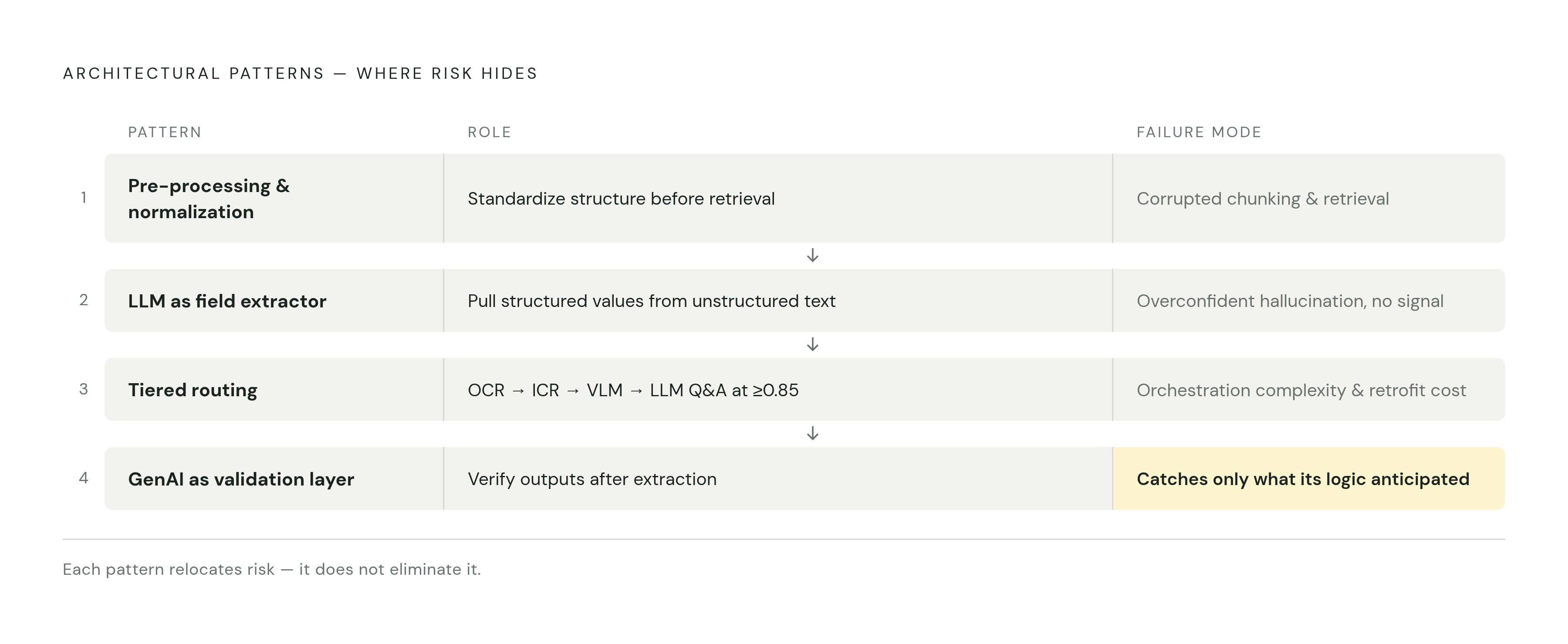
Four patterns cover almost every way teams are putting GenAI into document pipelines today. They're not ranked, and none of them is a default. Each solves a different problem, and each introduces a different risk.
Pattern 1 is pre-processing and structure normalization. Here, a layout-aware model, GenAI or otherwise, runs before any extraction logic touches the document, turning raw PDFs or scanned images into structured markdown or JSON. Its only job is fidelity: keep the document's structure intact, don't interpret anything yet.
Pattern 2 is field extraction with the LLM acting as the extractor itself. The model reads an already-normalized document and outputs structured field values directly. Accuracy runs high on clean inputs, and confidence calibration and hallucination become real engineering problems at that same stage.
Pattern 3 is tiered routing, where the LLM acts as an escalation layer. Deterministic OCR handles simple, well-formatted documents cheaply and fast. The LLM only gets invoked when confidence on a document drops below a set threshold. This keeps cost and latency under control, at the price of more orchestration complexity.
Pattern 4 is GenAI as a validation and reconciliation layer. Extraction happens somewhere else, through a separate system, and the LLM's job is limited to checking those extracted values for internal consistency, cross-field logic, and business rules. It never touches the raw document.
Each of the next four sections takes one of these in turn, with the detail needed to decide whether it fits a given pipeline.
Pattern 1: Why pre-processing fidelity determines everything downstream
Whatever comes out of the pre-processing stage sets a ceiling on everything built on top of it, whether that's a retrieval-augmented generation (RAG) pipeline or direct LLM extraction. A document that gets flattened, reordered, or stripped of structure during pre-processing corrupts chunking and retrieval before any model ever reasons over it.
When extraction at this stage goes wrong, the damage is specific: chunks come out in the wrong order, table structure and headings disappear, and text duplicates itself or vanishes. None of that shows up as an error message; instead it appears later, as worse retrieval and higher hallucination rates, in a part of the pipeline that looks, on the surface, like it's working fine.
IBM's open-source toolkit Docling makes this tradeoff explicit. A document can be exported to Markdown quickly, which works well enough for retrieval, or serialized losslessly to JSON, which costs more but holds the fidelity that audit or downstream validation requires. The shift from raw OCR toward agentic, governed document understanding has made pre-processing fidelity, the quality of the intermediate structured format, foundational to every pattern built on top of it. Invofox is one tool built around that separation, keeping data extraction distinct from orchestration and validation logic so that what would otherwise be an invisible failure becomes a measurable, validated output instead.
The real test of a pre-processing layer is layout generalization: can it hold up on documents it wasn't trained to expect? The DocLayNet paper (IBM Research, KDD 2022) found that models trained on scientific-article layouts lose accuracy significantly once applied to the messier layouts of real-world documents. A pre-processing layer that can't handle layout variation breaks every pattern downstream of it, because all three of the other patterns assume the structured input they're working from is trustworthy. For RAG pipelines and LLM-based extraction alike, a poorly structured input corrupts chunking, retrieval, and answer quality before the model does any reasoning. A document parsing API like Invofox addresses this directly, converting PDFs and images into validated, structured JSON with per-field accuracy guarantees, so that when something goes wrong further downstream, a team can tell whether it's an LLM problem or a data-quality problem.
Pattern 2: LLM as field extractor, where hallucination risk becomes a production problem
Running an LLM as the primary extractor gets strong results on clean, well-structured input. It also introduces a failure mode that template-based extraction never had: the model answers confidently even when the input it's reading is garbage, and it gives no signal that anything was wrong.
Three failure modes appear constantly when this pattern runs in production. The first is the overconfident wrong answer: given a low-quality scan, an LLM doesn't respond with "I don't know." It produces a plausible-looking value anyway, with no flag attached. The second is the silent straight-through failure: a system that's right most of the time will still let wrong answers through, unnoticed, unless confidence scores are calibrated and routed to human review. The third is mishandled document capture itself. Real documents rarely arrive as clean, single PDFs. A 200-page scan might actually contain 30 separate documents stapled together, and every intake channel, scanner, fax, email, upload portal, fails in its own particular way.
Confidence scores only help if they're calibrated correctly, and poorly calibrated systems tend to over-report their own certainty. A model can report 0.95 confidence on a field and still be wrong at that threshold far more often than the number suggests. That gap between stated confidence and real accuracy is one of the most dangerous failure modes in production, because high-confidence wrong answers are exactly the ones that skip human review.
Grounding, whether a given value can be traced back to a specific span on the page, turns out to be a more useful signal than the model's raw confidence score. A 2026 study on per-field selective risk control found the gap between grounded and ungrounded correctness strongly discriminative: grounding works better than confidence alone for deciding what to route for review. A confidence number means nothing if the value behind it was hallucinated rather than read off the page: confidence has to be calibrated and traceable to pixels, not just inferred from the model's own internal probability estimate.
There's a second, less obvious risk specific to this pattern: hidden text embedded in a PDF's text layer. A pipeline that doesn't separate visual rendering from text-layer parsing is exposed to prompt injection through content hidden in that layer, an active attack surface in real production systems, not a theoretical one.
None of this is an argument against LLM extraction. It's an argument that using it without grounding and calibration is an architectural gap, not a shortcoming of the model itself. This is where many teams separate extraction from reasoning: a deterministic or hybrid extraction layer, native text parsing with vision fallback for scanned pages, produces values traceable back to source fields, and the LLM interprets and validates those already-extracted values.
Pattern 3: Tiered routing, controlling cost and stochasticity through confidence-gated escalation
In a high-volume pipeline, the question is how to route each document to the cheapest tier that can still handle it accurately. The LLM is the most expensive tier and the least predictable one, so it belongs at the end of the chain, invoked only when cheaper tiers can't finish the job.
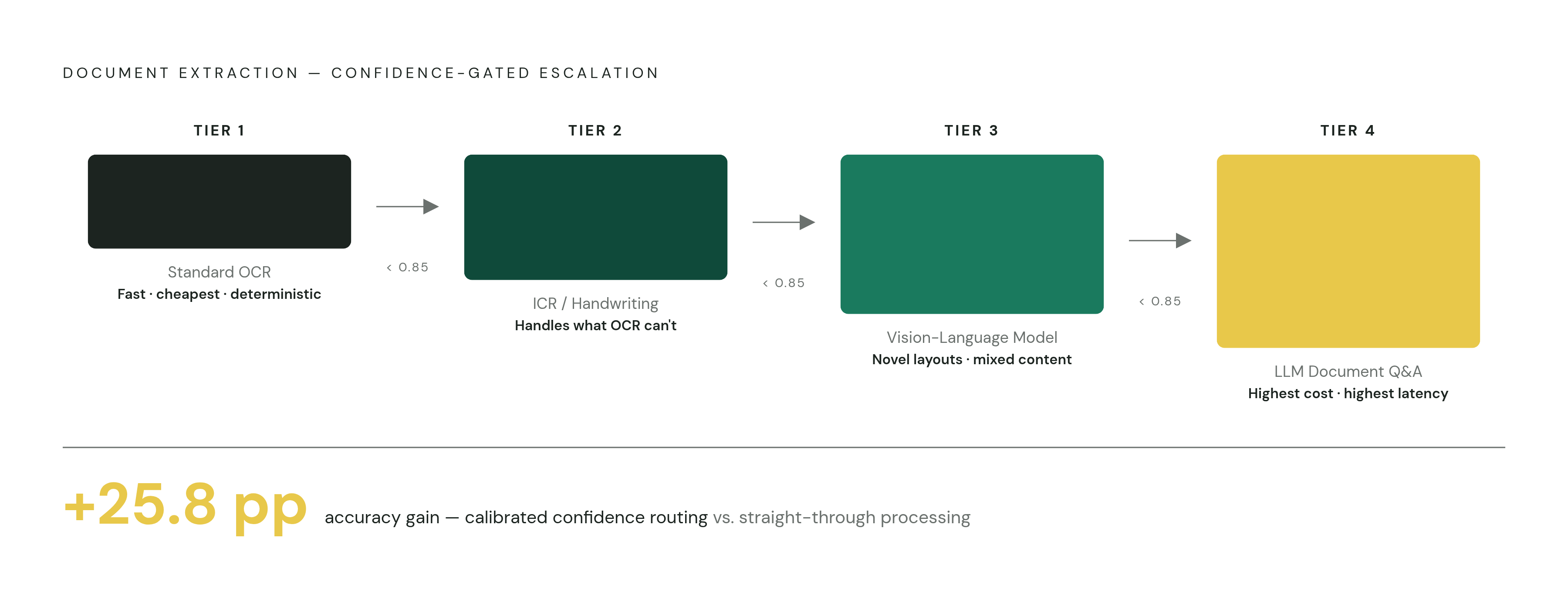
A mature tiered pipeline typically runs through four tiers in order. Standard OCR handles clean, well-formatted documents first: it's fast, deterministic, and the cheapest option per page. Intelligent character recognition (ICR) picks up handwriting that standard OCR can't read reliably. Vision-language model (VLM) extraction steps in for documents with novel layouts or mixed content, cases where the document type is familiar but the structure varies enough to trip up simpler methods. LLM document Q&A is the final escalation tier: highest latency, highest cost, highest stochasticity, reserved only for documents the lower tiers can't process with enough confidence.
The routing rule that production systems converge on is simple: if a document's predicted confidence score falls below a set threshold, say 0.85, it routes to the next tier up, or to a human reviewer. Field-level confidence scores make that routing decision possible, rather than letting bad data pass through silently because no one was checking.
The payoff from doing this well is measurable. A multi-signal confidence engine called EXTRACTCONF showed that at a high-coverage threshold, automated accuracy reached near-perfect levels, a 25.8 percentage-point improvement over the base rate. That's what calibrated confidence routing buys over naive straight-through processing, where every document gets treated the same regardless of how risky it is.
The hard part of this pattern is orchestration. Every extracted value needs to know exactly where it lives on the source page from the very first scan, because that positional data is what supports reviewer highlighting, redaction, and audit trails later on. Retrofitting that kind of page-level traceability into a pipeline that wasn't built for it from the start is brutal, often requiring a full rebuild.
Pattern 4: GenAI as validation layer, checking extraction output without touching the source document
For teams already running an extraction system, especially in regulated industries, the lowest-risk way to bring GenAI in is to use it purely for validation after extraction is done. The model in this pattern never sees the original document. It only sees the structured output, and its job is to flag inconsistencies and apply business rules, not to produce new values.
This pattern covers a specific set of validation tasks. It checks cross-field consistency: does an invoice total match the sum of its line items, does a date fall inside the contract period it's supposed to belong to. It applies business rules: does the extracted tax rate match the jurisdiction on record, is the payee name consistent with an approved vendor list. And it flags anomalies: values that are statistically unusual given the document type and historical patterns get routed to a human reviewer.
The architectural logic here is separation. Because the LLM never receives raw document content, the data exposure surface shrinks, since sensitive information in the source document never reaches the model. And because the output is structured, the audit trail consists of validated fields and confidence flags rather than raw, probabilistic model output, which is a much easier thing to defend to an auditor.
The pattern has a real limitation too. It can only catch the errors its validation logic was built to check for. It can't recover from a systematic failure somewhere upstream in extraction, and it only works as well as the schema defining the fields it's checking. This is the right choice in specific, well-scoped circumstances, not a universally safer option compared to the other three.
Choosing the right pattern for document complexity, volume, and compliance constraints
Three factors determine which pattern fits a given pipeline, and they operate at the same time: how complex and varied the documents are, how much volume needs processing and at what cost tolerance, and what compliance regime governs the data. These three rarely point toward the same answer, so the decision takes real judgment rather than a simple checklist.
On document complexity: high-volume, repetitive, well-formatted documents, standard invoice templates, payslips with fixed layouts, are best served by tiered routing with OCR carrying most of the load, since that keeps cost down where the documents are predictable. Documents with high variation, novel layouts, and mixed content push the bottleneck back to pre-processing. In that case, investing in Pattern 1 pays off across every tier built on top of it, because nothing downstream works if the structured input is unreliable.
On volume and cost: self-hosted document AI pipelines tend to break even somewhere between roughly 50,000 and 100,000 pages a month, and only with a dedicated ML engineer maintaining the system. Below that volume, the maintenance cost of running a self-hosted pipeline runs around five times its initial development cost, which usually makes a managed API cheaper over the life of the project. Teams often budget for the extraction work itself and get caught off guard by how much larger the engineering effort turns out to be for the human review layer that has to sit behind it. Building in-house earns its keep only when several conditions hold at once: sustained six-figure monthly page volume, document types the team controls and that stay repetitive, an ML team already on staff, and a sovereignty or sector-specific compliance mandate that no vendor can satisfy.
On compliance: confirm, before sending any regulated data through a model, that the specific model version is actually in scope for the relevant business associate agreement (BAA) and retention settings. A limited-preview or restricted-access version of a model may not sit on the compliant surface a team assumes it does. Zero data retention isn't a feature worth negotiating away for convenience. For documents carrying sensitive financial or personal information, a vendor that retains processed data creates a liability that a compliance team will eventually have to deal with, usually at the worst possible time.
Run a pipeline through these three axes in order, complexity, then volume and cost, then compliance, and the right pattern tends to fall out with a clear rationale behind it, rather than being picked on the strength of whichever model happens to be newest.