Vendors Offering Per-Field Accuracy SLAs for Document AI
Vendors can offer accuracy guarantees but choose easier uptime metrics instead.
Per-field accuracy SLAs remain rare in document AI, and that scarcity is a choice. Vendors would rather sell an uptime number than stand behind a correctness number, even though the technology to support the latter already exists.
Uptime SLAs as the wrong measuring stick for document AI
Uptime made sense when the thing being measured was a server answering a ping. A server is up or it's down, with no middle state where it's sort of responding.
AI extraction systems don't work that way. They sit on a spectrum, and they degrade in ways that never trip an uptime monitor at all. A document AI pipeline can answer every API call, hit every latency target, and still get a third of its extracted fields wrong. No one would accept that logic from a payroll system that paid every check on time but calculated the wrong amount for a third of them, yet that's effectively the bar document AI vendors get held to whenever the SLA measures throughput instead of correctness.
Accuracy is harder to define than uptime, and harder still to measure. That difficulty is why it matters more. A metric that's easy to fake tells a buyer nothing about the value they're getting. A metric that's hard to fake, because it means checking extracted output against verified ground truth, tells them almost everything. The industry's reluctance to adopt outcome-based SLAs looks less like a technical limitation and more like a preference for the number that's easier to report. Traditional IT SLAs measure availability and response latency, with the standard uptime target at 99.9%+ and response latency held under 2 to 5 seconds for chat and under 500ms for voice. Neither number says a word about whether the extracted invoice total was actually right.
The non-trivial definition of a per-field accuracy SLA
Vendor marketing uses the word "accuracy" loosely enough that it needs pulling apart before it means anything. Three distinct layers hide behind that one word: the buyer's own assumption that a single accuracy figure represents the whole system is the cause, and it produces a gap where buyers routinely get sold the first layer while assuming they're getting the third.
The first layer is aggregate model accuracy, one headline number applied across an entire system. It's the easiest number to produce and the easiest to game, since a vendor can generate it from a curated, clean sample set that looks nothing like a customer's actual document mix. The second layer is field-level accuracy, measuring how well the system pulls a specific value, such as an invoice date, a supplier name, or a line-item total, against verified ground truth for that field alone. The third layer is the contractual one, a per-field commitment with a defined remedy, financial or otherwise, when performance on that field drops below an agreed threshold. Only that third layer is actually an SLA.
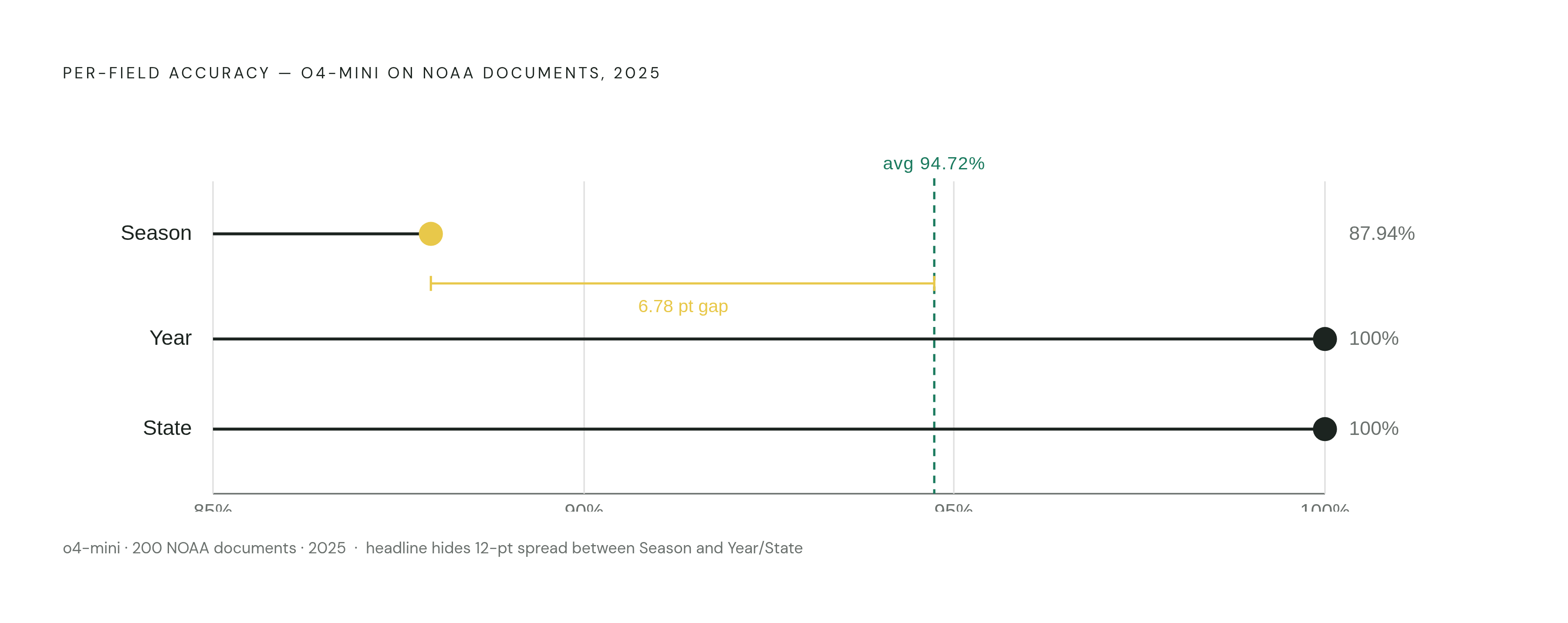
The gap between the first layer and the second isn't theoretical. A 2025 study applying o4-mini to 200 NOAA government documents, checked by two independent human reviewers, found an overall average accuracy of 94.72%, a number that would look fine on any sales deck https://arxiv.org/pdf/2505.01555. But per-field results ranged from 87.94% on the Season field up to a perfect 100% on Year and State https://arxiv.org/pdf/2505.01555. One average masked a 12-point spread. A buyer who specifically needed the Season field right, nearly every time, would have been badly misled by the headline number alone.
Even a well-defined accuracy number is incomplete without a remedy attached to it. A vendor can meet an activity-based SLA by delivering a high volume of API calls a day, and do so even if none of those calls produced a correct extraction. A real SLA has to specify acceptable hallucination rates, mandate human review for high-stakes outputs, and put a financial penalty behind the threshold. Each targeted field needs its own ground truth, and performance has to get stratified by document condition: digital versus scanned PDF, skew and noise, stamps and handwriting, language, unseen supplier templates.
Vendors' default to activity metrics instead of accuracy commitments
Gartner's Critical Capabilities report for intelligent document processing evaluates 18 vendors against ten criteria, including data extraction, ModelOps, and secure handling, and it's the most complete comparative framework buyers currently have. Even with that framework sitting in front of them, no vendor's public documentation contains a per-field accuracy SLA carrying a contractual financial penalty. Buyers who want that language have to ask for it directly in an RFP, because nobody volunteers it.
The incentive structure explains why easily enough. Uptime is cheap to instrument, binary to report, and low-risk to guarantee, since a vendor controls its own infrastructure and can generally keep it running. Field-level accuracy is none of those things. It demands continuous comparison against ground truth, it shifts by document type in ways a vendor can't fully predict in advance, and committing to it financially means accepting liability for edge cases outside the vendor's control, such as an unfamiliar supplier template, a handwritten annotation, or a stamp sitting on top of a critical field. Guaranteeing uptime costs a vendor almost nothing. Guaranteeing accuracy costs money on every document they get wrong.
That asymmetry produces a failure mode uptime metrics are structurally blind to: silent degradation. A system can report 99.99% uptime while model drift, stale training data, or, in document pipelines specifically, gradual format drift as new document layouts enter the mix, quietly erode its actual output quality even as the uptime number holds steady. The system stays "up" the whole time. Nothing in the SLA ever registers that it's getting worse.
Production document pipeline failures and their absence from demos
Vendor demos tend to run on clean, well-formatted samples, and a 99%-plus accuracy claim on that kind of input is entirely believable https://www.extend.ai/resources/document-extraction-ai-guide https://www.mindsprint.com/resources/blogs/ai-accounts-payable-2026. Production documents are a different animal. Once real-world variation enters the picture, inconsistent layouts, mediocre scan quality, actual human handwriting, accuracy on traditional OCR commonly drops into the 95 to 97% range, sometimes lower https://parseur.com/blog/why-ai-ocr-fail. At real document volume, that gap between demo and production is a routine, daily source of failed extractions, because scale surfaces the layout variation, scan quality, and handwriting that demos don't test.
The failures cluster into recognizable categories. Handwriting fails because style variation is close to infinite. Complex tables fail because they carry no semantic structure a model can lean on. Multi-column layouts fail because the model reads content in the wrong order. Low-quality scans fail because there's no surrounding context left to infer from, and mixed content, text sitting next to diagrams and tables, confuses models trained on cleaner separations. Validation gaps let a system happily output "Total: $1,00,000" without ever checking whether that figure lines up with the items above it.
Vision-language models bring failure modes of their own that have nothing to do with the source document. One involves recitation errors: provider-level copyright filters mistakenly flag a legitimate extraction as reproduced content, and the response comes back as None or gets truncated mid-output, with providers frequently billing for the failed request anyway. These aren't quiet failures either. They can cascade into system-wide rate-limiting and service errors.
Even a genuinely strong classifier doesn't guarantee reliable output on its own. A 2025-to-2026 arXiv paper on Document AI microservices describes a VLM classifier hitting 98% accuracy in evaluation that still misclassifies documents once it's running in production. At a throughput of 1,000 documents, that routing error rate translates into a meaningful number of daily failures needing human review. Evaluation accuracy and system reliability are not the same claim, and treating them as interchangeable is where a lot of procurement decisions go wrong. LlamaIndex's engineering team has disclosed two VLM-specific production failure modes across isolated LlamaParse outages.
The technical architecture behind a credible accuracy commitment
Confidence scoring is the mechanism that makes a real accuracy SLA possible in the first place. A 2026 preprint lays out the formal shape of it: every extracted field gets a confidence score between 0 and 1, a grounding reference back to the specific page, bounding box, or character span it came from, and a routing decision, accept the value or send it to human review. The engineering goal is to accept as many fields automatically as possible while keeping the error rate on accepted fields under a fixed threshold.
Grounding is what decides whether a confidence score can be trusted. On the CORD receipt dataset, a genuinely hard extraction benchmark, only 49.0% of the fields Claude Sonnet asserted turned out correct https://arxiv.org/html/2608.14639. That sounds damning by itself, but grounded extractions were far more likely to be correct than ungrounded ones, a gap of 0.352, and the model's own verbalized confidence predicted correctness with an AUROC of 0.845 https://arxiv.org/html/2608.14639. That's the technical floor an accuracy SLA can actually stand on.
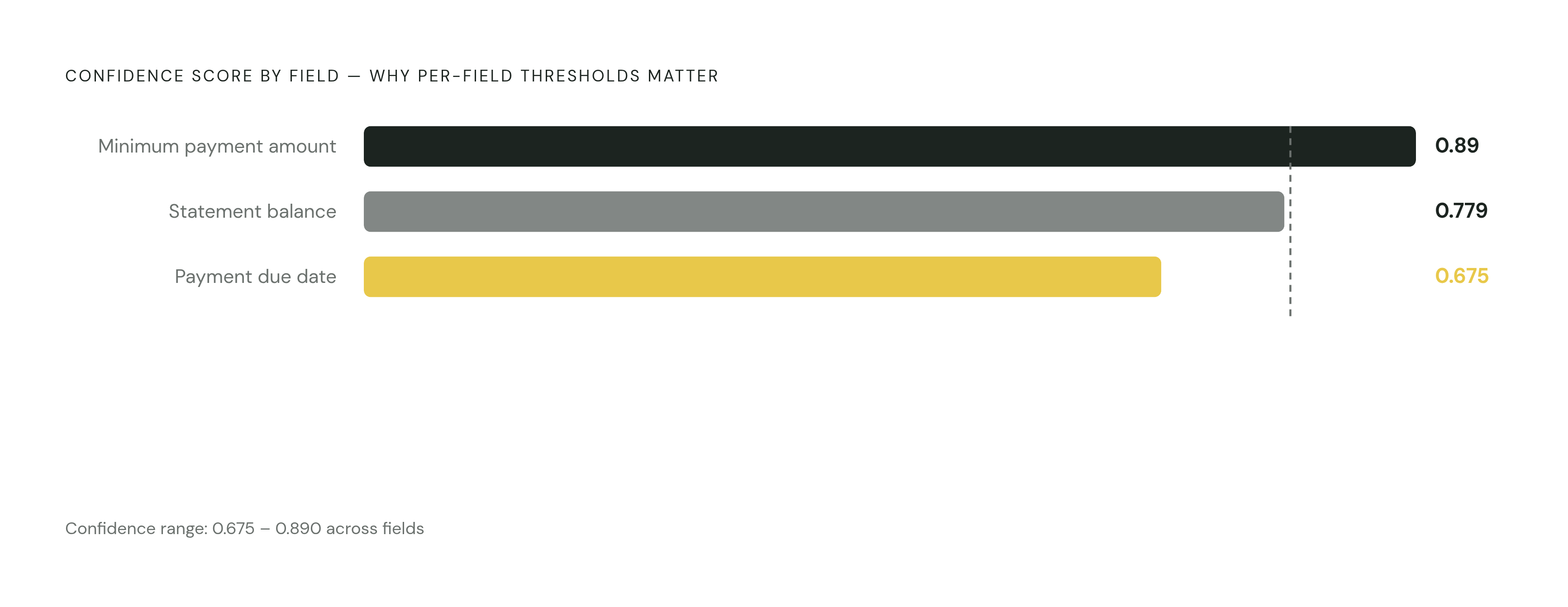
Confidence isn't flat across field types, and that matters for how thresholds get set. An audit study found overall average field-level confidence of 0.781, but the spread underneath that average was wide: minimum payment amount scored 0.89, statement balance 0.779, payment due date only 0.675 https://arxiv.org/pdf/2605.05252. Dollar amounts tend to sit in predictable, consistent spots on a document. Dates move around depending on layout, and the model's confidence reflects that instability. A single global threshold applied across every field type would either reject too many good amount extractions or wave through too many bad date extractions, so thresholds have to get set per field, calibrated to how that specific field actually behaves. That same CORD study puts a number on the payoff of grounding: a correctness gap of +0.352 (95% CI [0.33, 0.37]) between grounded and ungrounded assertions, and a verbalized-confidence AUROC of 0.845 [0.83, 0.86].
What the current vendor landscape offers buyers
The vendor landscape for document extraction spans several distinct categories, and SLA posture varies sharply between them. Agentic, AI-native platforms tend to emphasize schema-based extraction with citations and confidence scores attached to each field, which makes outputs more auditable by design, and they generally lean toward developer-facing SDKs suited to RAG and agent-style workflows. That auditability is a real step toward the architecture a genuine accuracy SLA needs. Even here, though, a publicly disclosed per-field accuracy SLA with financial remedies isn't something the documentation shows.
The large cloud platforms occupy different ground. Microsoft's Azure AI Document Intelligence has a strong reputation for its layout model, handling multi-column PDFs, nested tables, and checkboxes well, with deep integration into Power Automate and SharePoint for enterprise workflows, though some users find they need to write custom code to reach the newest features before those land in the UI. Published SLA commitments here, too, stop at uptime and never extend into field-level accuracy.
None of this means these platforms perform poorly on accuracy in practice. It means the accuracy claims live in marketing material and benchmark comparisons rather than in the contract itself, and closing that gap is the buyer's job before anything gets signed.
The build-vs-buy calculus when accuracy accountability is the constraint
Open-source models have gotten genuinely capable, and any buyer weighing self-hosting should take them seriously as an option. What none of them ship with is a managed API, an SLA of any kind, or a validation interface a non-engineer can actually use. Self-hosting buys capability and nothing else.
Pricing across the managed options varies more than a glance at headline rates suggests. AWS Textract charges $1.50 per 1,000 pages for basic text detection, but that climbs fast once structure enters the picture: roughly $15 per 1,000 pages for tables, around $50 per 1,000 for forms. Mistral OCR 4 runs a flat $4 per 1,000 pages, dropping to $2 per 1,000 with the 50% Batch-API discount, and charges nothing extra for tables or handwriting, where the hyperscalers do.
Self-hosting only starts paying off at real scale, roughly 50,000 to 100,000 pages a month, and only with a dedicated ML engineer on staff to keep the pipeline running. Below that volume, ongoing maintenance, running something like five times the cost of the initial build, quietly erases whatever got saved on a per-page basis. The API line item on an invoice looks like the whole story. It almost never is. Published API pricing for comparison:.
"Paying only for correct extractions" as a commercial model
The overwhelming majority of document AI pricing today is activity-based: the vendor gets paid regardless of whether the extraction was correct. That structure keeps the vendor's revenue and the customer's actual outcome only loosely connected. Process more pages, get paid more, whether or not those pages produced usable data.
A pricing model built around correctly extracted fields changes that relationship at the root. If a vendor only gets paid when the extraction is right, accuracy is the thing the vendor's revenue actually depends on, not just a claim in a sales deck. That's a fundamentally different commercial posture than a penalty clause buried in an SLA. A penalty clause says the vendor pays back the customer after failing. Pay-per-correct-extraction says something sharper: no pay unless the vendor succeeds in the first place.
Getting there requires the entire architecture the earlier sections describe, not any one piece in isolation: field-level confidence scores, continuous checking against ground truth, a human-review queue for anything low-confidence, transparent per-field reporting the customer can actually see, and a feedback loop where corrections improve future extractions. Pulling out any one of those pieces causes "pay only for correct extractions" to collapse back into a marketing phrase with no mechanism behind it.
Running an evaluation that surfaces accuracy commitments rather than demo performance
The single highest-leverage move a buyer can make before signing anything is refusing to evaluate on the vendor's sample documents. Build the test set from actual production documents instead, the ugly ones especially: poor scans, non-standard fonts, multi-column layouts that break simple top-to-bottom reading order, and genuine handwriting rather than a clean typed sample dressed up to look messy.
That evaluation set should be stratified the same way a real SLA would be: digital versus scanned, familiar templates versus ones the vendor has never seen, single-language versus multilingual documents. Run the vendor's system against it. Then look at the field-level spread rather than the aggregate number. A vendor happy to quote 94.72% overall accuracy should also be willing to show what that number looks like broken out field by field, the way the NOAA study exposed a 12-point gap between its strongest and weakest fields hiding under one average https://arxiv.org/pdf/2505.01555.
Then ask the question the whole SLA conversation actually hinges on: what happens when a field falls below threshold. A vendor with a real answer points to confidence scoring and grounding, shows what its review-routing logic looks like, and puts a number and a remedy in writing rather than a general assurance that the system is accurate. A vendor without a real answer points back to uptime. That reflex, retreating to uptime instead of offering a number and a remedy, is what separates a vendor accountable for correctness from one accountable for nothing more than keeping the lights on. Companies lose nearly 9% of revenue each year due to lapses in contract performance and renewal oversight https://www.sirion.ai/library/contract-insights/contract-management-vendors-uptime-sla-support/. Every 10-minute improvement in detection time can save approximately $50K to $100K per incident for a mid-size enterprise https://underdefense.com/blog/ai-soc-sla-guide/. TELUS Digital was placed a Leader in Everest Group's Data Annotation PEAK Matrix on 500-plus language coverage https://forage.ai/blog/ai-training-data-providers/. The standard AI SLA availability/uptime target for AI customer service platforms is 99.9% https://www.mavenagi.com/glossary/ai-service-level-agreement. The standard maximum response latency for AI voice systems under SLA is 500ms https://www.mavenagi.com/glossary/ai-service-level-agreement.