Multi-Agent AI Architectures for Document Processing Workflows
Extraction layer failures, not orchestration, derail production document AI systems.

Pipelines break when agents sit on top of fragile extraction, because the extraction layer, not the orchestration logic, is where the whole system actually lives or dies. Nothing throws an error. The first sign is usually a downstream report that doesn't reconcile, weeks after the documents that caused it were processed and filed away as done.
That gap between demo and production exists because most enterprises have digitized their documents without digitizing the structure behind them. Agents now get stacked on top of extraction infrastructure that was never designed to carry agentic weight. The consequences compound in predictable but costly ways: one layout error at the top of the pipeline propagates into every downstream chunk of a RAG system, a table-extraction failure that looks fine on output breaks a reconciliation a month later, and a hallucinated field in a financial or clinical record reads as confident and complete right up until an audit catches it.
Part of the problem is that the category mislabels its own tools. Calling any of these "agentic" sets expectations the architecture can't meet, and the gap between the label and the behavior is exactly where production incidents come from.
The seven-layer agent stack
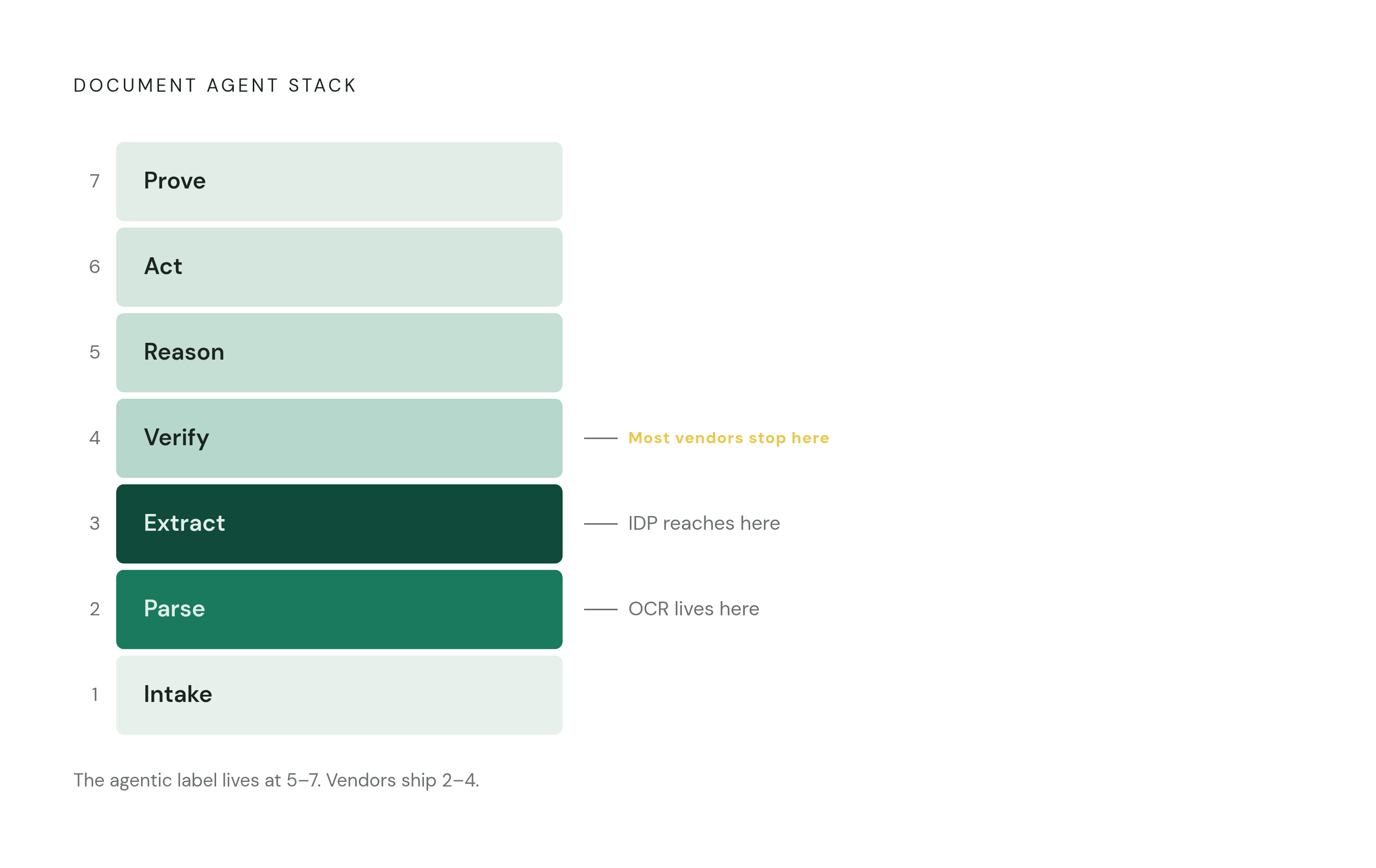
A production-grade document agent stack has seven distinct layers: Intake, Parse, Extract, Verify, Reason, Act, and Prove.
A system earns the label "agentic" only if it passes four operational tests. Most platforms on the market today satisfy zero or one of these four conditions and still market themselves as agents.
OCR lives inside the Parse layer. It converts images into machine-readable characters, but it has no concept of whether the page in front of it is an invoice or a lease. Traditional intelligent document processing (IDP) adds classification and field extraction on top of that, but it runs as a rigid, multi-stage sequential pipeline, so it has no capacity to reason about exceptions. The agent tier is what adds reasoning, exception handling, and governed downstream action, which is also where most vendor platforms stop shipping and start marketing.
The majority of document-processing cost is in the minority of documents that deviate from the expected format, not in the predictable majority. Agentic complexity earns its cost there and almost nowhere else. That's the logic behind hybrid routing: send the predictable, high-confidence bulk of documents down a fast deterministic path, and reserve the agentic path for the variance that actually needs reasoning. More than any other architectural choice, this one routing decision decides whether a document AI program survives its first budget review.
How the extraction layer breaks in production
Extraction rarely fails on the easy cases. It fails through a small number of failure modes that compound silently as the document population grows more diverse, and each one is a specific, identifiable mechanism.
Error cascading is the first. A minor inaccuracy in layout detection, something as small as a misread column boundary, leads to severe downstream failures in OCR and element parsing. A single layout error at the top of the pipeline propagates into every chunk built from that document further down the line.
Silent table errors are the second, and they're a large one: a large share of enterprise data lives in tables, and multi-page tables remain one of the most frequent failure points in the industry. On the CORD benchmark, a 2026 evaluation found that only 49.0% of asserted fields were correct. The errors that cause the most damage are the ones that pass through looking correct and then break a reconciliation weeks after the fact, when nobody is still thinking about that document.
Training data bias is the third. For industries like insurance or logistics, where a meaningful share of inbound documents are physical-origin scans, that hidden weakness becomes a live production risk.
Silent degradation is the fourth. Because none of them throw an actual error, the decline stays invisible until a downstream report turns out wrong.
For RAG and LLM pipelines specifically, these failures take a recognizable shape. Tables get flattened into a run of numbers with no row or column association left intact. Multi-column layouts get read straight across the page, so two unrelated sentences get interleaved into a single chunk that means nothing on its own. Headers, footers, and figure captions get merged into the body text, diluting the chunk's embedding with noise that has nothing to do with the content. These upstream parsing failures account for the majority of RAG misses in practice, not the embedding model and not retrieval depth. That matters for anyone optimizing the wrong layer of the stack, chasing a better embedding model when the actual damage happened at parse time.
The parsing infrastructure is usually the first place a production team should invest. If you combine hybrid PDF pipelines (native text extraction with vision-model fallback) with per-field accuracy targets, you can eliminate the silent extraction failures that otherwise propagate across every downstream agent and RAG chunk.
A prompt change that fixes extraction for one document type can break it for another type. An extraction system with no accuracy measurement attached to it is a demo running in production infrastructure, not a production system.
Measuring Extraction Accuracy for Routing Decisions
Aggregate accuracy numbers hide the per-field information an agent needs if it has to route a document correctly. The measurement method has to match the production decision it's meant to support, or the number being reported is disconnected from the decision being made.
Source grounding, attaching a page number and bounding box to every extracted value, is the single most actionable routing signal available. A 2026 arxiv study on per-field selective risk control found that grounded values were substantially more likely to be correct than ungrounded ones, so grounding works as a usable, discriminative signal for accept-versus-review decisions, not just a nice-to-have audit feature.
A confidence score means nothing on its own if the model hallucinated the underlying value. Confidence has to be calibrated and traceable back to actual pixels on the page, not inferred from what the model expects a typical document to contain. High confidence attached to a hallucinated field is the most dangerous failure mode in financial and clinical contexts specifically because the output looks complete and trustworthy at the exact moment it should be questioned.
Confidence thresholds need to be set per document type. A single global threshold applied across both produces false positives on the easy domain and false negatives on the hard one, failing both in different directions at once.
A practical routing structure follows from this. The bottom band should trigger manual handling or outright rejection, so a reviewer never has to guess.
A well-calibrated parser behaves like a much higher-accuracy system in practice when the large majority of documents get processed at high confidence, where accuracy runs close to perfect, and only a minority need to go to human review. Production-grade extraction demands more than an aggregate accuracy score. Services like Invofox that guarantee per-field accuracy and offer zero data retention by design address the specific failure modes, error cascading, silent table errors, training-data blind spots, that most generic extraction pipelines leave invisible until an audit or reconciliation surfaces the damage weeks later.
The verification agent as a reasoning step, not a threshold check
A verification layer applies a confidence threshold to an extraction output, but verification is fundamentally a reasoning step. It cross-references extracted values against business rules, live system data, and the internal consistency of the document itself.
Business-rule validation catches things a threshold never will. None of these questions get answered by pattern matching. They require reasoning against a rule set, which is a fundamentally different operation than scoring confidence on a single field.
Schema-constrained generation, forcing model outputs to match typed JSON schemas at inference time, is a useful downstream complement that keeps structurally malformed extractions from slipping silently into a pipeline. It's a necessary safeguard, but not a sufficient one on its own, since a value can be structurally valid JSON and still be factually wrong.
A trust layer attaches three things to every extracted field: a confidence score, a grounding (page, bounding box, character span, support score), and a decision of accept or review. Without that attachment, downstream agents receive fields with no indication of which ones deserve doubt, and they end up treating a guess and a certainty with the same weight.
Hidden text inside PDFs is an active attack surface, not a theoretical one. A verification layer has to treat the visual rendering and the text layer as potentially adversarial inputs to each other, checking one against the other. This is a design requirement for any pipeline handling documents from external or untrusted sources, not a side consideration bolted on after the fact.
How exception routing and human-in-the-loop escalation should be engineered
Exception routing is a designed component in its own right, and its design quality sets the cost at which variant documents get handled, or lets them quietly defeat the entire architecture around them.
A well-engineered escalation path hands the reviewer a plain-language explanation of what triggered the escalation, not a raw confidence score with no context attached. Interfaces that surface only extracted fields without grounding context produce corrections that are slower and lower quality than they need to be.
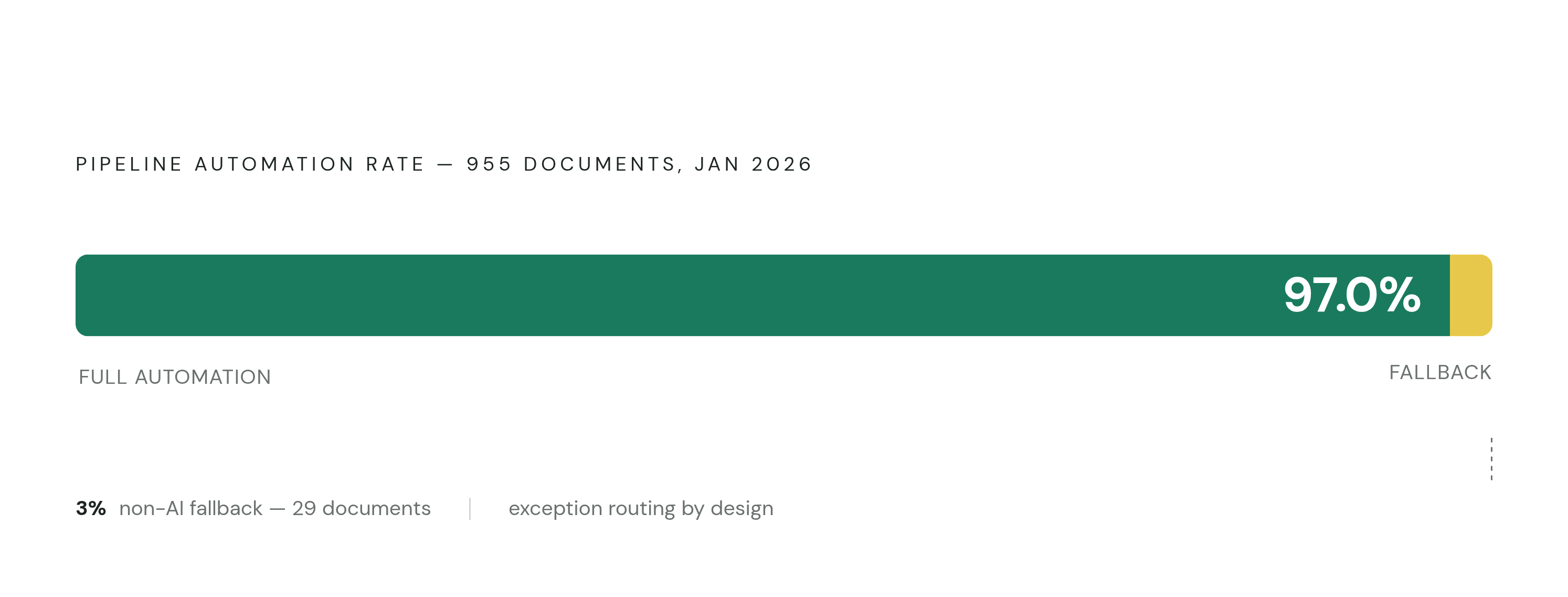
One production deployment of a multi-agent document pipeline, built around five specialized agents (a classifier, a splitter, a parser, an extraction agent, and a validation agent) with a human-in-the-loop mechanism, processed 955 real-world documents through January 2026 and reached a 97.0% full-pipeline automation rate, with only 3% requiring a non-AI fallback. That result shows what exception routing looks like when it's built as a real engineered path, integrated with downstream action.
You can tell an actual document AI product from a static OCR tool sitting next to a manual queue by whether human corrections feed back into the extraction model. Continuous learning from those corrections compounds accuracy over time, specifically on the document population the system actually encounters in that business, not on a generic benchmark.
The review application tends to outgrow the AI component as a development surface. Teams that treat the review interface as a thin wrapper around extraction output discover, usually the hard way, that reviewers need context, document history, prior-document comparison, and audit capability to do the job well. The review interface functions as a product in its own right, not a queue sitting at the end of a pipeline, and every decision a reviewer makes there needs to be logged in a way that can be reconstructed later.
That audit trail requirement, logging what was flagged, why, and what a human decided about it, is also the exact requirement that regulators and auditors come looking for.
Compliance and data retention requirements that the pipeline architecture must satisfy by design
In regulated industries, a vendor can't just check off data handling as a line item during procurement. It's a structural constraint that has to be built into the pipeline's architecture before the first real document ever passes through it.
Zero data retention (ZDR) and a contractual prohibition on using customer data for model training are two separate commitments, and a provider can offer one without the other. A buyer needs documentation of both, not an assumption that one implies the other. Invofox operates a zero-retention model and holds SOC 2, GDPR, ISO 27001, and HIPAA certification, which makes it a useful reference point for what a production pipeline should treat as the default.
SOC 2 Type 2 matters more for AI systems than it does for traditional SaaS products. Only a Type 2 report, which covers a period of time rather than a single snapshot, can demonstrate that.
The EU AI Act's Article 11 obligations for high-risk systems don't come into force until December 2027 for Annex III systems and August 2028 for Annex I systems, so they sit on the horizon as context for where documentation requirements are heading. None of this is a checklist to clear once; it's a set of constraints the pipeline's architecture has to satisfy continuously, because the systems it governs keep changing underneath it.
The build-vs-buy decision for document extraction infrastructure inside a multi-agent system
Building extraction infrastructure in-house means owning every failure mode described above: error cascading, silent table errors, training data bias, and silent degradation, all without the benefit of a vendor's accumulated correction data across thousands of other document populations.
Buying extraction infrastructure shifts that burden to a provider whose core business is solving exactly these problems, provided the provider can document per-field accuracy against ground truth, zero retention, and a continuous-learning loop from corrections. Invofox measures accuracy against per-field thresholds set against ground truth and lists continuous learning from corrections as a core part of its product, which is the specific combination a team should be checking for in any vendor being evaluated for this role, regardless of which one they choose.
The hybrid routing insight, sending predictable, high-confidence documents down a fast deterministic path and reserving agentic reasoning for variance, only works if the deterministic path is genuinely reliable. That reliability requirement is where extraction-focused infrastructure earns its place in the stack, because a 99.2% per-field accuracy guarantee is what keeps the fast path from silently degrading as document diversity increases across a growing enterprise document population. Whatever reasoning and action layers get built on top of that foundation inherit its quality or inherit its failures. There is no version of this where good agent design compensates for an extraction layer that cannot be trusted.