Why Your RAG Pipeline Needs a Dedicated Document Preprocessing API Not a General Extraction Library
Dedicated preprocessing APIs catch parsing errors that corrupt retrieval.

The document extraction market contains at least six distinct categories of tooling, and most teams building RAG pipelines pick from the wrong one without ever realizing it. The category boundaries are invisible from marketing copy, and the mistake surfaces only after the pipeline is in production. A dedicated document preprocessing API treats validation, confidence scoring, and structural integrity as first-class concerns, and that is what separates reliable RAG input from corrupted retrieval.
Why general extraction libraries and RAG parsers solve a different problem than production document pipelines need
A search for "document extraction API" returns results that all claim to solve the same problem. The truth is that the market contains at least six distinct categories of tooling: OCR engines that output text or markdown, cloud document intelligence platforms with pre-built and trainable models, RAG and LLM preprocessing tools that produce structure-preserving chunks, structured extraction APIs that return typed JSON from a schema, enterprise IDP platforms built around workflow automation, and approaches that call vision-language models directly. Each category solves a genuinely different problem, but the boundaries between them do not show up in vendor copy.
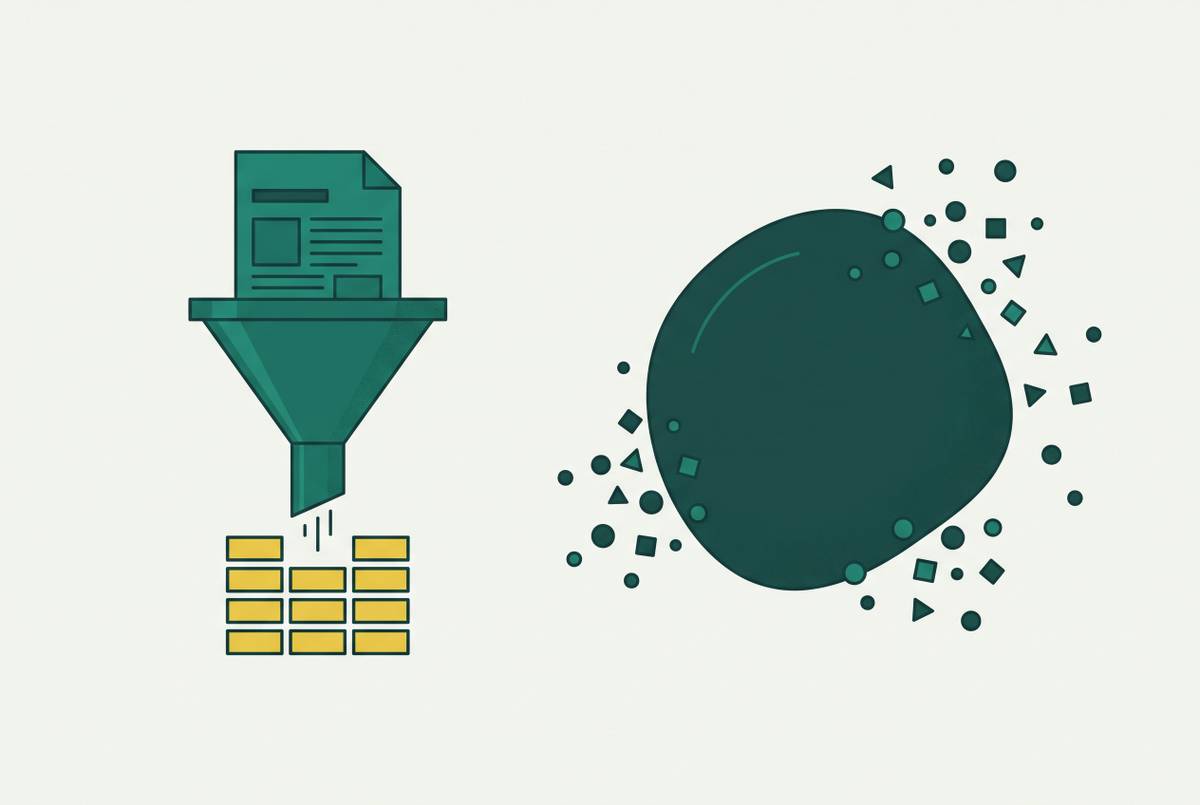
RAG and LLM preprocessing tools care about preserving document structure. Tables, headers, sections: these matter because they determine whether resulting chunks produce better retrieval results. What those tools are not designed to do is extract specific fields. A parser like LlamaParse produces document content in a consumable format, not the statement that the invoice total is $4,250. To get that field, you need an additional LLM extraction step on top of the parser's output.
The confusion crystallized when LLMs went mainstream. Every RAG pipeline and document-reading agent hit the same wall: the LLM can only work with text it can actually read. Document preprocessing stopped being a background concern and became a hard bottleneck for the entire AI stack. Teams reached for the most visible tool, not the tool built for the job they actually needed done.
What PDF parsers optimized for RAG actually produce, and where that output breaks down
PDFs were designed for print, not machines. They store content as positioned glyphs on a canvas, not structured text. A two-column research paper, a scanned invoice, and a slide deck exported to PDF are each a different parsing problem, and most libraries handle only one or two cases well. The format itself guarantees that no single approach will be universally reliable.
What separates a good parser from a bad one for LLM workflows comes down to six things: structural preservation rather than plain text extraction, awareness of how layout errors cascade, table handling quality, scanned document support, formula and visual element handling, and hallucination risk in AI-powered parsers. Tables are consistently the hardest element to parse correctly. Dense financial tables, multi-column spans, and merged cells break naive extraction in ways that are easy to see and hard to fix.
Traditional OCR tools fail on a large share of complex multi-column layouts because most legacy PDF parsers treat documents like flat text streams. They ignore visual hierarchy, split tables mid-cell, and lose context when text wraps across columns. A layout error does not just affect one sentence. It can corrupt an entire section's worth of retrieved context.
The output of even a well-structured RAG parser, clean Markdown with tables and headings intact, is still unvalidated prose from the perspective of a downstream system that needs to write "invoice_total: 4250.00" into a database or trigger a payment workflow. Teams that use a RAG parser as their only extraction layer must add an LLM extraction step on top to get typed fields. The structural fidelity is a necessary condition for reliable retrieval, not a sufficient condition for validated structured data.
A hybrid extraction approach avoids some of this damage. Native text extraction from digital PDFs, with vision-model fallback only for scanned pages, catches layout errors earlier in the pipeline and avoids the risk of rasterizing every document unnecessarily. Invofox uses this tiered strategy: it extracts embedded text where it exists, avoiding the character-error compounding that results from treating all PDFs as images, and applies focused vision processing only when OCR is genuinely required.
How errors introduced during parsing compound through the rest of the pipeline
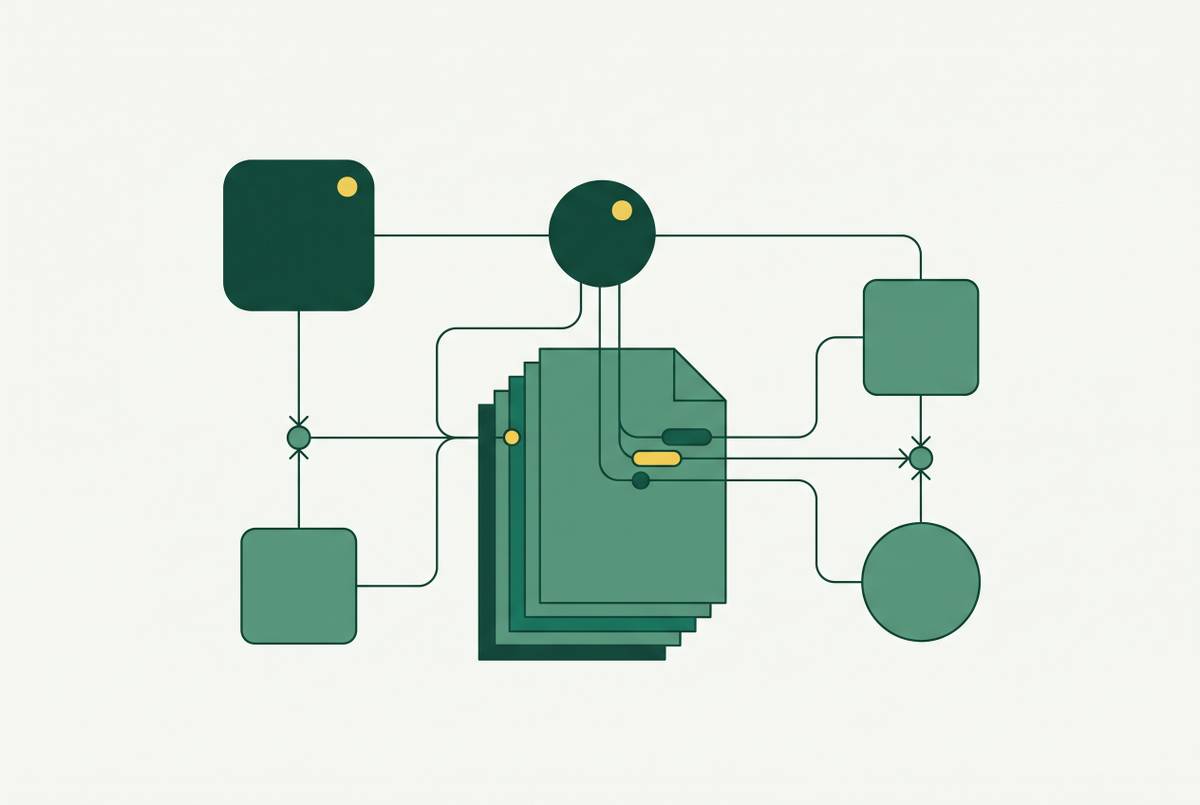
Parsing errors do not stay local. They cascade, and the damage compounds with each stage that trusts the previous one's output. The math is unforgiving because each downstream stage assumes the stage before it was right.
Edge cases represent a minority of production volume but account for a disproportionately large share of failures. Dense financial reports with tables and footnotes, multi-column layouts, watermarked documents, and language-specific density variations all punish models that score near-perfectly on benchmarks. Table misalignment alone accounts for a large share of production failures.
For RAG pipelines specifically, a corrupted chunk does not produce a visible error. The failure is invisible until a downstream consequence surfaces it. A general library absorbs all of this error silently, with no field-level confidence signal to tell you which outputs to trust and which to re-examine.
The tiered fallback pattern exists for a reason. Check for embedded text first, since digital-native PDFs such as invoices often have text layers that make rasterization unnecessary. Use text-extraction libraries before rasterizing. Route to OCR only when needed. Skipping tiers wastes compute and introduces unnecessary error at exactly the stage where accuracy matters most.
Why LLM-based extraction layered on top of a general parser adds hallucination risk rather than fixing the underlying problem
Adding an LLM extraction step on top of a general parser trades one set of errors for a more dangerous one: silent fabrications that are harder to detect than the structural errors they were meant to fix. The model generates a field value that does not exist in the source document: an invoice total, a due date, a counterparty name. It does so with apparent confidence, and the confidence tells you nothing useful because it is inferred from the model's internal state rather than traced to pixels on the page.
The CORD benchmark shows the scale of the problem. Source attribution matters more than model confidence. Without it, a high-confidence score means nothing if the model hallucinated the value.
Hidden text in PDFs is a separate attack surface. Injected instructions in the text layer can redirect extraction behavior without triggering any visible anomaly. This is not a theoretical risk for documents arriving from external parties. It is an active vector with real consequences in financial services, legal, and healthcare workflows.
The two-step pipeline of RAG parser followed by LLM extraction also means two latency budgets, two error surfaces, two systems to monitor, and two vendor dependencies. In regulated industries, hallucinated field values are not a tolerable error rate. They are a compliance event. Human review is required, and without field-level confidence scores that flag which outputs need review, the review burden expands to the entire document.
What validated structured extraction actually requires: field-level accuracy, calibrated confidence, and structural integrity as first-class engineering concerns
Reliable RAG input and reliable structured extraction share the same prerequisites. You need field-level accuracy measured against ground truth, calibrated confidence scores traceable to source content, and validation logic that catches errors before they propagate downstream. The correct evaluation starts with field-level accuracy on your own documents, not vendor benchmarks. Submit a representative production mix including worst cases, and measure per-field accuracy: what percentage of invoice_number extractions were correct, of total_amount, of due_date.
Each field requires a comparator suited to its type. String fields need character-level similarity. Numeric fields need proximity within tolerance. Date fields need semantic calendar equivalence. Confidence thresholds must be document-type-specific, because invoices are harder than contracts at baseline. Calibration is what makes the headline number meaningful.
Effective exception handling requires visibility into what failed and why. Did the OCR misread a character? Did the extraction model identify the wrong field? Did the validation rule flag a false positive? Exception handling is a first-class product feature, not an afterthought.
Continuous learning from corrections is what separates a document AI product from a static OCR tool. A system that improves from human-in-the-loop feedback closes the production accuracy gap over time. Validated extraction with per-field confidence scores and traceability to source document regions, rather than unvetted LLM inference, ensures that downstream systems can distinguish high-confidence data from uncertain extractions before committing to a database or workflow trigger.
How to evaluate the build-vs-buy decision for document preprocessing in a RAG pipeline
The open-source path looks free at the start. Tesseract is free, PyMuPDF is free, and Docling from IBM runs locally with no API dependency, so the compute cost feels like the only cost. Each new document type your business encounters resets the edge-case clock, and the maintenance burden never goes away.
The strongest objection to buying is data sovereignty. An API sends proprietary customer data across third-party endpoints, so it introduces compliance friction. A signed DPA matters more than a marketing page claim.
The correct framing for most teams is this: the build path is viable if field-level accuracy, calibrated confidence, compliance certification, and continuous learning are already solved. You are deciding whether to solve those problems yourself while also building everything else. The hard costs are in maintenance, edge-case handling, and compliance, not in the initial build.
Comparing dedicated document preprocessing APIs for production RAG pipelines
The options that best serve production RAG pipelines treat validation, confidence scoring, and structural integrity as first-class concerns rather than layering them onto a general extraction base. A few options stand out against that standard. Invofox is a structured extraction API, not a RAG parser, and that distinction matters. It converts PDFs and images directly into validated JSON for specific fields with a contractual accuracy SLA, whereas RAG-optimized tools like LlamaParse produce document structure for better retrieval chunks. Using a parser alone leaves teams needing a second LLM extraction step to actually write "invoice_total: 4250.00" into a database, introducing latency and hallucination risk that a dedicated extraction layer avoids.
The 'Perfect Docs Guaranteed' SLA specifies a 99.2% per-field accuracy guarantee, and the pricing model reflects this: customers pay only for pages extracted correctly. Invofox operates a zero-data-retention processing model by design, with documents not stored or used for vendor model training, backed by SOC 2, GDPR, ISO 27001, and HIPAA certifications, plus EU/US and on-premise deployment options. If extraction, validation, and confidence scoring happen in a single API call, you solve the two-step pipeline problem directly.
Firecrawl's Fire-PDF takes a different path. It is purpose-built for AI agents and production RAG pipelines, and it runs on a Rust library that classifies each page by analyzing PDF internals before deciding whether to use native text extraction or neural OCR, averaging under 400ms per page. It returns clean, LLM-ready Markdown with a single API call and no local installation or GPU required. It provides no field-level confidence scores, no per-field accuracy SLAs, and no validation layers.
LlamaParse preserves tables, layouts, and document structure, with pricing based on a credit model where different parsing modes consume different amounts of credits. Specific fields require an additional LLM step, which reintroduces the hallucination and latency risks. Mistral OCR is a strong fit for high-volume OCR where Markdown output is the end goal and structured extraction is handled separately, but it offers no typed fields, no confidence scores, no schema definition, and no validation.
Azure AI Document Intelligence, formerly Form Recognizer, offers pre-built models for invoices, receipts, ID documents, tax forms, contracts, and many more document types. Docling from IBM is open-source and suited to self-hosted deployments where privacy, cost control, or offline operation matters, but it has no API, no confidence scores, no validation layer, and no SLA. All the build-path costs apply in full.
What to verify before trusting any document preprocessing API with production RAG input
The difference between a preprocessing API that is safe to trust in production and one that is not comes down to a small set of verifiable properties. The inability or unwillingness to demonstrate any one of them is itself a signal. Start with accuracy verification. Does the vendor measure per-field accuracy against ground truth on your document types, or do they report headline model benchmarks? Verify confidence calibration by asking how the vendor derives confidence and what the accuracy distribution looks like above and below threshold.
Check validation and exception handling next. When the system is uncertain, does it flag the field, route it to human review with context, or silently return a value? The exception workflow should give reviewers enough diagnostic information, including which field failed, why, and what the raw OCR produced, to correct efficiently.
Data security and compliance require proof, not promises. Verify SOC 2 Type II, GDPR Article 28 DPA, and ISO 27001 certifications, and remember that SOC 2 says nothing about model accuracy, hallucination rate, or training-data provenance. For regulated industries, confirm whether on-premise or private-cloud deployment is available, because transmitting plain-text document content outside your network perimeter creates compliance exposure even when the vendor holds the right certifications.
Ask about continuous improvement and model versioning. Model versioning policy is now a standard item in AI vendor questionnaires and SOC 2 extension audits. Pipelines that do not are vulnerable to prompt injection via hidden PDF text by design, and this is not a theoretical risk for documents arriving from external parties. The vendor that cannot answer these questions, or answers them only with marketing language rather than contractual commitments, audit evidence, and testable demos on your documents, is asking you to absorb all the risk of their accuracy shortfall in production.