Insurance Claims Document Processing and Extraction Requirements
Claims extraction errors cascade through fraud scoring, adjudication.
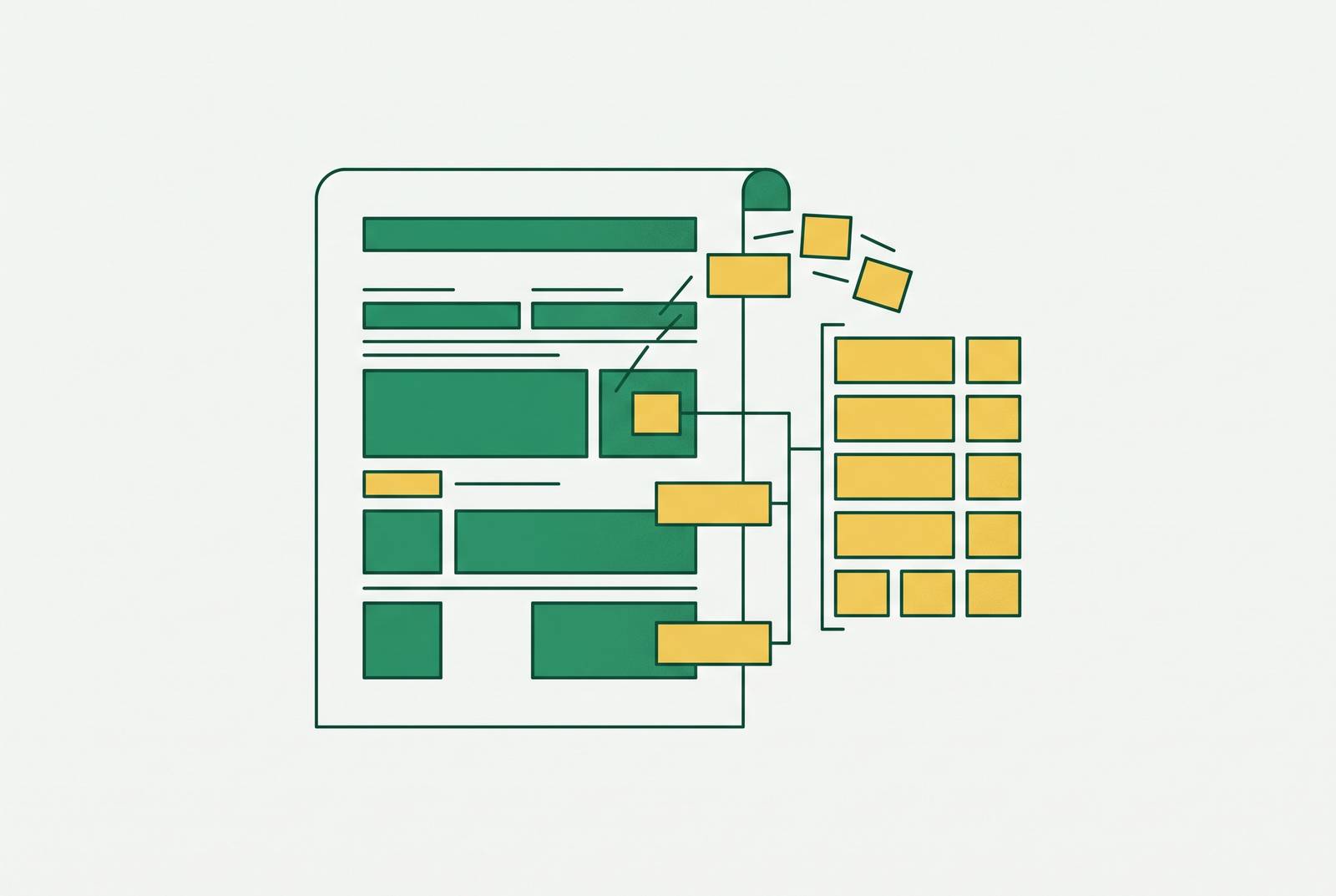
Insurance claims processing demands more from a document extraction pipeline than almost any other document-heavy workflow, because four conditions hit at once: extreme variety in document types, authorship spread across dozens of outside parties, formats that mix clean digital PDFs with faxes and photos, and a tolerance for field-level error that is zero. A single claim file can hold policy declarations, FNOL forms, medical records, police reports, repair estimates, ACORD forms, loss runs, endorsements, certificates of insurance, schedules of values, EOBs, and legal correspondence. Each one has its own layout, its own vocabulary, its own field schema. It's a structural fact about where the documents come from and what happens to them once they're read.
Accounts payable, by comparison, deals mostly with invoices, and most invoices share a recognizable schema. Claims documents come from hospitals, auto repair shops, law firms, government agencies, and policyholders filling out forms by hand. None of those parties coordinate on layout, scan quality, or field naming. A loss run stitched together from five different carriers in five different layouts is a routine Tuesday, and the pipeline has to get every version of it right.
If you get a field wrong, the cost doesn't stay contained to a database somewhere. A misread policy limit, a wrong effective date, or a dropped coverage field is a coverage decision made on bad information, with legal and regulatory consequences attached. That's the condition every section below responds to: extraction errors in claims don't sit still. They move downstream into adjudication, fraud scoring, and payment, and they do damage at every stop along the way.
The document types a claims pipeline must handle
A claims pipeline has to parse a working list of document types, and each one makes its own demands. A clean ACORD application extracts fast. Not every ACORD form is clean: scans arrive crooked, marked up by hand, or shot at a resolution too low to read reliably.
Loss runs raise the bar further. Five carriers, five layouts, one document class, and the pipeline has to handle it without a template break, every single day.
Medical records and EOBs bring a different kind of pressure. Clean, consistent extracted data is what makes an inflated line item visible.
Certificates of insurance and endorsements carry coverage terms, expiry dates, and endorsement changes that decide whether a claim is even valid, so imprecision there is something you can't afford. And then there are the documents that aren't text at all: damage photos from auto and property claims, and handwritten supplement forms, which need a vision-model approach to read. Different document classes need different parsing strategies, so that split in architecture carries into how you build the pipeline, which the engineering sections ahead work through in detail.
Document errors and downstream failures in the claims workflow
Intelligent claims automation runs as a chain of dependent stages: document understanding feeds entity and relationship recognition, which feeds decision support, which feeds workflow orchestration. Each stage only works with what the last one handed it. A system reads the claim narrative and pre-fills the case file, a fraud-scoring model checks for anomalies, and a straight-through processing engine decides whether to approve the claim or route it for review. None of those stages can fix a bad input on its own.
An extraction error at intake doesn't stay at intake. If the pipeline garbles a date, drops a coverage field, or misreads a claimed amount, that bad value becomes the input to the fraud model, the adjudication engine, and the payment decision that follows. Nobody downstream knows the number is wrong unless something flags it, and by the time it's acted on, the mistake is baked into a business decision.
Fraud detection depends on this chain holding together cleanly. A single misread field doesn't just miss a signal. A single misread field also compounds the cost of the error.
There's a regulatory dimension to this too. When two similar claims get different treatment because the same field was extracted inconsistently between them, the resulting decision can't be explained or traced back to a clear reason. It's the kind of inconsistency regulators are positioned to act on.
Where OCR and vision-model extraction break in claims documents
OCR and LLM-based extraction fail in different places, by different mechanisms, and insurance documents reliably trigger both. Knowing which failure mode applies to which document is the first step in auditing a pipeline honestly.
OCR tends to break on image quality. And once OCR gets a character wrong, that error compounds as it moves forward. A misread policy number doesn't just look odd. It fails to match the policy database, and the entire downstream lookup breaks.
LLM-based extraction fails differently, and in some ways more dangerously. If the system doesn't calibrate field-level confidence and ground it to the actual source span, a wrong amount can read as perfectly reasonable and pass review. There's also a security angle specific to agentic workflows: a cover letter or free-text claim narrative can contain embedded instructions that an LLM-based extraction agent reads as commands rather than text, a real risk wherever that agent's tools can affect claim outcomes.
Complex layouts, photographs, handwriting, and skewed scans, all routine in property and auto claims, require vision-language models for accurate reading. But vision models bring their own calibration and grounding demands. The failure mode that causes the most damage in production is the confident wrong answer: an extraction that looks right, clears automated checks, and lands in the claims system without a human ever looking at it.
What field-level accuracy measurement requires in a claims context
Measuring accuracy at the document level hides the exact failures that matter most in claims, where one wrong field, a policy limit, an effective date, a claimed amount, can swing a coverage decision on its own. A document marked "processed successfully" can still carry several wrong fields underneath that label. The right unit of measurement is the field, not the document: what percentage of policy_number extractions were correct, what percentage of coverage_limit values matched the true value, and so on down the schema.
Ground truth for this kind of evaluation has to come from the real production mix, including the worst cases, not a curated set of clean samples.
Field comparators need to match the type of field being checked. Date fields need semantic calendar equivalence, so a formatting difference doesn't get counted as an extraction error it isn't.
Confidence scores earn their keep by routing documents, not just scoring them. A well-calibrated extractor sends high-confidence fields straight through automated processing and routes low-confidence fields to a human reviewer, which pushes the effective accuracy of the automated path well above the raw field accuracy number on its own. The number that ties all of this back to business terms is the straight-through processing rate: how many claims move end-to-end with no human touch, and at what accuracy level that happens.
Compliance and data security requirements specific to claims document processing
Claims documents carry some of the most sensitive personal and financial data that exists, and the rules around that data shape what a production pipeline is allowed to do before accuracy even enters the conversation. Medical records and EOBs carry protected health information, regulated under HIPAA in the US, so you face real restrictions on sending that data to third-party services. Loss runs, policy declarations, and settlement records carry financial personal data, regulated under GDPR in the EU, with obligations around data minimization and retention. Every document type in the file carries personally identifiable information: claimant names, addresses, dates of birth, national identifiers.
Sending claims documents to an outside cloud API is a compliance decision, not just a technical one. If a healthcare insurer processes medical claims, it can't hand patient records to a third-party extraction service unless it satisfies HIPAA's business associate requirements. A carrier operating in the EU has to satisfy GDPR's data processing obligations: a documented legal basis, a processing agreement, real data minimization. The compliance posture of whatever vendor handles extraction belongs at the front of procurement, not tacked on at the end.
Enterprise buyers now expect a minimum set of certifications before they'll even talk terms: SOC 2 Type II for US and North American buyers, ISO 27001 for European and global buyers, and GDPR alignment, which is a legal requirement rather than a preference wherever EU data is involved. An insurer that can't produce proof of a vendor's certification is exposed to audit findings and regulatory scrutiny it didn't need to take on.
Zero data retention is the right default here. Under a zero-retention policy, documents don't sit in storage after extraction finishes. The sensitive content exists on the vendor's infrastructure only for as long as processing takes, and that's the only architecture that holds up for medical, financial, and legal claims documents under GDPR, HIPAA, and most enterprise security policies. Raw document content and OCR output shouldn't.
The EU AI Act adds another layer specific to insurance: it classifies life and health insurance risk assessment and pricing AI as high-risk under Annex III, 5(c), which brings logging, transparency, and human-oversight obligations. So if a pipeline can't show which page, which bounding box, which character span produced a given value, it can't meet that traceability bar.
Invofox is built around this set of requirements rather than bolting them on afterward: SOC 2 Type II attested, GDPR compliant, ISO 27001 certified, with zero-retention processing and deployment options across EU, US, and on-premise.
The build-vs-buy calculus for a claims extraction pipeline
The conditions laid out so far, document variety, compounding error risk, compliance obligations, a steady stream of new edge cases, push the real maintenance cost of a self-built extraction pipeline well past what most engineering teams budget for at design time.
Building a claims pipeline from scratch means standing up several things at once: multiple model strategies for different document classes (text-based OCR for structured forms, vision-language models for photos and handwritten documents, layout-aware parsers for multi-column loss runs and SOVs), a calibrated confidence layer that routes correctly rather than just scoring outputs, an ongoing retraining and edge-case labeling operation to keep pace with new carrier formats and regulatory changes, and a compliance architecture that satisfies SOC 2, GDPR, and HIPAA from the ground up.
Insurance adds a specific kind of compounding: every new carrier format, every new document type from an unfamiliar medical provider, every new jurisdiction's regulatory form, adds a variant the pipeline has to handle without losing accuracy on everything it already handles. Building covers the document set a team starts with. Maintaining covers the next three years of variation on top of it, and that's where most self-built pipelines run into trouble.
The strongest case for building in-house is data control in a regulated environment. But it's solvable through on-premise deployment of a bought solution too, not only by building the whole stack from zero.
Invofox addresses that objection directly through on-premise deployment, where documents never leave an organization's own infrastructure, while the accuracy guarantee, continuous learning, and compliance certifications stay in place. Its "Perfect Docs Guaranteed" SLA commits to 99.2% per-field accuracy, and its pricing charges only for correctly extracted pages, crediting back any page with a wrong field automatically. That structure turns accuracy from a vendor's promise into a commercial commitment, which shifts risk in a way a self-built pipeline has no mechanism to offer.
Continuous learning and human-in-the-loop validation in claims pipelines
If a claims extraction pipeline doesn't learn from its own corrections, it loses accuracy over time, as document formats shift, new carriers come on board, and regulatory forms change shape. Static accuracy isn't a real production standard in a domain that moves this much.
Human review of complex or high-value claims is already standard practice in claims operations. Continuous learning from corrections is what separates a real document AI product from a static OCR tool, and in insurance, where new carrier formats and regulatory forms show up constantly, that learning loop is the mechanism that keeps accuracy from drifting downward.
Confidence-based routing needs the same ongoing attention. A threshold set once, against a baseline document set at implementation, can be miscalibrated within six months if the document mix shifts toward a new carrier's format. Tracking the top exception failure reasons on an ongoing basis, the specific fields and document types where confidence routing starts to slip, is what keeps a pipeline properly calibrated.
Graceful degradation matters most in agentic claims pipelines. A pipeline that handles the large majority of documents end-to-end while routing the rest to manual review is worth more than one that tries to process everything and produces shaky output on the hard cases.
Invofox's continuous learning architecture, improving accuracy in real time from corrections, with field-level confidence scores and agentic validation built in, is aimed at exactly this ongoing maintenance problem, the one that makes static extraction tools fail once they're actually running in production. Paired with transparent performance reports and the per-field SLA, it gives claims operations both the visibility to monitor the pipeline and the commercial accountability to back it, neither of which a self-built or static tool can offer on its own. Extraction in claims is an ongoing engineering discipline, and the pipelines that hold up are the ones built to keep learning.