True Cost of Building an In-House Document Parsing Pipeline
Hidden costs in maintenance, monitoring, and edge cases dwarf the initial build savings.
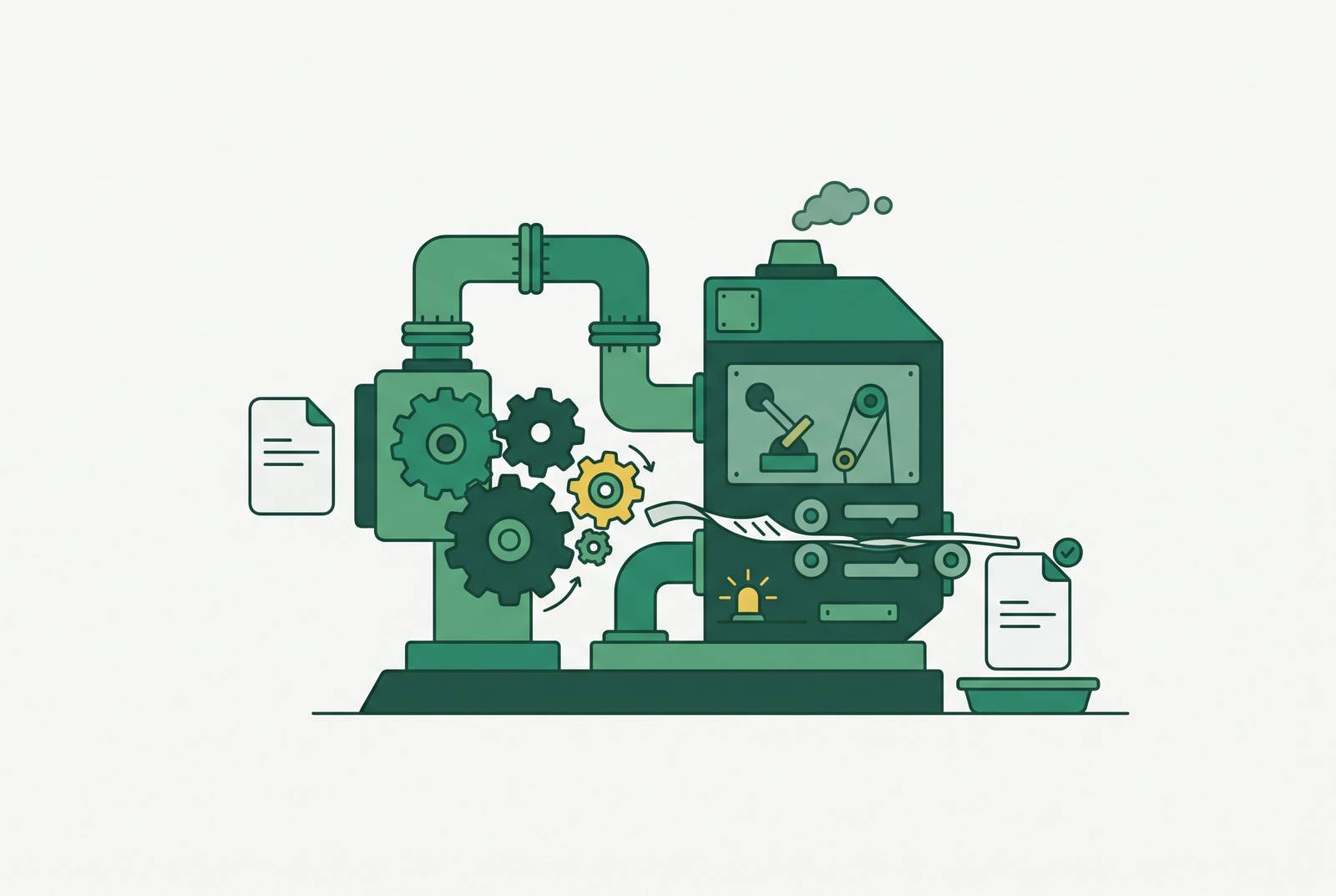
A document parsing pipeline looks easy to build because the first version of it genuinely is easy to build. The evaluation work, the edge cases, the validation rules, the slow drift in accuracy, and the maintenance that never stops raise the true cost later, in layers that never appear in a prototype demo. That gap between what the prototype costs and what the production system costs is the subject of this piece.
Why a Document Parsing Pipeline Looks Cheap at the Prototype Stage
Hand an LLM a PDF library and one sample invoice; it reads the invoice correctly on the first try. The code is short. The demo looks convincing enough to show a manager by lunch. Nothing about that moment hints at what the project turns into six months later.
The ease comes from the conditions, not from the approach. One clean PDF. One document type. No compliance requirement sitting over the team's shoulder. No real volume moving through the system. Every one of those conditions disappears the moment the pipeline has to handle actual production traffic, actual customers, and actual regulators. The prototype was never a small version of the production system. It was a demo built under conditions the production system will never get to enjoy.
What a production-grade pipeline requires beyond extraction
Extraction, pulling text and values off a page, is a small slice of what a working pipeline has to do. Above extraction sits a full stack of work that most teams don't picture when they scope out the "build our own" plan: splitting and classifying documents before any field gets pulled from them, parsing the data into clean structured fields, checking every result against business rules, routing anything that fails those checks into an exception queue, running quality checks on the output, reprocessing documents that failed, giving humans a usable interface to review and correct flagged cases, monitoring the model's behavior over time, and feeding corrections back in to improve it. Each of those pieces has to be designed, built, and kept running.
The real difference between plain OCR and what the industry calls Intelligent Document Processing is visible in that orchestration layer. OCR pulls text off a page. IDP is everything built around that text to make it usable: the routing, the validation, the review loops, the monitoring. That orchestration layer is where the engineering budget actually goes, not in the OCR call itself.
The documents a production pipeline has to handle make this worse. Invoices and contracts differ by vendor, by region, by language, by internal process. A single merger can change a company's templates overnight. Scan quality ranges from a clean digital export to a photo taken on a phone in bad light. Files arrive with stamps, signatures, watermarks, handwritten notes, tables that don't follow any standard shape, columns nested inside columns, and sometimes five different documents stapled into one PDF. None of that is an edge case. That's what a normal batch of real documents looks like.
The PDF format itself doesn't help. PDF was built to make a document look right on screen, not to make its structure readable by a machine. A layout that looks perfectly ordinary to a human eye can be structurally resistant to clean extraction, a mess underneath that only reveals itself once a single unusual document enters the pipeline.
The first-year engineering cost that most build proposals miss
Every build proposal has a budget line for model API calls, and that line is almost always the smallest problem in the plan. It's the one cost that scales in a predictable way, and it's a cost the team would pay whether it built the pipeline in-house or bought a managed platform. The costs that actually decide whether the project succeeds are the ones a build proposal is worst equipped to put a number on.
A document ingestion system needs to be built. Classification needs to be built. OCR has to be integrated and kept working across providers and formats. Validation logic has to encode a company's actual business rules. Exception handling needs a working interface for humans to review flagged cases. Monitoring infrastructure has to watch the whole system for drift. Integration pipelines need to move clean data into the ERPs, CRMs, and underwriting tools downstream. Each of those is a project in its own right, staffed by engineers whose salaries, benefits, and management overhead are absent from a proposal that lists only the model API bill as its headline cost.
The per-page savings of running a pipeline in-house only start to beat a managed API once volume clears a fairly high bar, and most small and mid-market teams never get there. A self-hosted pipeline that includes even a sliver of an engineer's time doesn't pull ahead of a managed API until document volume reaches a scale most teams won't see for years, if ever.
How production documents break pipelines that passed the demo
Pipelines don't fail in production because of the easy cases; they fail silently, because of the cases nobody tested. A wrong value doesn't throw an error. It reaches a downstream system and appears as a bad number in someone's ledger weeks later.
The root cause is usually in the training data. A parser trained mostly on clean digital PDFs posts strong scores in testing while hiding real weaknesses on scanned pages, handwritten notes, or documents laid out in multiple columns. Those weaknesses stay invisible until production traffic finally arrives from a vendor nobody happened to test against, and by then the bad output has already reached a downstream system.
The failure modes are not cosmetic. Parsers can insert stray whitespace, swap one word for another, scramble characters inside an identifier, or in the worst case, drop a whole page without any signal that anything went wrong. That last failure isn't limited to lightweight, cheaply built parsers either. Multi-column layouts cause their own distinct problem: the parser reads the columns in the wrong order and stitches together a document that makes grammatical sense but says something the source document never said. Each new vendor, each new template, each new document type becomes its own small project, needing its own labels, its own rules, and its own careful testing. Scale is what exposes the fragility the prototype never had a chance to reveal.
Why accuracy drift goes undetected without a purpose-built evaluation harness
Without a system built specifically to measure field-level accuracy, a pipeline can degrade for months with nobody noticing. The system keeps running. The errors keep piling up quietly in whatever database they land in. The team only finds out when a downstream report breaks or an audit turns up numbers that don't reconcile.
Accuracy has to be measured at the level of the individual field, not the whole document. Tracking the rate at which required fields get extracted correctly, how often high-risk fields come out right, whether every row of a table gets captured, how often the system wrongly accepts a bad value, and how often it wrongly sends a good value for human review: these numbers give a pipeline something concrete to fail against. A simple pass-or-fail score at the document level hides exactly the kind of field-level regression that matters most.
Confidence scores coming straight out of a large language model are not a reliable guide either. A high confidence score attached to a wrong answer is far more dangerous than a low confidence score attached to a right one, because the first case slips through unreviewed while the second case merely wastes a reviewer's time. A raw model output carries no calibrated sense of its own reliability, so there's no built-in signal telling a team which results are safe to auto-process and which need a human to check them. Building that signal, banding results into auto-accept, candidate-for-review, review-required, and reject categories, takes real calibration work, and that work is its own project sitting alongside the extraction pipeline, not a byproduct of it.
Much of what looks like a model problem is actually a document problem. A strong model reading a badly scanned page will still produce confident-sounding output about noisy, half-legible source material. Any confidence system that only looks at the model's internal signals and ignores the quality of the document itself is measuring the wrong thing. Building and maintaining that kind of evaluation system is ongoing work as new vendors and layouts appear over time, and most in-house teams skip it first when deadlines get tight. Define the output schema up front, before a single document gets processed, and let that become the contract the extraction logic has to meet, with any document that can't produce a valid result against that schema failing out loud, not slipping through quietly.
The maintenance burden that compounds after the first engineer moves on
A document parsing pipeline isn't a project that finishes; it's an ongoing commitment, and quality starts slipping, with nobody watching for it, the day the engineer who built it gets pulled onto something else.
What started as a simple ingestion script tends to grow into a web of services, queues, and small scripts that only one or two people fully understand. That's a real organizational risk the moment those engineers change teams or leave the company. Layouts keep changing. New document types keep appearing. Each change demands new labels, a model update, a round of regression testing, a redeployment, and renewed monitoring to catch any dip in accuracy. None of that work is optional, and none of it stops once the pipeline ships.
Every OCR or LLM provider a pipeline depends on adds its own slice of upkeep: SDKs to update, credentials to rotate, rate limits to manage, versions to track. A provider's API change can cascade straight into a regression nobody saw coming. The same lesson applies in legal AI, where the thing that kills a project is rarely the initial build. It's the maintenance nobody staffed for, and that's precisely the burden an in-house build takes on permanently while a managed vendor absorbs it instead. Teams relying on separate templates for each vendor feel this hardest: every vendor means another template, every layout change means another manual fix, and the maintenance load grows with the number of vendors, not with how skilled the engineering team becomes.
Compliance and Security Requirements on an In-House Build
Compliance isn't something a team bolts onto a document pipeline once it's already working. It shapes the architecture, the way data gets handled, and the audit burden from the very first design decision.
Zero data retention is the only safe default for any document carrying sensitive financial or personal information. Sending payslips, bank statements, tax forms, or medical records through a third-party model API without confirming the vendor holds to zero-retention terms means that vendor may be storing that data, and the regulatory exposure from that now belongs to the team that built the pipeline. The EU AI Act's provisions for high-risk AI systems apply to any operation touching the EU, and existing guidance from the OCC, the Federal Reserve, and the FDIC on model risk in financial decisions adds its own audit and documentation demands. An in-house pipeline has to satisfy all of that without the compliance infrastructure a specialist vendor has already spent years building.
Security has its own overlooked failure point: hidden text inside a PDF. An extraction pipeline that doesn't cleanly separate what a document visually renders from what its text layer actually contains is structurally open to prompt injection. Fixing that takes deliberate architectural work, not a policy memo. Getting any of this wrong doesn't register as an extra line in next quarter's budget. It appears as a regulatory action, a data breach notification, or a failed audit that stops the pipeline cold.
Running the honest build-vs-buy calculation before the prototype sets expectations
The build-vs-buy call gets made wrong when it gets made at the prototype stage, because the only cost visible at that point is the model API bill, and that's a cost the team would have paid under either path.
Building in-house makes sense when volume is low and likely to stay that way, when documents are one consistent and stable type, when there's no compliance or audit requirement hanging over the data, and when the team has the engineering capacity to keep maintaining the pipeline for years, not just ship a first version and move on. Buying a managed platform makes sense when volume is growing or already high, when document types and layouts keep shifting, when compliance or data residency requirements apply, or when engineering time is worth more spent on the core product than on parsing PDFs.
An honest cost comparison has to include the full first-year engineering labor across every layer of the stack, the evaluation harness that most proposals leave out entirely, the ongoing maintenance that follows every layout change, the compliance and security architecture the system needs from day one, and the organizational risk of depending on the one or two engineers who understand how the pipeline actually works. The soundest path for most teams starts on a managed layer, where cost is predictable and the system is working fast. Migrating to a self-hosted build only makes sense once volume clearly clears the break-even point and the team has engineers who can own machine learning work long-term, or a genuine sovereignty requirement that leaves no other option.