The Short List of Document Extraction Vendors With Accuracy Obligations in the MSA
Only a handful of document extraction vendors put accuracy guarantees into contracts.

Most document extraction contracts promise uptime, not accuracy. Almost none of them put a number on how often the extracted data has to be correct, and that gap is the subject of this piece: which vendors have actually written a per-field accuracy commitment into their agreement, what that commitment has to contain to mean anything, and why the rest of the market treats accuracy as a feature claim rather than a contractual one. Invofox is the clearest example of a vendor that has done this, with a named accuracy SLA tied directly to billing. Pathnovo, Nutrient, and ParseRail represent the more common posture: real extraction products, but without a confirmed per-field accuracy floor sitting in the MSA itself.
Why most document extraction MSAs make no accuracy promise
If you sign a document extraction contract, you probably assume the vendor is promising accurate data. What the contract usually promises is that the service will be online. That's the gap running through enterprise AI software generally: vendor counsel treats model output as inherently probabilistic, so instead of guaranteeing a result, the agreement disclaims one.
The standard SaaS MSA structure makes this easy to miss. One document sets the relationship terms once: limitation of liability, IP ownership, confidentiality, governing law. Performance specifics, the things that actually describe what the product does, get pushed down into a Statement of Work or a separate SLA exhibit, and for AI output quality, that exhibit frequently never gets written. Uptime makes it into the SLA because uptime is measurable and because the vendor controls it almost completely. Field-level accuracy against ground truth does not make it in, because a transformer-based model is nondeterministic. The same scanned invoice can produce slightly different extraction results from one run to the next, or after a routine model update, and a hard contractual floor is harder to defend when the underlying system was never built to be perfectly repeatable. None of this is vendor counsel acting in bad faith. It's a reasonable legal response to a genuinely probabilistic system. But the result is a document extraction market where almost every vendor will tell a sales prospect their model is highly accurate, and almost none will put that number in the contract where it would actually matter.
Accuracy obligations in contract language
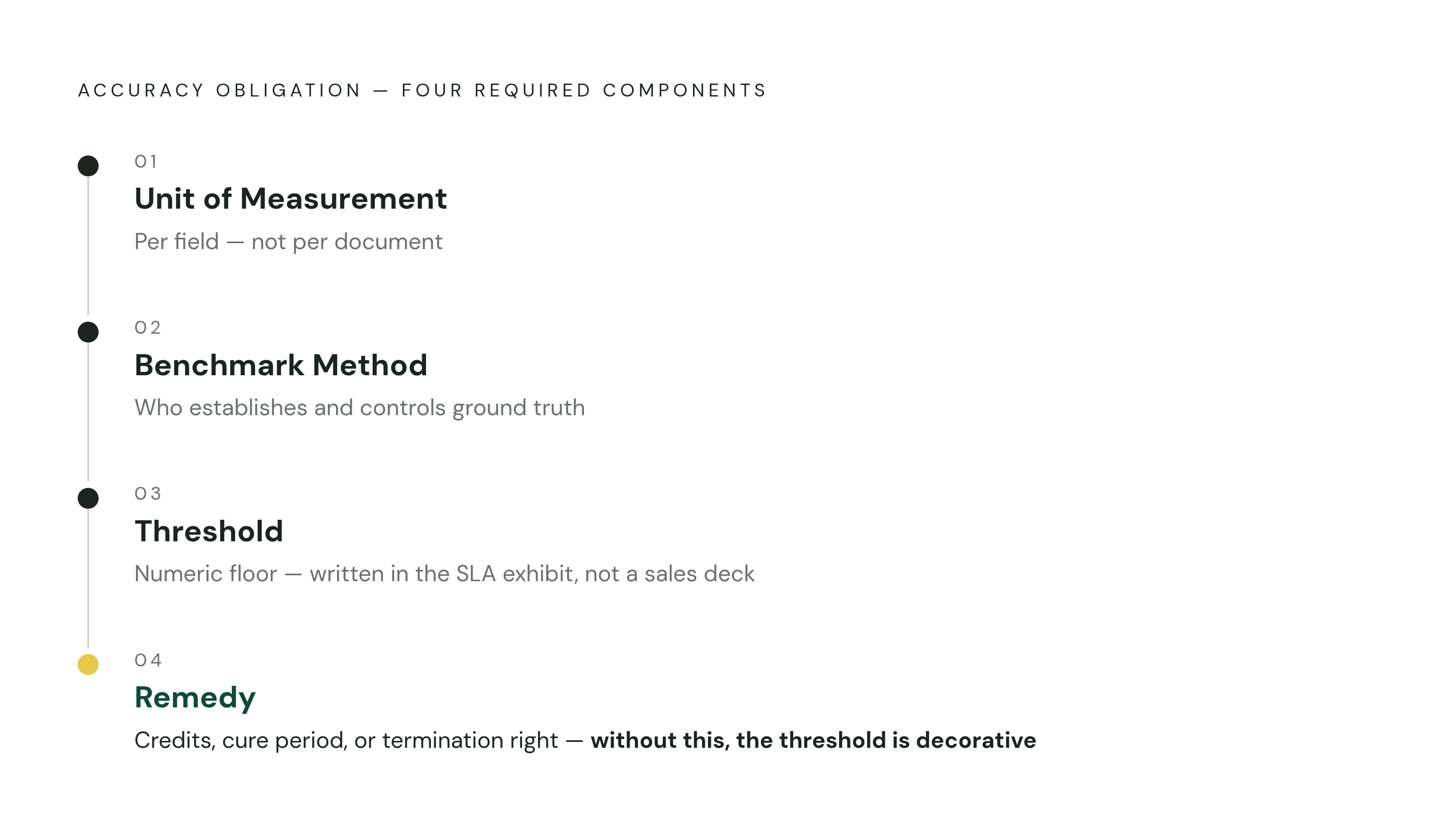
An accuracy clause that says a vendor is "committed to high accuracy" commits to nothing. A real accuracy obligation needs four things present at once: a unit of measurement, a benchmark method, a threshold, and a remedy. Almost no standard MSA SLA exhibit in document extraction contains all four, which is part of why the handful that do are worth naming directly.
The unit of measurement has to be the field, not the document. Document-level accuracy is a number that can hide serious problems: a vendor can report that the large majority of documents were processed "successfully" while consistently missing the tax ID field on every invoice, because document-level scoring only asks whether most of the page came back readable. Measuring accuracy per field, every extracted cell checked independently against a known correct value, is the only version of the number that tells a buyer anything about what will go wrong downstream. The benchmark method matters just as much as the unit: the clause needs to say how ground truth gets established, whether that's a human-verified test set, a labeled set the customer supplies, or an agreed document corpus, and who controls it. A benchmark the vendor builds and grades itself isn't a protection for the buyer, no matter how good the resulting number looks. The threshold is the actual floor stated in the SLA exhibit itself, not in a sales deck or a documentation page, with the scope spelled out: which document types, which field types, which confidence tiers it applies to. And the remedy has to answer a plain question: what happens when the vendor misses the number. Service credits, a cure period, a termination right, something concrete has to follow a miss, or the threshold is decorative.
A few clauses next to the accuracy language deserve the same scrutiny. Liability caps in vendor contracts commonly run twelve months of fees, and that cap limits what a buyer can recover even if an accuracy SLA is breached, so if you're in a regulated industry, push for carve-outs that cover data errors that cause downstream compliance failures. Data-use terms matter too: a confidentiality clause that lets the vendor train its own models on customer documents means the vendor gets better at the buyer's expense without taking on any accuracy obligation in return. And if a retention clause keeps processed documents indefinitely, it creates its own compliance exposure, no matter how the accuracy number reads.
Regulated industries cannot treat accuracy as a best-effort promise
An unguaranteed error rate in regulated document workflows is active financial and compliance exposure that compounds with volume. Three industries make this concrete.
In accounts payable, a misread amount, tax ID, or line-item total that goes through straight-through processing without a human check produces duplicate payments, tax reporting errors, and audit findings. When invoice volume is high, even a small per-field error rate adds up to a lot of wrong payments moving through the books. In mortgage lending, a single loan file can run to hundreds of pages across income documents, tax forms, and closing disclosures, and one misextracted figure on a 1003 form or a closing disclosure can trigger regulatory review under TRID or RESPA. In healthcare and insurance, if extraction feeds automated underwriting or claims decisions, it falls under GDPR's restrictions on fully automated decisions about individuals. Article 22(3) gives people the right to human intervention and to contest the decision, and Articles 13 through 15 require meaningful information about the logic behind it, though the regulation stops short of a standalone right to a full explanation or a requirement that explanation be built into the workflow.
What makes this worse than old-fashioned OCR error is the way it fails. A blank field is a visible miss: someone catches it, because nothing came back. A hallucinated field, a plausible but invented invoice number or tax amount from a vision-language model, passes right through validation, because it looks like a normal value. Vision-language model parsers can produce this kind of fabrication on high-resolution, text-dense pages, so you have to check extracted values against the source pixels and not just read the model's confidence score. That confidence score is part of the problem on its own: a model that hallucinated a value and reports high confidence in it is strictly more dangerous than a model that flags low confidence on something it got right. Best-effort accuracy might be tolerable when the cost of an error is a resend. It is not tolerable when the error is silent and the downstream decision is a loan approval or a claims payout.
What accuracy vendors have put in writing
Confirmed accuracy obligations backed by financial remedies, sitting in the agreement itself rather than in a product page, are rare across this market. Most vendors who talk about accuracy are talking about it in documentation, not in the SLA exhibit a customer actually signs.
Invofox is the clearest exception. Its "Perfect Docs Guaranteed" commitment is a named per-field accuracy SLA, with a defined accuracy floor, stated at 99.2%, built into the agreement. The commercial structure backs the number up directly: customers pay only for pages extracted correctly, so an incorrectly extracted page gets credited back once it's reported through the API feedback endpoint, and this SLA tier is available on higher-volume plans. So Invofox's own revenue is on the line for each extraction, rather than collecting on volume regardless of correctness. The measurement side holds up too: per-field confidence scores come with page, region, and source provenance attached, so confidence is calibrated against ground truth. Invofox's answer to nondeterminism, the reason vendor counsel usually cites to avoid committing to a number at all, is continuous learning from validated corrections, so the accuracy floor moves up over time instead of drifting unpredictably between model releases.
Microsoft Azure Document Intelligence reports strong confidence figures for its structured document models, receipts and identity documents in particular, but those figures live in product documentation, not in the enterprise MSA's SLA exhibit. Microsoft's standard contractual commitment covers uptime and model-version retention, so GA model versions stay supported for a defined period after a deprecation notice, but it does not cover per-field extraction accuracy. No binding accuracy guarantee with a financial remedy appears in Microsoft's publicly available enterprise terms, though large buyers negotiating bespoke enterprise agreements may be able to push for a custom SLA exhibit; it isn't a standard offering. Azure's compliance footprint is genuinely strong, with SOC 2, GDPR, ISO 27001, and FedRAMP coverage, so buyers evaluating Microsoft should look closely at the data-retention and model-training language in the enterprise agreement alongside accuracy.
Google Document AI follows a similar pattern. Its published SLA commits to uptime, defined as Monthly Uptime Percentage, as the sole measured service level, with no field-level correctness commitment anywhere in the document. You find accuracy figures for Google's models in product and research documentation instead. A document-level prompting capability added to the product improves contextual accuracy in practice, but that improvement doesn't carry over into a contractual floor. Buyers considering Google should weigh the data-use and model-improvement terms against whatever accuracy claims show up in the sales process.
Mistral's OCR 4 is harder to place. Whether Mistral contractually commits to a specific per-field accuracy number with financial remedies in a standard agreement could not be confirmed from available information. The product architecture supports the kind of measurement an accuracy SLA would need, but the contractual commitment itself remains unconfirmed, and buyers accessing OCR 4 through Microsoft Azure AI Foundry add a procurement layer between themselves and Mistral's own terms, which complicates the question further.
Pathnovo, Nutrient, and ParseRail all operate in this same space, offering real document extraction capability without a confirmed per-field accuracy floor written into their standard agreements. That puts them in the same position as most of the market: credible products whose accuracy claims live in documentation and sales conversations, enforceable only by a number written into the contract itself. The core library is open-source under a permissive license, with no enterprise MSA to evaluate, though its maker has since built a commercially structured managed offering on top of it with its own subscription pricing.
Why vendors avoid accuracy SLAs
The standard vendor explanation for skipping an accuracy SLA holds up to a point: document quality, format diversity, and edge-case volume genuinely sit outside a vendor's control, and that's a real argument, not a dodge. A rotated, coffee-stained scan of a 1990s fax is just harder to extract correctly than a clean digital-native PDF. You can't reasonably hold a vendor to one flat accuracy number across every document type and quality grade. Nondeterminism adds a second layer: because transformer-based models aren't perfectly repeatable, a routine model update can shift extraction behavior on a document type the vendor didn't intend to touch, and locking a static floor across every model version risks punishing the vendor for improving the system.
Neither point justifies skipping an accuracy obligation entirely, though. A well-built accuracy SLA scopes the problem instead of avoiding it: document types, quality grades, field types, and the measurement corpus can all be defined in advance. A vendor who says accuracy "can't be guaranteed" usually means the scoping work hasn't been done, not that the work is impossible. The confidence score itself gives this away: most mature document extraction platforms already assign a confidence figure to every field they extract, which is already an implicit accuracy claim. Declining to put a contractual floor under a number the system is already producing internally is a business decision, not a technical limit. Pricing tied to correctly extracted pages, the approach Invofox uses, resolves the vendor's own objection by sharing the risk rather than avoiding it: the vendor only gets paid when the extraction is right, so the incentive to measure and improve accuracy sits on both sides of the contract instead of one.
There's also a quieter asymmetry: confidentiality clauses that let a vendor train its own models on customer documents mean the vendor is extracting ongoing value, better model performance, from the customer's data, without accepting any accuracy obligation in return. And even where an SLA exhibit technically exists, most vendor agreements only issue credits when the customer files a formal claim. If you aren't actively monitoring extraction output and logging misses, you will recover nothing, even under a contract that looks protective on paper.
A procurement checklist for accuracy obligations in a vendor MSA
Start with the four elements and test each one directly. Ask whether accuracy is defined per field or per document, and reject any SLA that leaves this unspecified, because document-level scoring can mask systematic failures on specific fields. Ask how ground truth is established and who controls that benchmark, because a vendor-graded benchmark with no independent audit right is a marketing number wearing a contract's clothing. Ask whether a numeric threshold actually appears in the SLA exhibit itself, not in the product documentation or the sales deck, since only the number in the exhibit is enforceable. And ask what happens when the vendor misses that number: service credits triggered only by a formal claim, automatic billing adjustments for incorrect extractions, a cure period, and termination-for-cause rights on sustained failure are four meaningfully different levels of protection, and a buyer should know which one is actually in the agreement before signing.
A few adjacent clauses deserve the same attention. Check whether the confidentiality clause lets the vendor use submitted documents to train its own models; this has become common in SaaS terms, and you can easily read past it. Check that a zero-retention commitment, if one is promised, actually appears in the DPA or the MSA's data security exhibit with an explicit deletion timeline and an audit right. Confirm that the standard twelve-month-fee liability cap carves out data errors that cause downstream compliance failures, like a misextracted tax figure or a wrong loan amount. And confirm how long a model version stays supported after a new one ships, since a model update that quietly degrades accuracy on a buyer's specific document types is a practical accuracy failure even where it isn't a contractual one.
Teams weighing a build-it-yourself extraction pipeline against any of this should price in the parts of the vendor relationship that don't show up as line items: SOC 2 Type II certification, GDPR-compliant data handling, ISO 27001 information security management, and chain-of-custody logging aren't features bolted onto a pipeline, they're ongoing governance programs that need dedicated people and recurring audits. In-house builds also tend to stop at OCR and extraction, leaving validation, reconciliation, and compliance checks to manual review, which quietly recreates the accuracy risk the automation was supposed to remove. A vendor carrying a contractual accuracy SLA, pricing tied to correctly extracted pages, and certified compliance infrastructure already in place usually comes out ahead on total cost once maintenance, edge-case handling, and compliance overhead are counted honestly. The checklist above is what separates a vendor who has taken on accuracy risk from one who has simply described it well.