Migrating From a Legacy OCR Pipeline to a Managed IDP API
How to safely replace document understanding while keeping OCR and managing vendor risk.
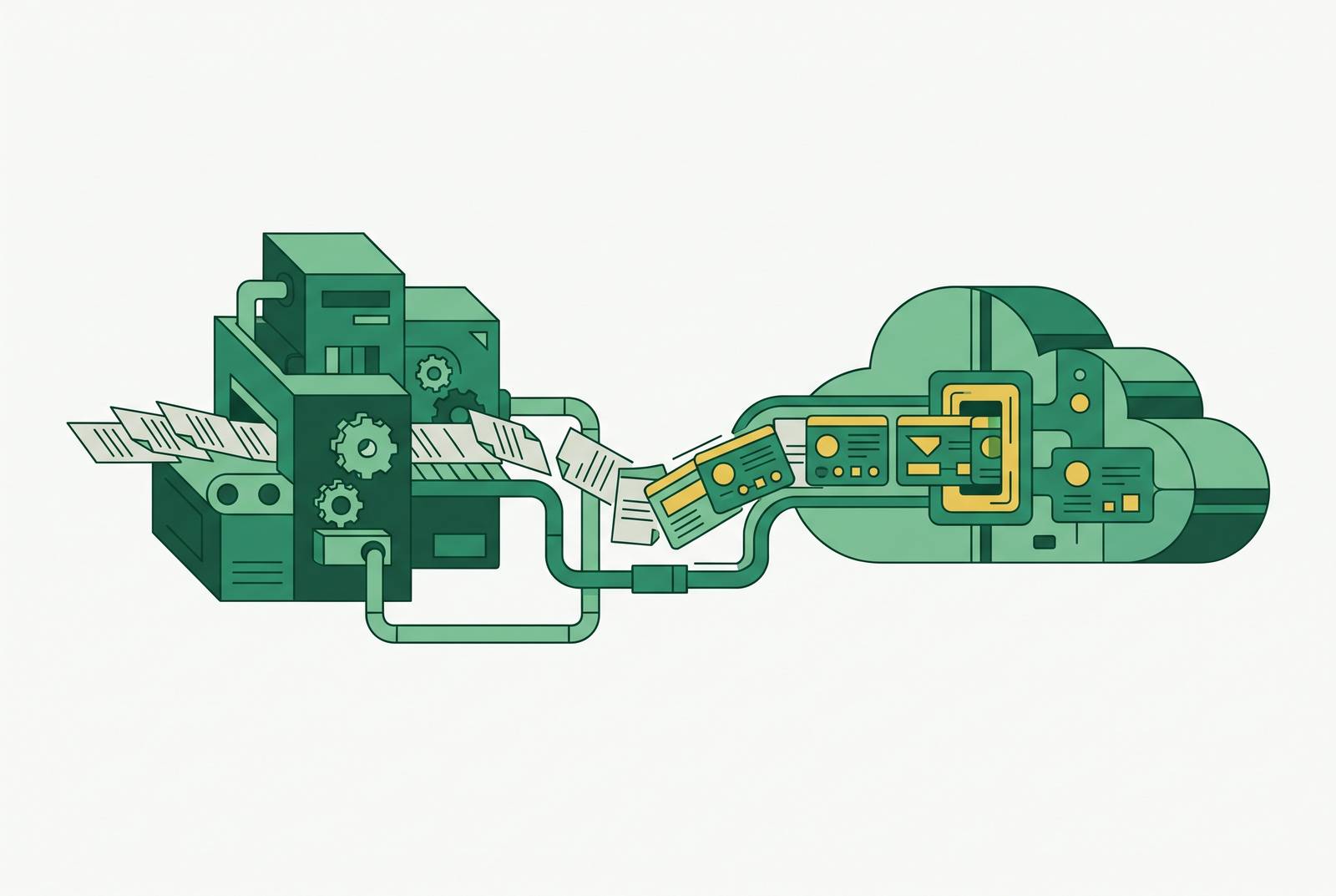
Migrating from a legacy OCR pipeline to a managed IDP API means replacing a brittle understanding layer while retaining OCR. The API can remove much of the template and model maintenance, but it does not remove engineering responsibility. A safe migration depends on field-level accuracy tests, contractual security guarantees, and a phased cutover with validation built in.
What the legacy OCR pipeline actually contains and where it breaks
A legacy pipeline has at least four distinct layers, namely document capture, OCR, template matching or rules, and downstream validation or ERP integration. Capture brings the document in, and OCR turns pixels into characters. The rules layer maps those characters to fields. Validation and integration then control the extracted values' entry into a business system. These layers do different jobs, so replacing them as though they were one component addresses the wrong problem.
The OCR engine generally continues to read text. What breaks is the assumption that a fixed template can anticipate every layout in the document population. A finance team handling a 200-bank statement workload must keep a template up to date for each bank layout. A PDF redesign can silently break the mapping, just as a supplier ERP migration can break an invoice template.
That maintenance burden grows with format churn. AP teams that once managed a few hundred templates now manage several times that, with each change requiring manual retraining and reopening the exception queue. Structural problems compound the work, including merged cells, hierarchical headers, cross-page tables, multi-column reading order, checkboxes, and handwritten attachments. When a large minority of documents need manual correction, running the “automated” pipeline can cost more than it saves.
What a managed IDP API actually replaces in that stack
A managed IDP API replaces the understanding layer that decides what a document is, which fields matter, and what a value means in context. Modern IDP uses a two-phase architecture. A purpose-built OCR or vision model handles the pixel-to-character step, while a language-model layer identifies fields, resolves meaning, and produces structured output.
The managed service takes over template authoring and maintenance by generalizing across layouts without per-supplier configuration. Confidence-scored outputs replace brittle routing rules written for each document type. The service also takes on model drift and retraining as document populations change. An evaluation harness can measure each field against ground truth, so the team has one less costly tool to keep up to date. Those are substantial transfers of work, but their scope still needs to be clear.
The team still has to handle document capture, including email ingestion, scanner connectors, and portal polling. Writing structured JSON into an ERP, workflow tool, or data warehouse also remains integration work. Confidence scores can identify fields for review, but the team must design and operate that review workflow. Nor does outsourcing processing transfer legal responsibility. The vendor processes documents on the customer's behalf, while the customer remains accountable for compliance.
Why accuracy must be measured per field before migration begins, not after
Character-level accuracy alone cannot show whether the replacement is ready for production. Most of the text in a document can be right even when the invoice total, tax ID, or date is wrong. What matters is whether each field consumed downstream is correct. The evaluation unit must therefore be the field, scored against labeled ground truth from the team's actual document population. A vendor's curated benchmark cannot substitute for that test.
Build the baseline from real documents, including hard cases such as scans, degraded stock, non-standard layouts, and multi-page documents. Test each part of the pipeline on its own so the results show which errors come from recognition and which come from field-mapping or validation. Then ask the vendor for per-field accuracy on a representative document type, rather than an aggregate claim across unrelated documents. Require accuracy commitments in an SLA. If the vendor will not make that commitment, quantify and price the production-error risk before signing.
Confidence needs a separate test because it is a routing signal. High-confidence fields can route to auto-acceptance, mid-range fields to review, and fields below a defined threshold to manual processing. The dangerous case is a wrong value with enough confidence to bypass review. Calibration also differs by field type, with numeric fields tending to be better calibrated than free text, which can be overconfident at high predicted probabilities. Test those bands against the team's ground truth before using them to control live traffic.
The data-security obligations that must be resolved before any document leaves the perimeter
Accuracy does not override the security gate. Sending a customer document to a managed API is a compliance event, and its contractual terms belong before integration. Under GDPR, the team must have a signed Data Processing Agreement to send personal data to an external processor. Without the DPA, the transfer is unlawful regardless of the vendor's technical security posture. Procurement and legal need that instrument before documents cross the perimeter.
Vendor review must cover a SOC 2 Type II report for operational effectiveness, with Type I attestation limited to design. Under SOC 2, vendors receiving data must also be inventoried, scoped, and assessed periodically for risk. Processing Integrity matters here because extraction must be complete, valid, accurate, timely, and authorized. The team must be able to demonstrate that automated extraction did not bypass validation. ISO 27001 certification is recommended where work is regulated, and healthcare workflows must have a HIPAA Business Associate Agreement.
Require a zero data retention policy in the contract that covers both documents and extracted fields and bars storing them or using them for model training once processing is done. A privacy policy is not that guarantee, and sensitive financial, personal, health, or payroll data makes this a default requirement. Confirm EU/US regional processing where appropriate. Where residency rules prohibit shared cloud processing, resolve the need for on-premise deployment or deployment in an isolated private cloud before sending data.
How to structure the migration in phases without cutting over a live pipeline in one move
The first phase is shadow mode. Send the same inbound documents through the legacy pipeline and managed API, but keep the API's output on a separate path with no downstream routing change. Compare output fields against the established ground truth to measure divergence. This exposes document types on which the new system underperforms before its output reaches live workflows. Run the comparison long enough to see how formats change and how documents vary by season, since one week of invoices may miss a supplier's quarterly statement format.
The second phase moves one well-understood document class into one workflow. Choose a class with clear ground truth, measurable field definitions, and an identifiable downstream consumer. Keep all other classes on the legacy pipeline while proving field accuracy, review routing, and correction rate.
The third phase establishes human review as permanent architecture. Set auto-acceptance, review, and manual-processing thresholds by field criticality. When a document has schema failures, missing required fields, or low confidence, it should go to review with its best-effort extraction kept intact. Feed reviewed corrections back through the API so a service that supports continuous learning can improve from them.
The fourth phase expands the portfolio once the first class and its review workflow are stable. Prioritize by volume and error cost, starting with high-volume, high-correction-rate document types. Shut down the legacy path one class at a time so the shadow infrastructure does not keep running forever. Otherwise, the transition leaves two sources of truth for the same document.
Where production failure actually happens during and after cutover
The most commercially damaging extraction failures are silent. The pipeline returns output, confidence is high, and no review fires, but the value is wrong. A shifted table header or merged-cell error can associate a value with the wrong column while confidence reflects structural extraction. Multi-column reading order creates similar trouble. Cross-page tables also need tracking from one page to the next, but most template-based and many API-based parsers handle each page on its own.
Poor scans, unusual fonts, and faxed-twice PDFs can cause a language model to turn OCR noise into text that looks right, with no automatic warning about the quality of the source. Ingestion therefore needs preprocessing gates for scan resolution, embedded-image-only PDFs, and hidden text layers. Hidden text is also an attack surface because instructions that cannot be seen on the rendered page can get into an LLM-based extraction path through PDF text. Verify that the API separates visual and text-layer processing and sanitizes raw PDF text before passing it to a language model.
After cutover, changes in the documents can cause more failures. Suppliers change layouts, new rules require more fields, and acquisitions bring in document types the team has not seen before. Without continuous learning, a managed API can drift like a static template, only more slowly. The reviewed-correction loop is therefore more than a way to clear today's queue. Document threshold decisions, known edge cases, and special field validation during migration so that this operating knowledge survives the engineer who built it.
The build-vs-buy question at the evaluation stage, not after costs compound
Decide whether to build the understanding layer before finalizing the migration plan. A working extraction demo does not represent the whole cost of ownership. A self-built stack needs labeled ground truth, per-field scoring, and confidence calibration. It also needs handling for scans, degraded stock, handwriting, and multi-page layouts. Those cases may be absent from a demo while dominating the production exception queue.
The team also has to build human review with structured validation errors, audit trails, and traceability for regulated workflows. Maintenance continues as documents change and the original engineer moves on. The self-hosting break-even is above 50,000–100,000 pages per month with a dedicated ML engineer available. Low managed-API prices have pushed that threshold higher than many teams expect.
The strongest case for self-hosting is an air-gapped workload whose residency requirements prohibit any external API call. Even there, managed deployment on-premise or in an isolated private cloud may satisfy the requirement without making the team own the model. Commercial terms also change the comparison. Paying only for pages extracted correctly, rather than every raw page processed, puts the cost of failures on the vendor. That aligns the service's commercial incentive with the customer's accuracy requirement.
What a production-ready cutover checklist actually covers
The accuracy gate asks whether every downstream field type scores at or above its SLA threshold when checked against ground truth from the team's own documents. It asks whether confidence has been calibrated by band and whether the high-confidence band is safe for auto-acceptance on that distribution. It also asks whether shadow mode ran long enough to see the ways formats vary in real documents. Each answer must be yes before the document class moves.
The security gate asks whether the DPA is signed, the SOC 2 Type II report is reviewed, and applicable ISO 27001 and sector requirements are confirmed. It asks whether zero retention is guaranteed in the contract. It also asks whether the selected region or on-premise deployment satisfies residency requirements. A further gate asks whether hidden-text and prompt-injection risks have been evaluated for the extraction architecture.
The validation gate asks whether every output is parsed against the expected schema and failures reach review with the best-effort extraction preserved. It asks whether confidence routing is defined and tested per field. It also asks whether human review is operational before live traffic moves. The feedback gate asks whether reviewed corrections go to the learning system.
The continuity gate asks whether the legacy pipeline remains live for unmigrated classes without shared infrastructure creating a single point of failure across both paths. It asks whether shadow-mode edge cases, expected behavior, and threshold decisions are documented for the next maintainer. The final gate asks whether there is a schedule for regular reports on per-field accuracy after cutover. The migration is complete when traffic has moved and the team can keep measuring whether the new pipeline is working correctly.