Document AI Vendor Lock-In Risks and Mitigation Strategies
Organizations can escape document AI lock-in by owning data and testing exit paths early.
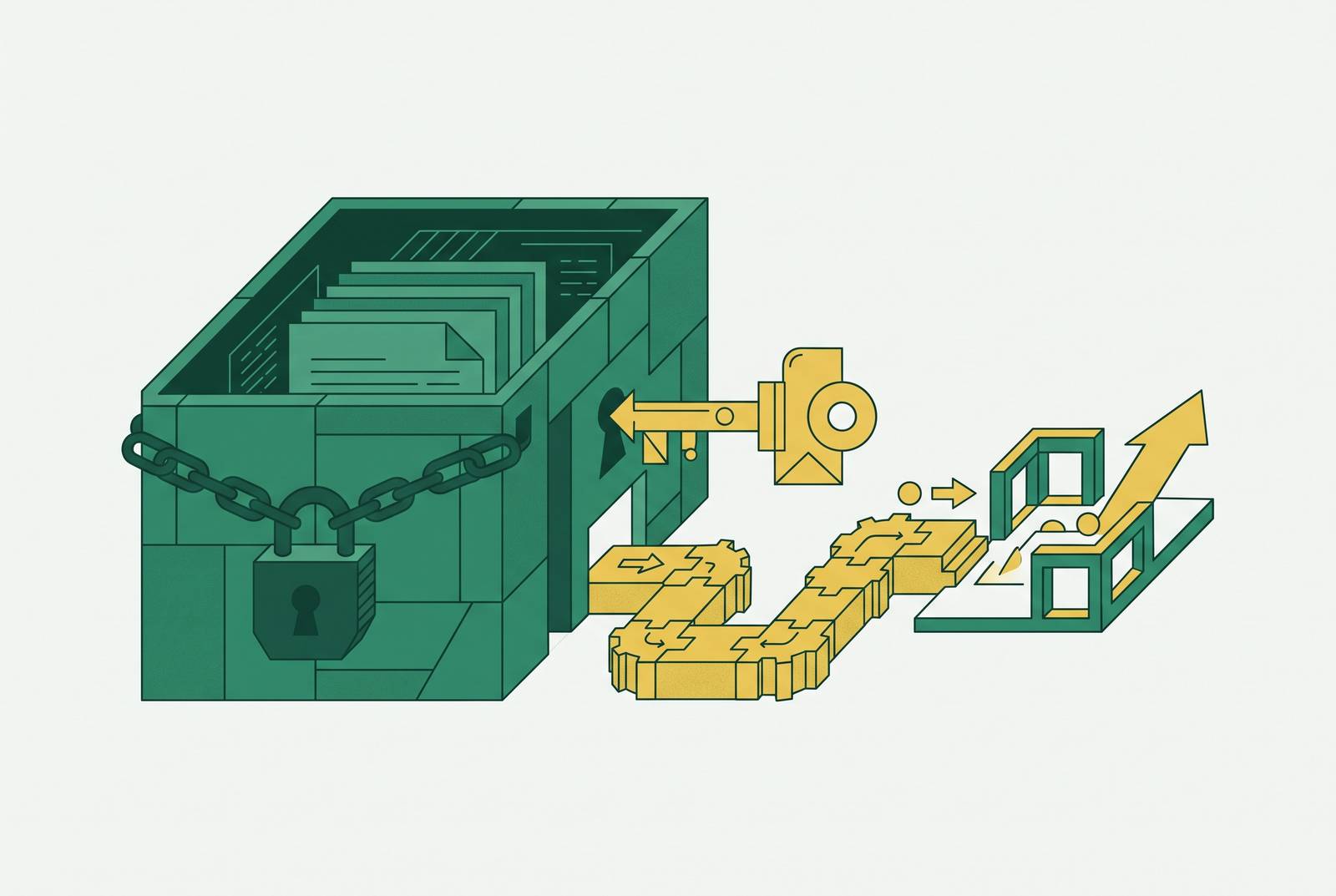
Document AI vendor lock-in grows through more than a hard-to-replace API. It takes hold in output schemas, correction history, accuracy contracts, and compliance records. To keep that dependency recoverable, the organization must own the evidence and data it needs to leave, keep vendor output separate from downstream systems, and test a migration path before it needs to switch in a hurry.
Why document AI lock-in accumulates differently than generic software lock-in
Standard SaaS migration usually means exporting data, rebuilding integrations, and retraining staff. The underlying workflow exists independently of the software, even when moving it is expensive. In document AI, part of that workflow lies in how the vendor’s model extracts data. Exporting the source documents does not carry over what the model has learned about extracting data from them.
That distinction changes what a migration must recover. A replacement needs to return fields that can be used, deal with the exceptions learned through corrections, and provide the records needed for audit. Meanwhile, as the model is updated often, the behavior that a replacement must match keeps changing. The more ordinary danger is not a sudden shutdown but a pricing change at year two that the customer cannot respond to economically. The useful measure of dependency is therefore the cost of changing vendors.
The five layers where document AI lock-in actually accumulates
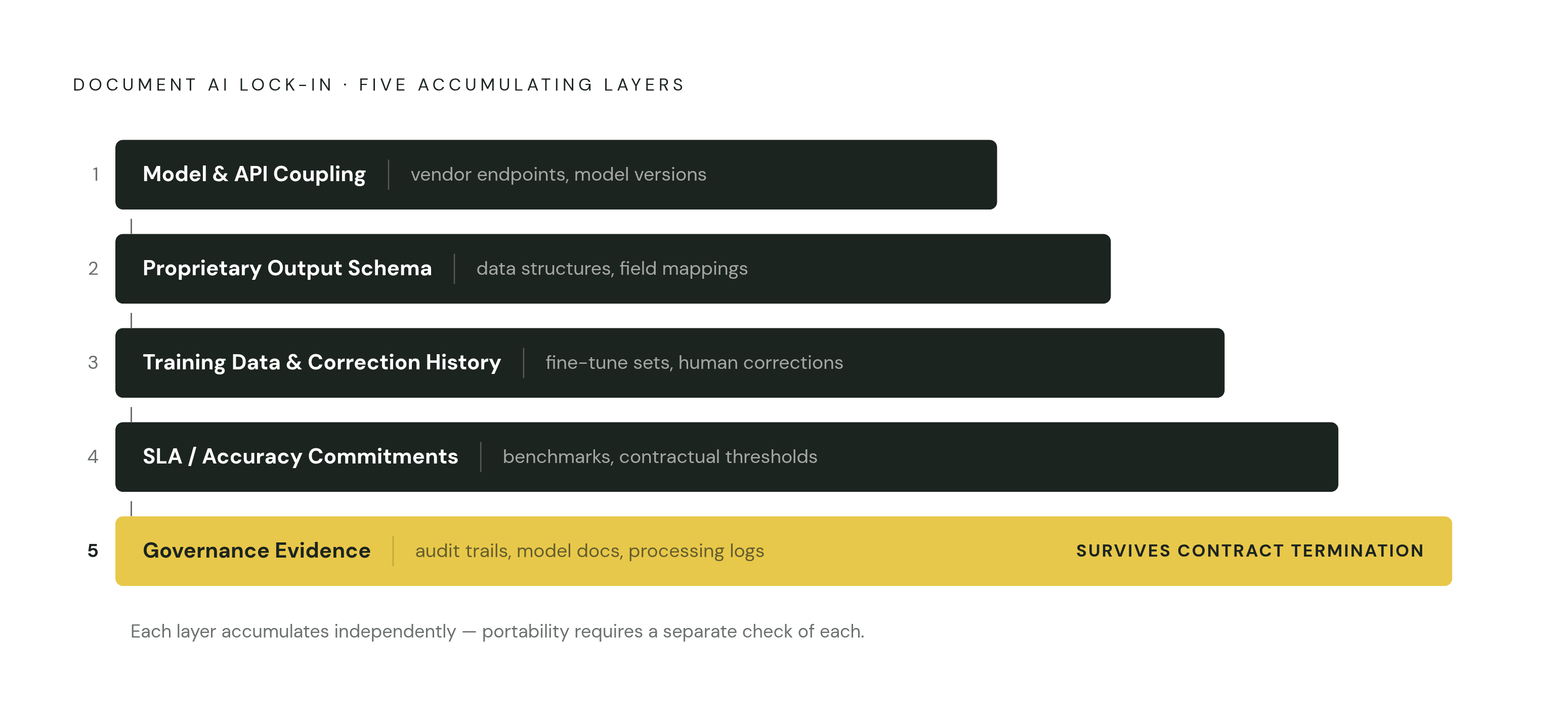
The first layer is model and API coupling. Application logic can depend on proprietary parameters, authentication schemes, structured-output behavior, and tool-calling conventions. Replacing those interfaces also means retesting extraction fields against different model behavior on real documents. The second layer is the proprietary output schema, which becomes the assumed contract for validation rules, database writes, and ERP integrations. A vendor-controlled field definition can therefore become a dependency across the business.
The third layer is training data and correction history. The ground truth that people have reviewed, the labeled exceptions, and the edge-case samples may all be held only in the systems the vendor uses for training. The fourth layer is the SLA, where uptime or aggregate accuracy promises can hide the quality of individual extracted fields. These layers accumulate separately, so assessing portability requires independent checks of the API, trained behavior, and field-level quality baseline needed to measure what a replacement must match.
The fifth layer is governance evidence. Audit trails, model documentation, processing logs, and compliance records may be accessible only through vendor-controlled tooling. That makes continued access a dependency even after extraction has moved elsewhere. Together, the five layers distinguish the ability to send documents to another API from the ability to move a production operation.
Why the schema and output format layer is the first trap engineering teams walk into
Schema lock-in starts at integration, when the vendor’s JSON output looks like a useful shortcut. The fields already have names, types, and documentation, so engineering teams build against them. The database columns, validation rules, ERP mappings, and logic used for reporting then take on the same structure. Each connection is cheap to create, but the combined contract is expensive to change. The dependency forms before leaving the vendor feels like a concern.
Schema drift exposes that dependency even without a migration. A renamed field, changed type, or different nesting structure can break a validation rule or database write without an announced API version change. The mitigation is a translation layer that maps vendor output into a canonical data model owned by the organization. Downstream systems consume that model. Vendor changes are then contained in the mapping.
For document extraction, the canonical model should follow the organization’s document types, including invoice fields, payslip fields, and contract clauses. It should not simply copy whatever one vendor happens to return. Defining it independently forces the translation work to happen at adoption. A later vendor change still requires extraction testing, but it does not require rebuilding every downstream integration.
How correction history and training data create a lock-in that compounds with accuracy
Correction loops turn benchmark performance into useful performance on an organization’s documents. A reviewer identifies a wrong field value, supplies the correct value, and feeds that correction back into the learning process. Over time, those corrections address the document population that the operation actually handles. The resulting accuracy is valuable. It is also a switching cost if the data behind it cannot leave.
The loss is greater than an average accuracy score suggests. Correction history records the fixes for unusual layouts, low-quality scans, and non-standard formats that would otherwise cause failures in production. A replacement does not inherit that coverage merely because it receives the same source documents. The model weights belong to the vendor, while correction history may be unavailable in a format another vendor can use.
The concrete mitigation is to maintain labeled ground truth in organization-controlled storage, in a portable format, from day one. That dataset gives a future vendor the reviewed examples and gives the customer a meaningful basis for evaluating alternatives. Procurement should require portable ground-truth exports, confirmation that corrections are not used to train shared models, and a data deletion certificate at termination. Those terms protect what the customer has contributed, though owning the labels alone does not make trained model behavior fully portable.
What SLA structures that obscure per-field accuracy actually cost in production
An uptime commitment does not protect against wrong extracted values. Document-level throughput also says nothing about whether the fields can be used. An invoice counted as correctly processed may still have the wrong total amount, wrong VAT rate, or misread vendor name. Those errors reach accounts payable, tax reporting, or supplier matching even when the headline metric looks good. Without a per-field commitment, the customer absorbs the extraction risk through errors, reprocessing, and audit findings.
Per-field accuracy against ground truth makes that risk visible. Measurement can follow the value type, using string similarity, numeric proximity, or date equivalence. It also reveals which fields and document types consistently underperform. Without that reporting, the customer sees the promise but lacks the detail needed to assess delivery. That missing detail also makes it hard to work out switching costs because the customer lacks a clear quality baseline.
The contract needs three commitments, namely named fields with a defined accuracy measurement method, regular reporting against shared ground truth, and remediation when performance falls below the agreed threshold. A replacement can be judged against operational requirements.
Governance evidence lock-in: the compliance exposure that survives contract termination
In regulated settings, an audit may need to establish which document was processed, by which model version, on which date, with which output, and who reviewed it. If that trail lives only in a vendor dashboard, termination can cut off evidence the organization must retain. Moving new processing elsewhere does not repair the missing history.
EU AI Act Annex IV documentation should be maintained in organization-controlled systems. The contract should also preserve regulatory access for the applicable retention period after termination. That clause needs to give access to system logs, model documentation, and audit trails. A separate export clause should require portable processing records within a defined period after termination. A deletion certificate should confirm that no customer document data or derived training data remains in vendor systems.
Zero-retention architecture addresses a related but different problem. When the vendor keeps no document data after processing, there is no retained sensitive document data to recover or account for after an acquisition or insolvency. That removes the post-termination document custody question. It does not replace the need for organization-controlled audit evidence, which must remain available independently of the vendor relationship.
How agentic and multi-step document workflows deepen every lock-in layer
An agentic document workflow makes extraction the start of a longer dependency chain. Instead of sending JSON straight to a consuming system, it feeds orchestration logic, memory, tool calls, and reasoning steps. All of those parts may run on the same proprietary infrastructure. Moving the extraction model then leaves separate migration work in workflow state and orchestration. The API boundary no longer marks the boundary of the dependency.
Errors also travel farther through that chain. A misread field can become an input to reasoning and produce a confident but wrong downstream decision. ParseBench identifies production weaknesses involving tables, charts, content faithfulness, and semantic formatting. In a multi-step document workflow, an omission or reading-order error can enter the reasoning chain without a flag. Extraction quality therefore matters both as a field-level result and as the foundation for later decisions.
The mitigation is modular orchestration that separates extraction, validation, and reasoning. Field-level confidence scores and validation results should pass from one step to the next in clearly defined, typed fields rather than free text that the next model must parse again. Containerization and open standards support platform independence, but they do not make interaction history or behavioral calibration portable. A migration path must be tested because hidden coupling often appears only when a component is actually replaced.
A pre-contract audit framework for document AI procurement
The pre-contract audit should turn each dependency into a concrete requirement while the terms are still negotiable. For model and API coupling, establish whether extraction can be replaced independently of the vendor’s orchestration or agent framework. For schemas, require documentation, versioning commitments, and a defined notification lead time for changes. Establish whether outputs can map to an organization-defined canonical model and whether custom field naming is supported.
For correction history, establish ownership of the labels and reviewed ground truth before reviewers begin producing them. Require portable exports during the relationship and at termination. Check whether correction data is used to train shared models and whether the termination certificate covers derived training data. For accuracy, require named fields, a measurement method, regular field-level reports, and remediation obligations. This makes the audit cover both the investment in learning and the quality that investment delivers.
For governance, establish where processing logs, audit trails, and model documentation will be held. Require post-termination regulatory access and portable record delivery. Review relevant certification commitments and whether zero-data-retention is the default or requires a separate addendum. For multi-step workflows, establish that confidence and validation outputs are typed and portable. Finally, test the migration path against representative documents rather than accepting a written plan as proof of recoverability.
What a recoverable document AI dependency looks like versus a structural trap
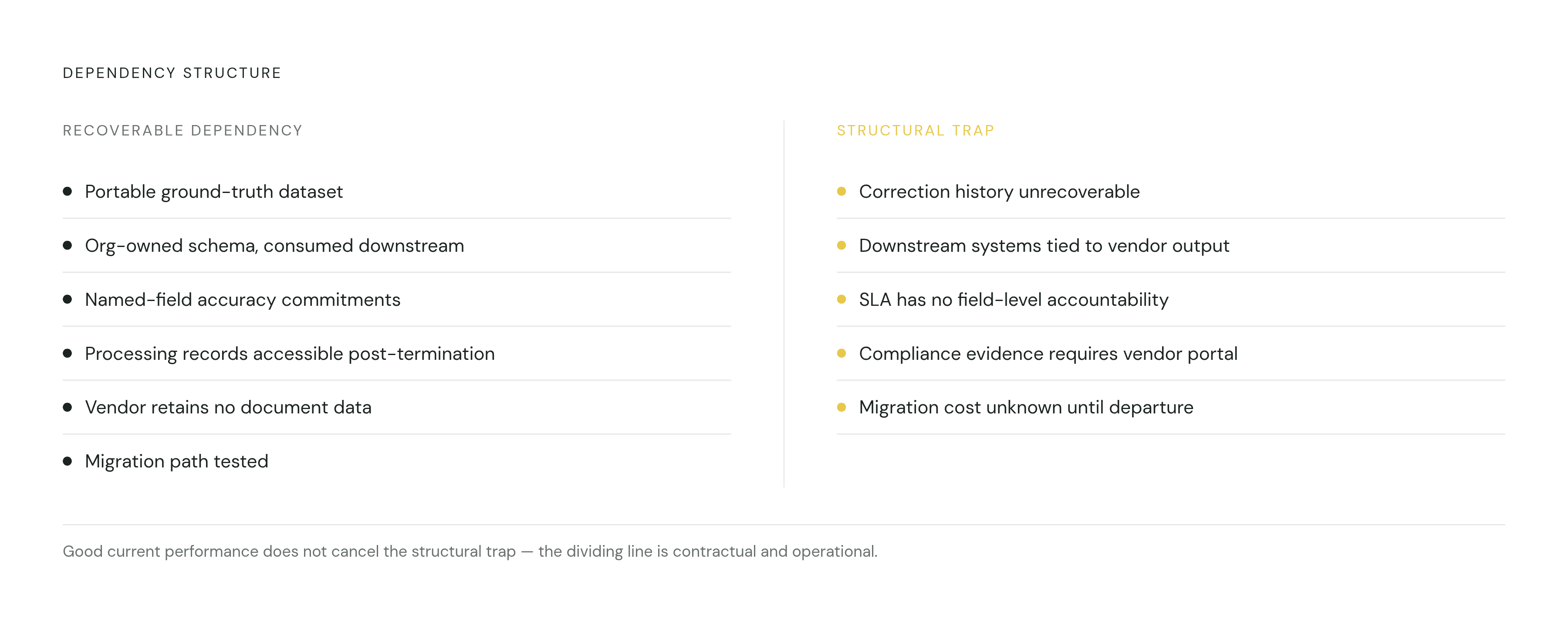
With a recoverable dependency, the organization holds the assets and evidence needed to judge the work before committing to it, even when switching has a cost. Its ground-truth dataset is portable, and its downstream systems consume an organization-owned schema. Its accuracy commitments name the fields that matter, with reports that can be assessed independently. Its processing records remain accessible after termination, the vendor retains no document data after processing, and a representative migration test has exposed the work involved.
A structural trap has the opposite shape. Correction history cannot be recovered, downstream systems depend directly on vendor output, and the SLA offers no field-level accountability. The organization needs access to a vendor portal to get compliance evidence, while the work needed to migrate stays unknown until it starts to leave. The organization may still receive useful extraction results, but it cannot evaluate the cost of leaving without taking on disruption. Good current performance does not cancel that constraint.
The dividing line is therefore contractual and operational as much as architectural. Ground-truth ownership, measurable accuracy, portable governance records, and tested migration paths preserve the ability to change providers. These decisions belong at procurement and integration, when they can shape the relationship. Once the dependency has accumulated, the same protections are much more expensive to retrofit.